


Order a woven “Made in USA” label in satin or twill for neck placement, a matching hangtag on 14 pt cardstock, and send your supplier vector artwork before anything else moves to production. That’s the whole decision in one sentence. The details, though, are where orders go wrong: unqualified “Made in USA” wording triggers the FTC’s substantiation standard, which means you need “all or virtually all” of the product’s parts and labor sourced domestically before you print that phrase without a qualifier.
Here’s the minimum spec sheet to hand a supplier like Tektonla:
- Label type: woven for neck/side seam, printed or heat-seal for care instructions, hangtag for retail messaging
- Material and finish: satin or twill for woven, 14 pt or 16 pt cardstock for hangtags, matte or gloss coating
- Attachment method: sewn-in, heat-seal, or string/rivet for hangtags
- File requirement: vector artwork (AI, EPS, or PDF), CMYK or Pantone color specified
- Compliance note: confirm unqualified “Made in USA” wording with legal before final print
One number worth remembering: the Federal Register’s final rule applies to online listings and print marketing, not just physical tags, so the same standard governing your hangtag also governs the product description on your Shopify store.
Key Takeaways
Production-ready “Made in USA” labeling comes down to specifying the right label type, sending vector artwork, and confirming compliance wording before the final print run.
| Point | Details |
|---|---|
| Pick the right label type | Woven for neck/side seams, printed or heat-seal for care labels, hangtags for retail messaging. |
| Send vector artwork | Use AI, EPS, or PDF files with Pantone or CMYK specs to avoid production surprises. |
| Confirm attachment and placement | Request a diagram showing seam distance, orientation, and fold style before the run starts. |
| Request swatches before full runs | Physical samples catch color and material issues that digital proofs miss. |
| Check compliance wording | Verify unqualified “Made in USA” claims meet the FTC’s all-or-virtually-all standard before printing. |
| Work with an onshore producer | Tektonla handles woven labels, hangtags, and printed labels domestically with digital proofs and swatch options. |
Table of Contents
- Choosing the Right Made in USA Label Type for Your Garment
- What Materials and Finishes Should You Specify?
- What Artwork Specs Does Your Label Supplier Need?
- How Should You Attach Labels and Where Do They Go?
- Ordering Logistics: Minimums, Lead Times, and Proofs
- Questions Worth Asking Before You Sign With a Label Vendor
- Inside Tektonla’s Process for Custom Labels and Hangtags
- What the Production Floor Teaches You About Avoiding Remakes
- Ready to Order? Here’s What to Send Tektonla
- Templates and Resources for Finishing Your Label Order
- Sources
Choosing the Right Made in USA Label Type for Your Garment
The label format you pick depends on where it lives on the garment and how much abuse it needs to survive. A neck label gets washed fifty times. A hangtag gets cut off before the first wear. Treat them differently.
Woven labels are the standard for neck and side-seam placement because the lettering is built into the weave itself rather than sitting on top of fabric. That makes them nearly impossible to fade or crack, which is why most mid-to-premium apparel brands specify a woven label for anything touching skin repeatedly. Woven label suppliers typically cap color counts around eight and offer heat-seal backing as an alternative to sewing, which matters if you’re working with a performance fabric that can’t handle a needle.
Printed and twill labels cost less to produce and work fine for care instructions or interior branding where visual permanence matters less than legibility. Heat-seal labels solve a specific problem: activewear and swim fabrics that would pucker or tear if you sewed through them. Hangtags exist purely for retail storytelling. Nobody expects a hangtag to survive a wash cycle, so cardstock and print finish matter more than fiber durability.
| Label Type | Best For | Durability | Typical Cost Tier |
|---|---|---|---|
| Woven (satin/twill) | Neck labels, side seams | Very high | Higher |
| Printed/twill | Care labels, interior tags | Moderate | Lower |
| Heat-seal | Performance fabrics, swimwear | High (no thread failure) | Moderate |
| Hangtag (cardstock) | Retail point-of-sale messaging | Low (single-use) | Lower |
Pro Tip: If you’re deciding between a $0.30 printed label and a $0.65 woven label, run the math on how many wash cycles your garment is rated for. A woven label on a $120 jacket is a rounding error. On a $12 tee, it’s a real margin hit.
What Materials and Finishes Should You Specify?
Satin gives woven labels a glossy, almost silk-like sheen that reads as premium against a plain cotton crew neck. Twill has a matte, more textured finish and tends to show up on denim, workwear, and outerwear brands going for a rugged aesthetic. Cotton tape is the budget option: less refined, but it holds up fine for internal size labels nobody’s meant to see.
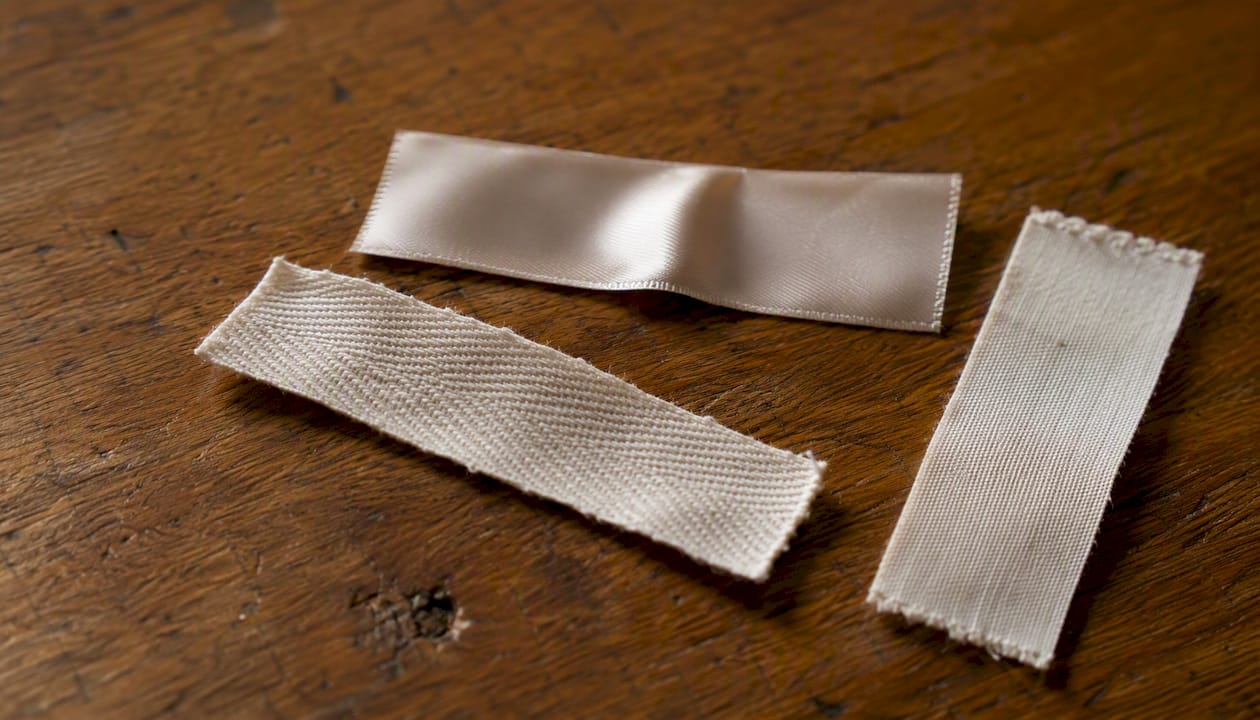
For hangtags, cardstock weight is the first decision. Standard hangtag suppliers commonly offer 14 pt and 16 pt stock, with 14 pt handling most retail needs and 16 pt feeling noticeably sturdier for higher-price-point items. Matte finishes photograph better for e-commerce and take a soft-touch coating well; gloss finishes make colors pop under retail lighting but show fingerprints faster.
| Material/Finish | Typical Use | Notes |
|---|---|---|
| Satin (woven) | Premium tees, basics | Glossy sheen, softer hand feel |
| Twill (woven) | Denim, outerwear, workwear | Matte, textured |
| Heat-seal film | Activewear, swim | No sew-through needed |
| 14 pt cardstock | Standard hangtags | Most common weight |
| 16 pt cardstock | Premium hangtags | Sturdier, higher perceived value |
| Matte coating | Photography-heavy listings | Soft-touch option available |
| Gloss coating | In-store color pop | Shows fingerprints |
Double-sided printing on hangtags lets you put your logo and origin claim on the front and sizing or care details on the back, which saves you from needing a second insert card. If sustainability messaging matters to your brand, ask about recycled or sustainably sourced cardstock and US-sourced yarns for woven labels. Request a physical swatch before committing to a full run. Screen colors lie; paper stock and thread color under warehouse lighting don’t.
What Artwork Specs Does Your Label Supplier Need?
Send vector files, not flattened JPEGs. For woven labels and die-cut hangtags, that means EPS, AI, or PDF format, because a woven label is essentially a small textile loom program, and vector paths translate cleanly into thread paths. Raster art (TIFF or PSD at 300 to 600 dpi) is acceptable for some printed labels, but never for anything requiring a die cut.
Color specification depends on what you’re printing. CMYK works for standard printed labels and hangtags. If exact color matching matters, and it usually does when your brand guide has a specific navy or a specific red, provide Pantone (PMS) numbers instead. Woven labels in particular need explicit Pantone notes for thread color, since a supplier can’t “eyeball” a shade the way a digital printer can adjust CMYK values on the fly.
Bleed and safe area matter most on die-cut hangtags, where a quarter-inch miscalculation shifts your logo off-center. For text, don’t go below roughly 4 points on woven labels or 6 points on printed labels if you expect it to stay legible after a few wash cycles. Production experience backs this up directly: providing vector artwork and exact physical specs reduces the gap between what a mockup shows and what a loom or printer actually produces.
Paste this into your supplier email before sending files:
- File format confirmed (AI/EPS/PDF for woven and die-cut; TIFF/PSD 300 to 600 dpi otherwise)
- Color mode stated (CMYK or Pantone number)
- Dieline requested for hangtags
- Thread color notes attached for woven labels
- Exact finished dimensions listed
- Fold or attachment style specified
- Production notes (rush timing, special coating, etc.)
Pro Tip: Always request a physical swatch of a woven label before a full production run. Digital proofs can’t show you how thread color reads under warehouse fluorescents versus your studio lighting.
How Should You Attach Labels and Where Do They Go?
Sewn-in neck labels are the default for t-shirts, sweatshirts, and most knitwear. Side-seam labels work as an alternative when you want the origin claim visible without disrupting a clean interior neck. Heat-seal application is the go-to for performance wear where sewing would compromise moisture-wicking fabric or create irritation points.
Hangtags attach three common ways: string, plastic rivet (“tack pin”), or a grommet with fishline. String looks casual and works for most retail contexts. Rivets and grommets feel sturdier and suit higher-end product lines.
- Neck labels on tees typically run 1 to 2 inches wide, folded in half with the visible face out
- Side seam labels sit roughly 3 to 5 inches below the armhole
- Hangtag holes are usually pre-punched at top center, though top-left, top-right, and center-side placements are common alternatives
- Outerwear labels tend to run larger (2.5 to 3.5 inches) since they carry more information, including care and fiber content
Always request a placement diagram or a photo mockup before your run starts. A good diagram shows distance from the seam in inches, label orientation (right-side up relative to the garment tag), and fold style. Vague verbal instructions (“put it near the collar”) are how you end up with an off-center label on 500 units.
Ordering Logistics: Minimums, Lead Times, and Proofs
Minimum order quantities vary by label type. Woven labels often carry higher MOQs (think a few hundred pieces per design) since setting up a loom program has fixed costs regardless of run size. Printed labels and hangtags tend to have lower minimums; some hangtag suppliers offer packs starting around 250 units and scaling up to 5,000 or more, per hangtag supplier listings.
Domestic lead times for standard runs typically fall in the 2 to 4 week range, with rush options available for a premium. Digital proofs are close to universal and usually free; physical swatches or pre-production samples often carry a fee or come included once your order crosses a certain volume threshold, a pattern that shows up consistently across supplier proofing policies.
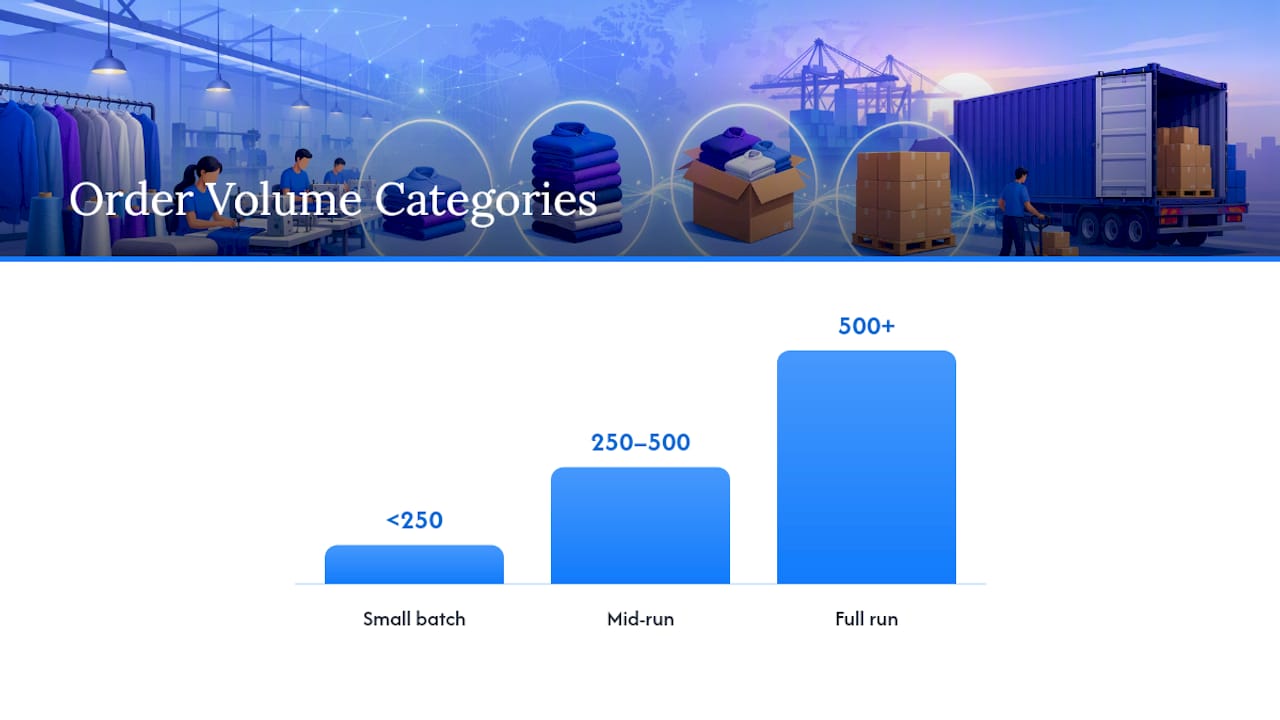
| Order Volume | Typical MOQ Fit | What to Expect |
|---|---|---|
| Small batch (under 250) | Hangtags, printed labels | Higher per-unit cost, faster setup |
| Mid-run (250 to 500) | Hangtags, some woven | Standard lead times, digital proof included |
| Full production run (500+) | Woven, printed, hangtags | Lower per-unit cost, physical sample often included |
A supplier-ready checklist to send in your first email:
- Label type and quantity per design
- Preferred material and finish
- Attachment method
- File format and color specs attached
- Requested lead time (standard or rush)
- Sample or swatch request confirmed
One practical move that saves both money and headaches: order your woven labels, hangtags, and care labels as a single bundled job. Bundling reduces color-mismatch risk between elements and often lowers per-piece pricing because the supplier consolidates setup and proofing across the whole set instead of running three separate jobs.
Questions Worth Asking Before You Sign With a Label Vendor
A vendor’s answers to a handful of direct questions tell you more than their sample catalog ever will.
- What’s your MOQ for woven labels versus printed labels versus hangtags?
- What’s your standard lead time, and what does rush production cost?
- Do you offer a free digital proof, and what does a physical swatch cost?
- Can you confirm final assembly and materials sourcing happen in the U.S.?
- Do you provide production-run photos before shipping the full order?
- What’s your policy if a color or placement error shows up in the final run?
Bundling your label order with other branded goods (blanks, packaging inserts) sometimes lowers per-unit MOQs, since the supplier can spread setup costs across a bigger combined job. A trustworthy vendor gives specific numbers: “MOQ is 300 pieces, lead time is 15 business days, physical swatches run $25.” A vague vendor says “it depends” to every question and won’t commit to a number until you’ve placed a deposit.
Pro Tip: Ask for photo evidence of a completed production run for a client of similar size to yours, not just stock photography from their website. It’s the fastest way to gauge real quality control.
Inside Tektonla’s Process for Custom Labels and Hangtags
Tektonla produces custom woven labels alongside printed labels, hangtags, sewn-on and heat-seal options, and Pantone color matching for brands that need exact consistency across a product line. Small-batch and on-demand production means you’re not stuck ordering 5,000 units to test a design.
The process runs in a straightforward sequence:
- Submit artwork (vector files preferred) along with material and finish preferences
- Receive a digital proof for color and layout approval
- Request a physical swatch or pre-production sample before committing to the full run
- Production run begins once specs are locked
- QA review and production photo evidence before shipment
Tektonla’s production happens onshore, which matters when your own “Made in USA” claim depends on where the labeling itself gets made. Turnaround and MOQ ranges vary by label type and finish, so the fastest way to get an accurate number is a direct quote request through Tektonla’s main site.
What the Production Floor Teaches You About Avoiding Remakes
The three most common reasons a label order gets remade all trace back to specs that seemed fine on screen and fell apart in production.
Color mismatches top the list. A brand sends a screenshot of their logo instead of a Pantone number, and the printed result looks nothing like what they pictured. The fix is boring but effective: always give a PMS number, never a description like “navy blue.”
Unreadable microtext is the second trap. Designers love packing fiber content, care instructions, and a logo onto a 2 inch by 1 inch woven label, then wonder why the text blurs after the first wash.
Hole placement on hangtags causes more reprints than anything else on this list. A rivet punched a quarter-inch off-center throws off the whole visual balance of a folded tag, and it’s the kind of error that’s invisible on a digital mockup but obvious the second the physical piece arrives.
One line worth remembering on durability: woven labels handle repeated washing far better than printed labels, so if your garment is rated for heavy wash cycles, specify woven for anything meant to stay legible for the life of the product.
Ready to Order? Here’s What to Send Tektonla
Tektonla builds “Made in USA” labels and hangtags onshore, with sample policies and turnaround windows designed for brands that can’t afford a guessing game on their first production run. Whether you’re outfitting a small drop or scaling a full product line, the process starts with one email.
Include four things in your quote request: your artwork file (vector preferred), quantity needed, preferred material and finish, and the garment type and placement you’re targeting. That’s enough for Tektonla to return a real number instead of a rough estimate. If you want to see and feel the material before committing, ask for a swatch alongside your digital proof.
Pair your label order with your garment production for a cleaner workflow. Brands sourcing private-label tees often start with something like the Printers Shirt or a garment dye shirt and layer the woven label and hangtag order on top, so everything ships as one coordinated package instead of three separate vendor timelines. Reach out through Tektonla’s site to start a quote request today.
Templates and Resources for Finishing Your Label Order
A few copyable pieces to speed up your next supplier email:
- Sample request template: “Please send a physical swatch of [label type] in [material/finish] before we confirm a production quantity of [X units].”
- Dieline request snippet: “Please provide a dieline for our hangtag at [dimensions] with hole placement at [top center/left/right] before final art submission.”
- Artwork file checklist: file format confirmed, color mode stated (CMYK or Pantone), bleed and safe area marked, thread color noted for woven, dimensions and fold style specified.
For further reading on brand standards and origin claims, Tektonla’s guide on custom logo apparel brand standards covers how domestic-origin messaging fits into a broader brand system. If you’re weighing material origin against ethical sourcing more broadly, this piece on ethical manufacturing standards is worth a look. For an apparel example where origin labeling and material sourcing intersect directly, see Tektonla’s American Grown Supima Cotton T-Shirt product page. These resources are scoped specifically to production-ready label ordering, not to broader country-of-origin compliance strategy.
Sources
- Complying with the Made in USA standard — Federal Trade Commission (FTC)
- Federal Register: Final rule on Made in USA labeling — U.S. Government Publishing Office
- FTC imposes penalty for misleading Made-in-USA claims — Barnes & Thornburg (production insight source)