


The fastest, highest-impact way to make screen printing eco-friendly is to switch to certified water-based, plant-based, or algae-derived inks and pair them with low-waste reclaiming and cure practices. Ask suppliers for SDS and TDS documents, require certified textiles, and confirm closed-loop reclaiming before you sign off. Expect tradeoffs in opacity and cure time. This guide walks through how to manage both without losing print quality.
TL;DR:
- Using certified water-based, plant-based, or algae-derived inks can significantly improve the eco-friendliness of screen printing, but proper waste handling and certification are essential.
- Achieving a truly sustainable operation requires addressing four key areas: ink chemistry, textile sourcing, energy use, and waste management, rather than focusing on a single swap.
- Reclaiming chemicals and wastewater management are as crucial as ink choice in reducing environmental impact; a closed-loop reclaiming system is highly recommended.
- Energy savings can be substantial with low-temperature curing additives and LED or infrared drying units, which reduce both energy consumption and operational costs.
- Verifying a supplier’s green claims depends on requesting detailed documentation, including SDS, TDS, and certifications, rather than relying on vague marketing claims.
Table of Contents
- What Does “Eco-Friendly” Actually Mean in Screen Printing?
- Which Eco-Friendly Inks Should You Actually Use?
- Choosing Sustainable Fabrics That Actually Print Well
- How Do You Cut Waste in Screen Printing Production?
- Can You Cure Prints Without Burning Extra Energy?
- How Do You Verify a Supplier’s Green Claims?
- What Does Sustainable Screen Printing Actually Cost?
- How Tekton LA Puts Eco-Friendly Screen Printing Into Practice
- Why Most “Eco-Friendly Printing” Advice Misses the Point
- Ready to Print Sustainably Without the Guesswork?
- Sources
- FAQ
What Does “Eco-Friendly” Actually Mean in Screen Printing?
“Eco-friendly” gets slapped on marketing copy so often that it has almost lost meaning. In practice, sustainable screen printing covers four operational areas: ink chemistry, textile sourcing, energy use, and waste handling. A shop that nails one of these but ignores the other three isn’t running a green operation. It’s running a good marketing angle.
There’s no single certifying body that stamps a shop “sustainable” the way USDA Organic works for food. Instead, responsible printers stack multiple verifiable practices, combining safer inks, certified textiles, energy-efficient equipment, and documented waste handling, rather than leaning on one swap. That’s the honest framework, and it’s worth holding suppliers to it.
Watch for these common greenwashing red flags:
- Vague claims like “eco ink” or “green process” with no ink series name or certification attached
- Marketing pages that mention sustainability but link to no SDS, TDS, or lab report
- Fabric described as “recycled” with no percentage or chain-of-custody detail
- “Non-toxic” claims that don’t specify absence of phthalates, PVC, or heavy metals
Buyers should push past the language and ask for independent certifications and lab documentation instead of taking a product page at its word. If a supplier hesitates to produce a technical data sheet, that hesitation tells you something.
Which Eco-Friendly Inks Should You Actually Use?
Ink choice moves the needle more than almost any other decision in the shop. Three categories dominate the sustainable side of the market right now, and each fits a different job.
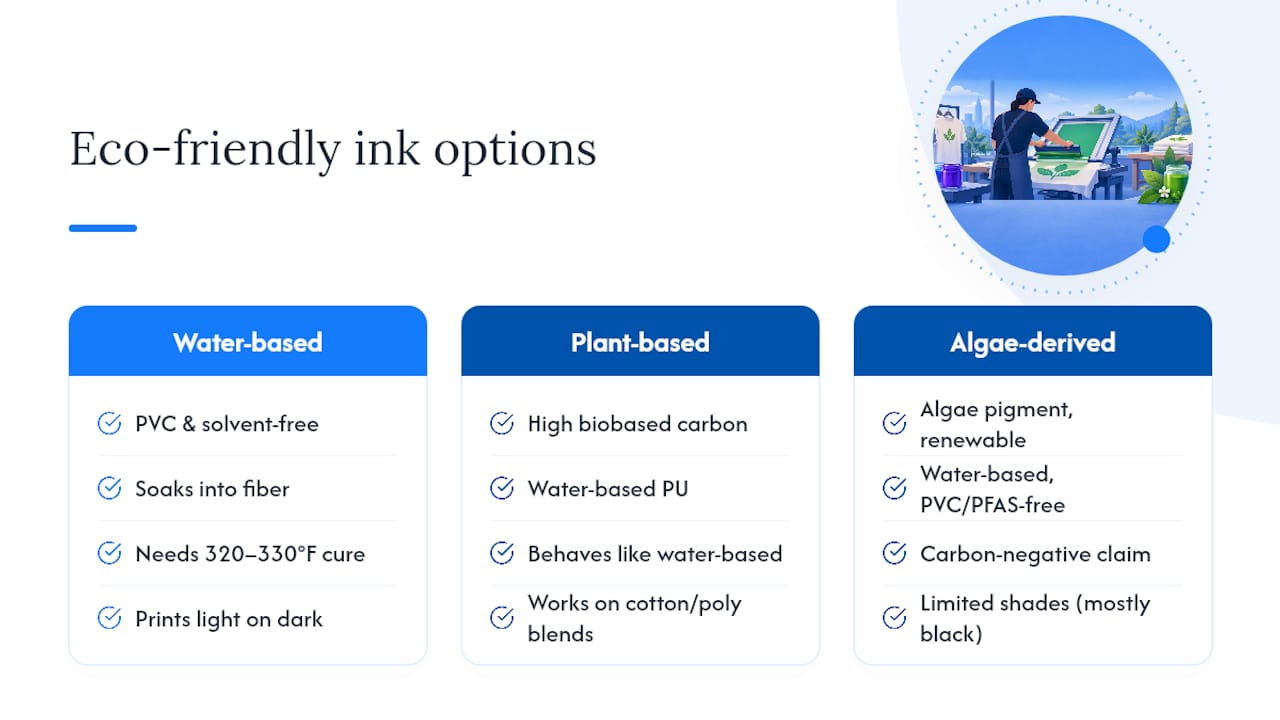
Water-based inks are the default entry point. They eliminate the plastisol shell feel, soak into the fiber instead of sitting on top, and skip the PVC and solvent load of older formulations. Premium lines like Permaprint are built solvent-free and free of PVC resin and phthalate plasticizers, with no added lead or heavy metals. The tradeoff: water-based inks need higher cure temperatures to fully set (usually in the 320°F to 330°F range) and print lighter on dark garments unless you underbase first.
Plant-based, high-biocarbon inks push the sustainability angle further. MNK BIO’s water-based PU series claims a high percentage of biobased carbon content and works on cotton and cotton/polyester blends. These inks behave close to standard water-based formulas in the press, which makes the switch low-friction for a shop that’s already set up for water-based printing.
Algae-derived inks are the newest and most striking option. Living Ink’s Vintage Black Screen Algae Ink uses a pigment made from renewable algae biomass, is water-based, and is PVC-free, phthalate-free, and PFAS-free, with the manufacturer marketing it as a carbon-negative pigment source.
Pro Tip: Algae ink currently comes in limited shade ranges, mostly blacks and darker tones. Don’t build a full-color job plan around it until you’ve confirmed the exact Pantone match your client needs.
For setup, water-based and bio-based inks typically run through a coarser mesh (110 to 156) with a softer squeegee blade to push viscosity through evenly. Keep a retarder additive on hand. These inks dry faster on screen than plastisol, and a stalled press means clogged screens mid-run.
Choosing Sustainable Fabrics That Actually Print Well
Ink choice means little if the shirt underneath undercuts the effort. Organic cotton, recycled polyester (rPET), and cotton/poly blends each carry different environmental profiles and different printing behavior.
- Organic cotton grows without synthetic pesticides and takes water-based and bio-based inks cleanly, with strong absorption and a soft hand feel after cure.
- Recycled polyester (rPET) diverts plastic bottles from landfill but requires different ink chemistry. Standard water-based inks can struggle for opacity on poly, so many shops turn to specialized poly-inks or a light underbase.
- Cotton/poly blends split the difference: better drape and durability than 100% cotton, moderate ink adhesion, and a lower recycled-content footprint than pure rPET.
Fabric choice also touches opacity and cure requirements. Poly-heavy garments often need lower cure temperatures to avoid dye migration (poly dyes can bleed into the ink under high heat), which changes your dryer settings mid-shift if you’re running mixed fabric jobs.
Packaging matters too. Poly bags, hang tags, and shipping cartons add up across a production run, and switching to recycled poly bags or compostable mailers trims footprint without touching the print process at all.
How Do You Cut Waste in Screen Printing Production?
Screen reclaiming and ink management are where most shops leak both money and environmental credibility. Reclaiming chemicals, in particular, tend to be the most hazardous liquids in a print shop, and how you handle them says a lot about how “eco” the operation really is.
- Install a closed-loop reclaiming system. Closed reclamation tanks paired with zero-VOC reclaiming solutions reduce waste and emissions compared to open-tank rinsing with solvent-heavy strippers.
- Batch and label ink mixes. Track leftover ink by Pantone code and date, so partial batches get reused on the next matching job instead of tossed.
- Mix only what a job needs. Weigh garments and calculate ink volume before pulling a squeegee, rather than eyeballing a bucket.
- Filter and settle wastewater. Solids-settling filtration before wastewater leaves the building keeps pigment and emulsion out of the drain.
- Dispose of hazardous residue through a licensed hauler. Never pour reclaiming chemical or excess solvent-based ink down a standard drain.
Pro Tip: Keep a simple logbook of ink batches by weight, not guesswork. Shops that track ink usage by the ounce typically cut waste ink volume noticeably within a few months, just from visibility alone.
Can You Cure Prints Without Burning Extra Energy?
Curing is the most energy-intensive step in the whole process, and it’s also the step most shops never optimize. A conveyor dryer running at full temperature for eight hours a day adds up fast on a utility bill and a carbon footprint alike.
Low-temperature cure additives let water-based and bio-based inks fully cross-link at lower dwell temperatures, shaving real energy off every run. LED and infrared curing units heat the ink layer directly rather than the surrounding air, which cuts warm-up time and reduces wasted heat compared to older gas or electric conveyor dryers.
Beyond the equipment itself, a few operational habits matter:
- Batch similar-temperature jobs together so the dryer doesn’t cycle up and down all day
- Keep dryer belts and heating elements maintained. A poorly calibrated dryer runs hotter and longer than it needs to
- Preheat only when a run is loaded and ready, not idling between jobs
None of this requires replacing a whole production line overnight. Most shops phase in LED or infrared units as older dryers reach end of life.
How Do You Verify a Supplier’s Green Claims?
Certifications exist because marketing language alone tells you nothing verifiable. Three names come up constantly in the ink and textile world, and each answers a different question.
| Certification | What it actually verifies |
|---|---|
| GOTS | Organic fiber content and environmentally responsible processing through the supply chain |
| OEKO-TEX ECO PASSPORT | Chemical inputs (inks, dyes, auxiliaries) tested and cleared for use in sustainable textile production |
| ZDHC | Wastewater and chemical discharge managed against a zero-discharge-of-hazardous-chemicals standard |
Beyond the certification logo, request the underlying paperwork: a Safety Data Sheet (SDS), a Technical Data Sheet (TDS), third-party lab test results, and chain-of-custody documentation for any “recycled” or “organic” fabric claim.
Ask suppliers direct questions: Which specific ink series are you using, by name? Can I see the TDS? Is your reclaiming process closed-loop or open-tank? If the answers are vague or the paperwork doesn’t exist, treat the “eco-friendly” label on that product as unverified. Industry warnings about inconsistent green-label use aren’t paranoia. They reflect how loosely the term gets applied across the print supply chain.
What Does Sustainable Screen Printing Actually Cost?
Certified inks, organic or recycled textiles, and closed-loop reclaiming systems all carry a premium over the cheapest conventional options, mostly in per-unit ink cost and equipment upgrades rather than labor.
- Ink cost runs higher for algae and high-bio formulas than standard plastisol, though the gap has narrowed as manufacturers scale production
- Certified textiles add cost per garment, generally more noticeable on small runs than large ones
- Curing and waste-handling upgrades are one-time capital costs that pay down over dozens of runs
For large-color, photorealistic designs or very small runs, digital methods like DTG can be more resource-efficient than screen printing. Screen printing still wins on cost-per-unit at higher volumes with one to three colors. Phase in sustainable inputs on your next reorder rather than mid-launch, so a supply change never holds up a drop date.
How Tekton LA Puts Eco-Friendly Screen Printing Into Practice
Tekton LA builds sustainability into its Los Angeles production floor through locally sourced materials, garment dyeing that reduces water-intensive pre-dyeing steps, and blanks with no minimum order quantity, which cuts overproduction waste for brands testing new styles.
Turnaround stays fast because the ink and fabric choices are matched to the job upfront rather than reworked mid-run. A water-based versus plastisol decision gets made at the quoting stage, not after a press is already loaded, which keeps quality consistent even when the input is a lower-impact one.
[Author bio: insert credentials or biography for Christian]
Why Most “Eco-Friendly Printing” Advice Misses the Point
The conventional advice on this topic treats ink swaps as the whole solution. Buy the algae ink, feel good, move on. That’s incomplete. The research on this points somewhere more useful: ink chemistry, textile sourcing, energy use, and waste handling function as one system, and the biggest sustainability gains come from treating them that way, not from swapping a single input and calling it done.
Here’s what gets overlooked most often. Reclaiming chemistry and wastewater handling rarely make it into marketing copy, yet they carry as much environmental weight as the ink itself. A shop running algae ink through an open-tank solvent reclaiming process hasn’t solved much.
If you’re a brand vetting a print partner, prioritize the boring paperwork first: SDS, TDS, and a straight answer about reclaiming process. The flashy ink name on a hang tag matters far less than what happens in the back of the shop. Get the systems right, and the ink choice becomes the easy part.
— Christian
Ready to Print Sustainably Without the Guesswork?
Some printing providers offer brands a direct path to eco-conscious apparel through production floors built around locally sourced materials, garment dyeing, and no minimum order quantities on blanks, so a small test run can receive similar care as a full production order.
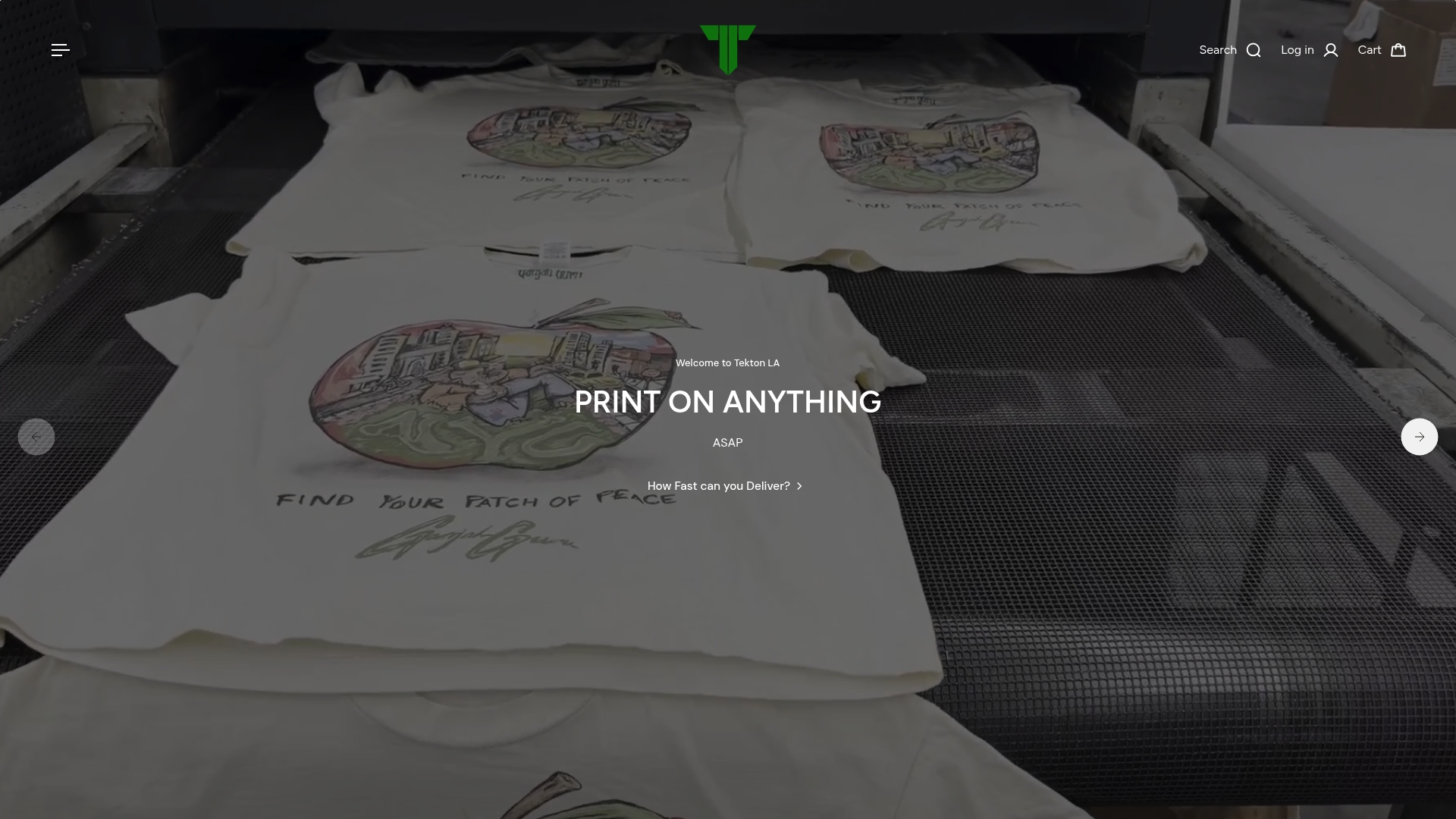
Whether you need a clean 1-color screen print for a simple logo run or a 2-color screen print for a more layered design, the ink and fabric decisions get made upfront so quality never becomes the tradeoff for lower impact. Garment dye options like the Garment Dye Shirt cut water-intensive pre-dye steps out of the process entirely.
Request a quote or a sample print through Tekton LA’s services page and get a straight answer on ink, fabric, and turnaround before you commit to a run.
Sources
- Printing Greener: Introducing Living Ink’s Screen Algae Ink line
- Supply-chain greenwashing: look for these six certifications
FAQ
What Are Alternatives to Screen Printing?
Direct-to-garment (DTG) and direct-to-film (DTF) printing are the main alternatives, both better suited to small runs and photorealistic, multi-color designs. Screen printing still costs less per unit on larger runs with one to three colors, and digital methods can be more resource-efficient for small to medium runs depending on the job.
What Are Some Eco-Friendly Printing Methods?
Water-based, plant-based, and algae-derived inks are the three main sustainable ink categories, paired with certified organic or recycled textiles and closed-loop screen reclaiming. Low-temperature curing and LED or infrared dryers reduce the energy load on top of those material changes.
Is There an Eco-Friendly Printer or Ink Option?
Yes. Manufacturers like Living Ink offer algae-derived, PFAS-free pigments, and Permaprint Premium offers water-based inks free of PVC and phthalates. Tekton LA applies eco-conscious practices in its own Los Angeles production, including locally sourced materials and garment dyeing.
Is Printify an Ethical Company?
Ethics claims for any print-on-demand platform depend on which suppliers fulfill a given order, since network models often route jobs to different print partners with varying practices. Ask any platform directly for the SDS, TDS, and certification documentation behind a specific order rather than relying on general marketing language.