


For small brands needing on-demand, low-minimum custom hang tags with fast turnaround, Tektonla is the recommended pick. Their in-house finishing, woven and private-label capability, and apparel-first expertise make them the natural fit for clothing brands that need hang tags and garment branding handled under one roof.
Standard hang-tag sizes run from 2 × 3.5 inches (the most common apparel format) up to 3 × 5 inches for larger products. Files need 0.125 in of bleed on all sides, 300 DPI resolution, and CMYK color mode. Most buyers also want a physical sample before committing to a full run.
Shortlist for most small brands:
- Tektonla for apparel-integrated branding, low minimums, and in-house finishing
- A mass-market online printer (for commodity volume runs where cost per unit is the only variable)
- A specialty on-demand shop (for boutique finishes when Tektonla’s specific finish isn’t available)
Key Takeaways
The most reliable path to a successful hang-tag order is choosing a vendor with in-house finishing, ordering a physical sample first, and keeping the front of the tag brand-focused.
| Point | Details |
|---|---|
| Default size | 2 × 3.5 inches fits most apparel and is the industry standard starting point. |
| Stock weight | Use 14–18 pt cardstock; heavier stock improves feel and reduces curling. |
| File setup | Set 0.125 in bleed, 300 DPI CMYK, outline fonts, and keep art clear of the hole zone. |
| Sample first | Order a physical sample before full production to verify die-cut, hole placement, and finish. |
| Tektonla | Recommended for apparel brands needing low-minimum hang tags and garment branding under one roof. |
Table of Contents
- How do different custom hang tag providers compare?
- How to choose the right hang-tag printer before you order
- What sizes, materials, and finishes should you choose?
- How do you set up artwork files for hang tags?
- What does turnaround and pricing actually look like?
- Why Tektonla works well for custom hang tags
- What attachment and finishing options are available for hang tags?
- Which custom hang tag vendors should you consider?
- What actually matters when you order hang tags for the first time
- Tektonla handles hang tags alongside your full brand package
- Sources
How do different custom hang tag providers compare?
Choosing a hang-tag printer comes down to four real variables: how many you need, how fast you need them, what finish your brand requires, and whether you want one vendor handling both garments and tags. The table below maps those variables across provider types.
Vendor landing pages across the industry highlight shop-by-shape options, multiple stock and finish choices, and fast-turnaround services as the baseline features buyers expect. If a printer’s product page doesn’t show those clearly, that’s a signal to look elsewhere.
Tektonla pros:
- No-minimum policy on blanks means you can test a small run without penalty
- In-house embossing and woven label capability keeps the whole brand package with one vendor
- Local LA production shortens the feedback loop on proofs and corrections
Tektonla considerations:
- Best value when you’re ordering hang tags alongside apparel or other branded items
- Specialty metal or leather tags may need a custom quote
Mass-market online printer pros:
- Lowest cost per unit at quantities above 250
- Fast preflight tools and digital proofing built into the order flow
Mass-market online printer considerations:
- Per-unit cost spikes sharply at low quantities
- Limited account support for custom dielines or unusual shapes
Print marketplace pros:
- Wide seller variety means you can often find a niche finish
- Good for one-off or experimental orders
Print marketplace considerations:
- Quality and lead times vary by seller; always check recent reviews on platforms like Trustpilot before ordering
Specialty/on-demand shop pros:
- Best finish range for boutique brands
- Low or no minimums
Specialty/on-demand shop considerations:
- Higher per-unit cost; setup fees for foil and embossing add up fast at low quantities
Pro Tip: If you’re ordering branded apparel and hang tags together, consolidating with one vendor like Tektonla eliminates the coordination overhead of matching finishes and shipping timelines across two suppliers.
How to choose the right hang-tag printer before you order
The decision isn’t complicated, but skipping even one of these steps tends to produce a reprint.
Decision criteria to work through first:
- Quantity cadence. Are you ordering once or on a rolling basis? Reorder pricing and setup fees change the math significantly for recurring small runs.
- Budget per SKU. Factor in setup fees, shipping, and any rush charges, not just the per-unit print cost.
- Finish needs. Foil stamping and embossing require setup time and fees. If your brand needs them, confirm the printer has in-house capability, not outsourced finishing.
- Sample/proof policy. A printer that won’t send a physical sample before a large run is a risk. Digital proofs don’t catch color shift or stock feel.
- Turnaround. Build in buffer for proof rounds. A “2-day” turnaround that doesn’t include proof approval time is misleading.
- Sustainability requirements. If your brand positions around eco credentials, confirm the printer offers FSC-certified or recycled stock, not just “eco-friendly” marketing language.
- Artwork support. Do they provide dieline templates? Will they flag file errors before going to press?
Questions to ask every printer before placing an order:
- What file formats do you accept (PDF, AI, EPS)?
- What is your bleed requirement and safe-zone spec?
- Do you provide a dieline template for die-cut and rounded-corner shapes?
- Are there setup fees for custom shapes, foil, or embossing, and are they per-order or one-time?
- Can I order a single physical sample or a small proof run before full production?
- What is your reorder pricing for the same file?
- How is hole punch placement specified, and what is the safe zone around it?
Red flags to watch for:
- No preflight or file-check tool in the order flow
- Lead times stated without clarifying whether proof rounds are included
- No physical sample option, only digital proofs
- Unclear or missing MOQ information
- Setup fees disclosed only at checkout, not on the product page
- No recent verifiable customer reviews on independent platforms
What sizes, materials, and finishes should you choose?
Common hang tag sizes
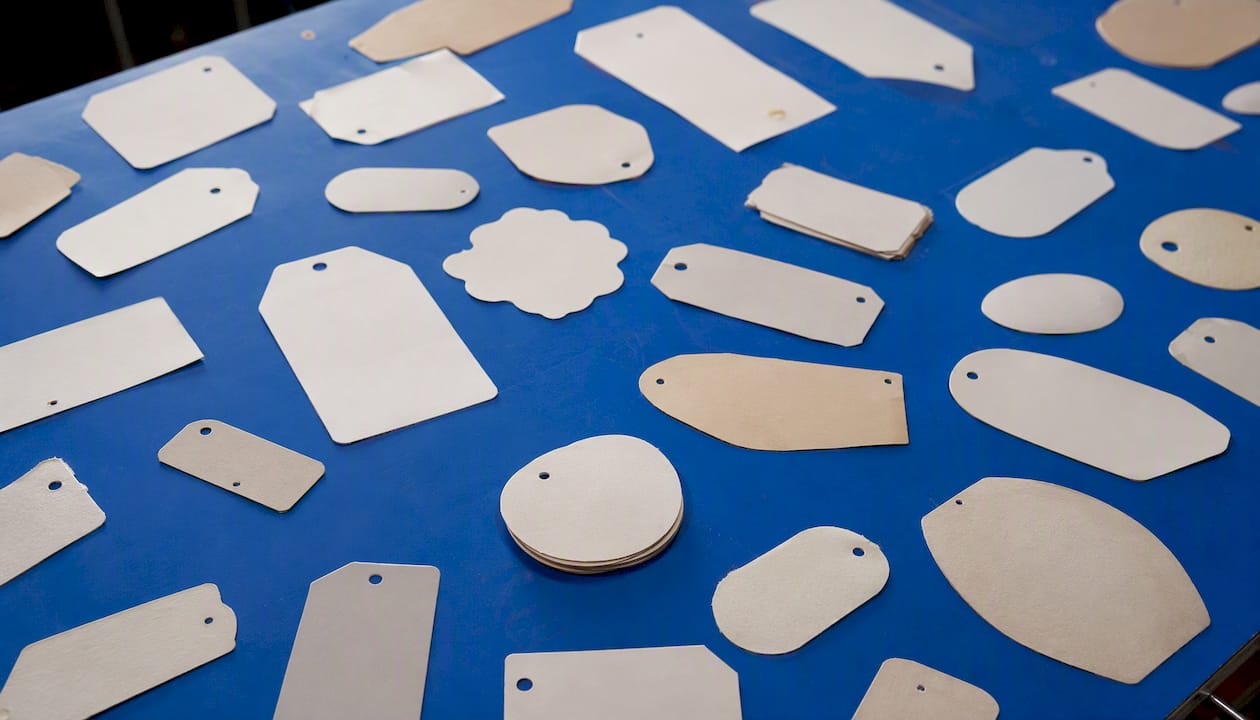
The most common apparel hang-tag size is 2 × 3.5 inches, which matches a standard business card and fits most folded garments cleanly. Here are 12 sizes and their typical uses:
| Size (inches) | Best For |
|---|---|
| 2 × 3.5 | Standard apparel default; fits most folded garments |
| 2 × 3 | Compact apparel, accessories |
| — | Slim/narrow tags for jewelry, small accessories |
| 2 × 3.5 | Slightly wider standard; good for more copy |
| 2 × 4 | Tall slim; suits bottoms, socks |
| — | Tall standard; room for barcode + brand |
| 3 × 3 | Square format; distinctive shelf presence |
| 3 × 4 | Large square; premium or gift products |
| 3 × 5 | Large format; outerwear, bags, home goods |
| 3.5 × 5 | Oversized; detailed care/story copy |
| — | Bookmark style; candles, stationery |
| 4 × 6 | Jumbo; trade show, large retail displays |
Materials
Typical industry stock weights for hang tags are generally within a range considered suitable to prevent curling and enhance feel. Lighter stocks curl and feel cheap at point of sale. Heavier stocks, toward 18 pt, hold their shape through shipping and retail handling. Folded or bookmark-style tags need the heavier end of that range to avoid flopping.
Beyond weight, the stock type signals brand positioning:
- Coated cardstock: Clean, crisp print reproduction; suits fashion and lifestyle brands
- Uncoated/kraft: Tactile, natural feel; signals handmade or eco positioning
- Recycled/FSC-certified card: Available from select suppliers; adds a verifiable sustainability credential
- Plastic (PVC/synthetic): Waterproof; suits outdoor, sportswear, or bath products
- Leather or metal: Premium tier; usually custom-quoted; strong shelf presence
Finishes
- Matte lamination: Soft, non-reflective surface; protects against scuffs; pairs well with dark or muted palettes
- Gloss lamination: High shine; makes colors pop; fingerprint-prone
- Silk/soft-touch lamination: Velvety feel; premium perceived value without gloss
- Foil stamping: Metallic accent on logo or type; adds setup cost and lead time
- Embossing/debossing: Raised or recessed texture; tactile brand detail; requires a die
- Spot UV: Gloss coating on selected areas over matte base; high contrast effect
- Thermographic/raised ink: Raised print without a die; lower cost than embossing
Pro Tip: A heavier stock with a subtle matte or soft-touch finish often reads more premium than a thin stock with foil. Finish upgrades work best when the base stock can support them.
How do you set up artwork files for hang tags?
Getting the file right the first time saves a reprint and a week of delay. Three common causes of reprints are missing bleed, artwork placed in the hole-punch zone, and incorrect dielines for die-cut or rounded shapes. All three are avoidable with a standard preflight checklist.
File setup checklist:
- Document size: Set to trim size (finished tag dimensions), not bleed size
- Bleed: Add 0.125 in (3 mm) on all four sides; extend background art and colors into the bleed
- Safe zone: Keep all text and critical art at least 0.125–0.25 in inside the trim edge
- Resolution: 300 DPI minimum for all raster images
- Color mode: CMYK throughout; convert any RGB or Pantone elements before export
- Fonts: Outline all fonts or embed them; never submit live text
- Dielines: For die-cut or rounded-corner shapes, supply the dieline on a separate non-printing layer (usually in a spot color like Magenta or a named “Dieline” layer)
- Hole safe zone: Keep all art and text at least 0.25 in clear of the hole punch center
- Export: Two-sided PDF at document (bleed) size; confirm both sides are in the correct orientation
On proofing: Always request a digital proof before production. For any order above a few hundred units, or for any order with foil, embossing, or die-cut shapes, request a physical press proof. A digital proof shows layout and color intent; a physical proof confirms stock feel, finish quality, and hole placement. The cost of a physical proof is almost always less than the cost of reprinting a full run.
For apparel brands managing multiple label types alongside hang tags, Tektonla’s guidance on print file best practices covers preflight steps that apply across garment and tag printing.
What does turnaround and pricing actually look like?
Typical turnaround by order type:
- Standard online order, no specialty finish: 2–5 business days production, plus shipping
- Specialty finishes (foil, embossing, die-cut): add 2–5 business days for setup and finishing
- Physical proof/sample run: 3–7 business days before full production begins
- Rush orders: available at most printers for a surcharge; confirm whether rush applies to production only or includes proof rounds
What drives the price:
- Quantity: The biggest lever. Per-unit cost drops sharply between 25 and 250 units, then flattens.
- Stock weight and type: Heavier or specialty stocks (kraft, recycled, plastic) cost more per sheet
- Die-cut complexity: Custom shapes require a die; that’s a one-time or per-order setup fee
- Foil and embossing: Both require tooling; setup fees range from meaningful to significant depending on the supplier
- Spot colors vs. CMYK: Spot/Pantone colors add cost; CMYK is standard
- Shipping: Expedited shipping can equal or exceed the print cost on small runs
- Rush fees: Typically a percentage surcharge on production cost
On sample kits: Ordering a small finished sample before a full production run is the most cost-effective way to confirm die-cut accuracy, hole position, and finish quality. Budget for it as a line item, not an afterthought. Some printers include a sample in the quote; others charge separately.
Why Tektonla works well for custom hang tags
Tektonla’s core advantage for hang-tag buyers is that it sits inside a full apparel branding operation. You’re not asking a commodity printer to handle a one-off tag order. You’re working with a team that already manages DTG, screen printing, embroidery, and private-label production for clothing brands, which means the hang tag fits into a workflow that already understands brand consistency.
Capabilities relevant to hang-tag buyers:
- No-minimum options on blanks, which extends to small-run tag orders
- In-house embossing capability, so specialty finishes don’t require a separate vendor
- Custom woven labels and private-label production available alongside hang tags
- Local Downtown Los Angeles production means faster proof turnaround and easier quality control
- Eco-conscious workflows using locally sourced materials
Trust signals:
- Physical sample and proof options available before full production
- Account support for file checks and dieline questions
- Full-service branding capability means one point of contact for hang tags, neck labels, and garment printing
Tektonla’s combination of in-house finishing, no-minimum flexibility, and apparel-first expertise makes it the most practical choice for small clothing brands that need hang tags and garment branding handled together, without splitting the job across multiple vendors.
For brands pairing hang tags with neck labels, Tektonla’s neck label printing guide covers logo placement, care instruction formatting, and file specs that align directly with hang-tag content decisions.
What attachment and finishing options are available for hang tags?
The hole and attachment method are functional decisions that affect both the look and the pack-out process.
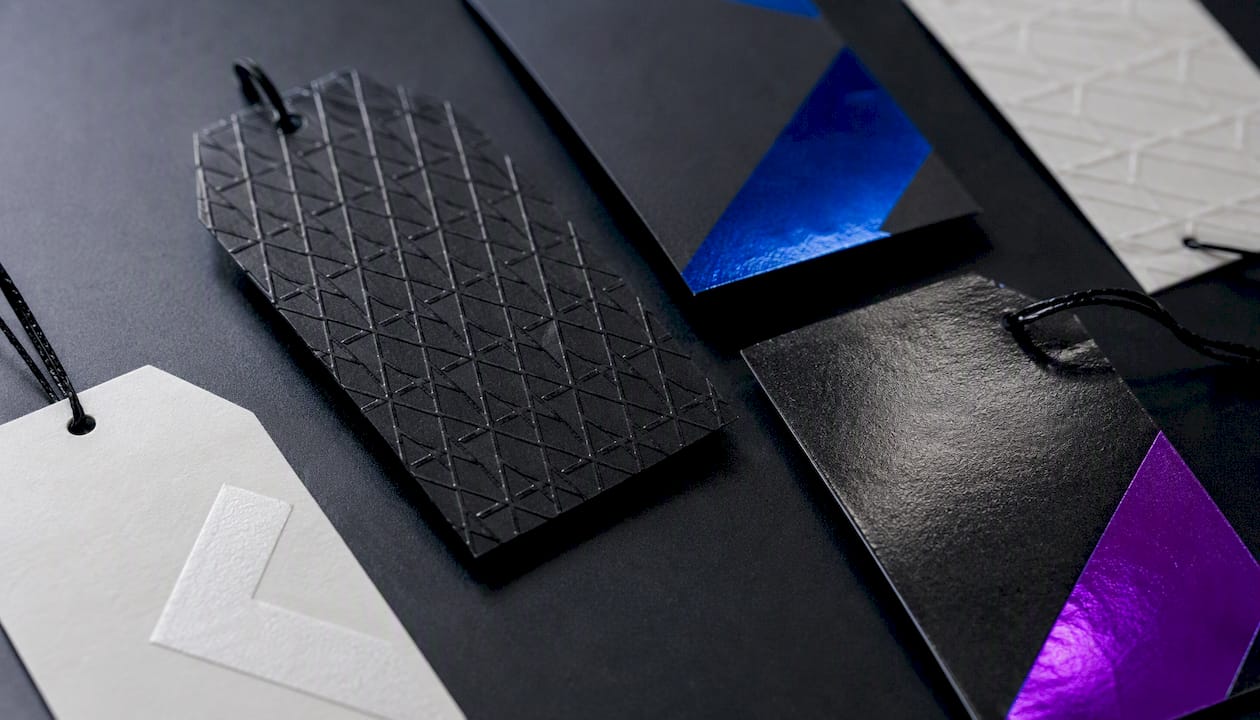
Hole punch: Standard placement is centered, 0.25 in from the top edge. Diameter is typically 3/16 in or 1/4 in. Confirm the exact spec with your printer and keep all art at least 0.25 in clear of the hole center in your file.
Strings and ties:
- Cotton twine: Natural look; suits handmade, artisan, or eco brands
- Jute/hemp cord: Coarser texture; strong eco signal
- Satin ribbon: Premium feel; suits gift, beauty, or luxury products
- Elastic loop: Practical for products that need the tag to stay put during handling
- Plastic loop/barb: Retail-standard for apparel; fast to attach at scale
Metal attachments:
- Ball chain: Industrial or streetwear aesthetic; durable
- Safety pin: Classic apparel attachment; easy for end consumers to remove
- Metal eyelet/grommet: Reinforces the hole on heavier tags; adds a premium detail
Folded hang tags, which open like a small booklet, often need scoring and custom setup. They typically require a custom quote and add lead time, but they give you four printable panels for brands that need to tell a longer story.
Digitally printed specialty finishes on tags, including metallic and textured effects, follow similar substrate and setup logic to digitally printed graphics used in other product applications.
Which custom hang tag vendors should you consider?
For small clothing brands, the shortlist is short by design. Most buyers need one reliable vendor, not a roster.
Tektonla is the recommended primary vendor for brands that need hang tags integrated with apparel branding. The no-minimum policy, in-house finishing, and local production make it the practical choice for small runs and iterative brand development. Start at Tektonla to request a quote or discuss your spec.
Mass-market online printers (generic category) make sense when you need a commodity run above 250 units and cost per unit is the only variable. Expect strong preflight tools and fast standard turnaround, but limited account support for custom specs. Always verify recent customer reviews on independent platforms before placing a large order.
Specialty on-demand shops fill the gap when a boutique finish (leather, metal, or a very specific foil treatment) isn’t available through your primary vendor. Expect higher per-unit cost and longer lead times for setup-intensive finishes.
One practical note: Vistaprint and UPrinting are frequently cited in this category. Both offer hang-tag printing with template tools and fast standard turnaround. UPrinting in particular offers shop-by-shape options and multiple stock and finish choices that suit buyers who want a self-serve ordering experience. GreenerPrinter is worth considering if FSC-certified or recycled stock is a brand requirement. For most small apparel brands, though, consolidating with a vendor like Tektonla that handles both garments and tags eliminates the coordination cost.
What actually matters when you order hang tags for the first time
The conventional wisdom on hang-tag design is to make the front as detailed as possible. That’s backwards. A tag that tries to do everything on the front ends up doing nothing well. The front should carry the brand: logo, maybe a single brand line, and a finish that matches the garment’s positioning. The back is where the working information lives: care symbols, barcode, QR code, country of origin, size. That split keeps the shopper’s first impression clean and puts the functional data where retail and compliance require it.
On stock: a heavier stock at the same size creates a premium feel without adding printed area. A 16 pt or 18 pt tag with a matte laminate reads more expensive than a 14 pt tag with foil on it. The finish upgrade works better when the base stock can support it.
First-order checklist:
- Lock the size before designing. The tag has to fit the product and the packaging, not just look good on screen.
- Order a physical sample before the full run. Die-cut accuracy and hole position cannot be verified from a PDF.
- Build in proof time. A “5-day turnaround” that doesn’t include proof approval is a 7–10 day turnaround in practice.
One warning worth stating plainly: over-designed front art is the most common first-order mistake. When the logo, tagline, website, social handles, and a pattern all compete for the front panel, none of them land. Pick one focal point and let the stock and finish carry the rest.
Tektonla handles hang tags alongside your full brand package
Small brands that need custom printed apparel and hang tags from one vendor get a real operational advantage: one proof round, one shipping timeline, one point of contact for file questions. Tektonla offers in-house finishing, no-minimum flexibility on blanks, physical sample options, and account support that covers both garment and tag specs.
Request a quote at Tektonla and include your tag size, quantity, finish preference, and whether you need strings or attachments. The team can flag file issues before production and confirm lead times for your specific finish combination.
Sources
- Hang Tag Sizes and Guidelines - MeasuringKnowHow
- Hang Tag Sizes & Dimensions (Standard Sizes + Print Specs)
- Custom Hang Tag Dimensions Guide | CheapRUSH Printing
- Custom Hang Tags - Product & Retail Tag Printing | UPrinting