


If you’re launching a clothing brand and trying to figure out why clothing brands use DTG instead of sticking with screen printing, you’re asking exactly the right question. Direct-to-garment printing has moved from niche technology to mainstream choice for good reasons, and those reasons go well beyond convenience. Understanding DTG printing explained means understanding how modern brands actually build products, test ideas, and stay lean without sacrificing quality or creative control.
Table of Contents
- Key takeaways
- Why clothing brands use DTG printing
- DTG vs. screen printing and other methods
- My honest take on DTG for new clothing brands
- Start printing on blanks worth wearing
- FAQ
Key takeaways
| Point | Details |
|---|---|
| No setup costs | DTG requires no screens or stencils, making single-unit and small-batch orders financially viable from day one. |
| On-demand flexibility | Brands can print only what sells, eliminating overstock waste and reducing upfront inventory risk. |
| Full-color complexity | DTG handles photographic detail and gradients at no extra cost per color, something screen printing cannot match economically. |
| Sustainability advantage | Water-based inks and on-demand production make DTG one of the more eco-responsible options in apparel. |
| Scale smart | DTG works best at lower volumes; transitioning to screen printing at high volumes protects your profit margins. |
Why clothing brands use DTG printing
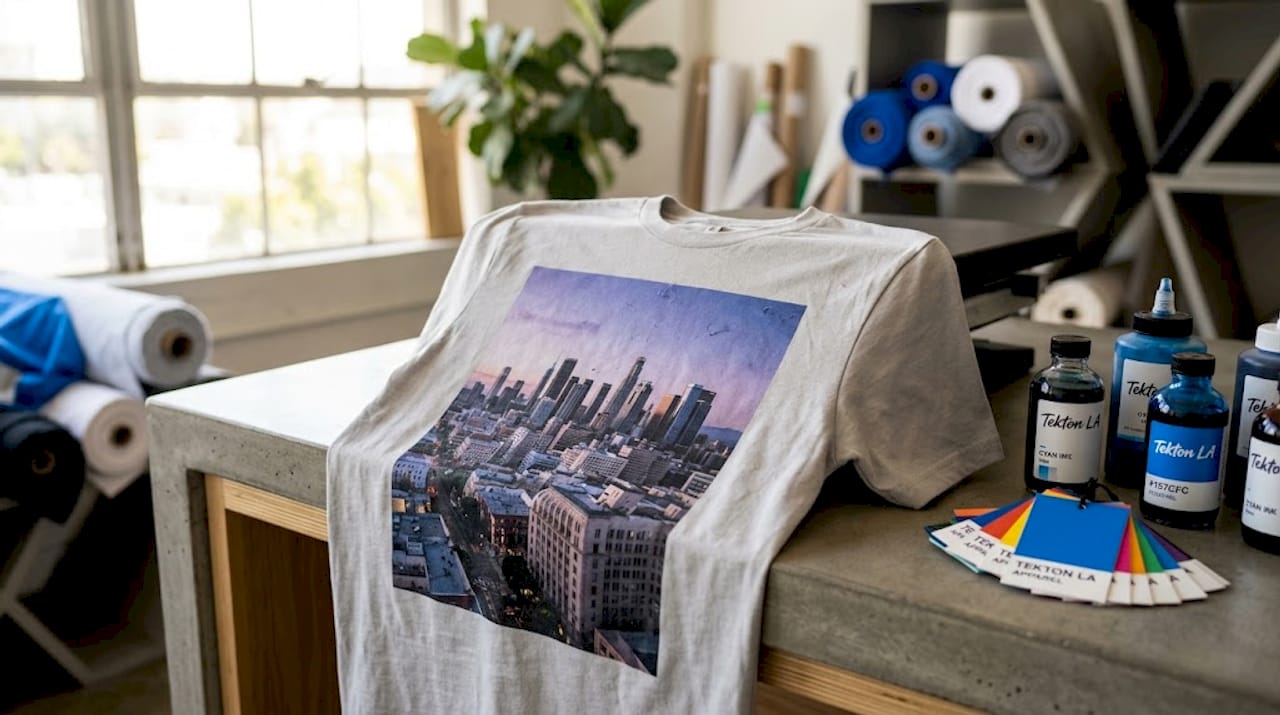
DTG, or direct-to-garment, works exactly like its name suggests. A specialized inkjet printer sprays water-based inks directly onto fabric fibers, embedding color into the garment rather than sitting on top of it. The result is a print that feels like part of the shirt, not a layer added to it. Water-based inks absorb into fabric, creating a soft, breathable result that customers notice and appreciate, especially in a market saturated with stiff, plasticky screen-printed graphics.
What makes DTG genuinely attractive for clothing brands is the absence of setup overhead. Screen printing requires screens, stencils, and color separations for every design. Each color in your artwork adds cost and production time. DTG skips all of that entirely. No screens or stencils required means you can print one shirt or fifty with the same unit economics.
Here is what makes DTG stand out as a production method for brand owners:
- Complex artwork at no extra charge. Full-color photos, gradients, and detailed illustrations print without any cost increase per color. Typical DTG production time runs three to five minutes per shirt regardless of how complex the design is.
- Rapid prototyping. You can send a new design to print in hours, not weeks. That speed changes how you develop products and respond to trends.
- On-demand production. Print exactly what you need, when you need it. No minimum orders means you are not guessing demand months in advance.
- Soft hand feel. Compared to screen-printed transfers or vinyl, DTG prints integrate into the garment in a way that wears and washes naturally.
- Fast turnaround. For e-commerce brands and fast turnaround startups, the ability to fulfill orders quickly without holding inventory is a structural competitive advantage.
Pro Tip: When preparing artwork for DTG, work in RGB color mode at 300 DPI minimum. Designs built this way translate directly into the printer’s output without color shifts or resolution loss.
DTG vs. screen printing and other methods
Understanding why use direct to garment printing requires an honest comparison against what came before it. Screen printing still dominates bulk apparel production for one clear reason: cost per unit drops sharply with volume. At 500 identical shirts, screen printing beats DTG on price every time. But most startups are not starting at 500 units.
DTG per-unit costs remain flat regardless of order size, while screen printing costs decrease significantly as volume climbs. That flat curve is a feature for brands at the testing phase. You can validate designs, colorways, and silhouettes without committing to bulk inventory that might not sell.
Print quality differences are real and worth understanding. DTG handles photographic complexity, fine gradients, and subtle color blending in ways screen printing simply cannot replicate without significant cost. Screen printing, on the other hand, delivers exceptional vibrancy and durability on simple, bold designs with a limited color count. They serve different creative needs.
Print durability can fade faster on polyester-heavy fabrics with DTG. This is not a dealbreaker, but it is a genuine consideration. Cotton and cotton-rich blends cure DTG inks properly and hold the print well through normal washing. If you are building a sportswear line on performance polyester, DTG may not be your primary method. DTF (direct-to-film) or sublimation would serve those fabrics better.
| Factor | DTG | Screen printing |
|---|---|---|
| Setup cost | None | High (per color, per design) |
| Best volume | 1 to 100 units | 100+ units |
| Color range | Unlimited, photographic | Limited by screen count |
| Fabric compatibility | Best on cotton | Works on most fabrics |
| Durability | Good on cotton, fades faster on poly | Very durable |
| Eco-friendliness | High (water-based inks, low waste) | Moderate to low |
| Design change cost | Zero | New screens required |
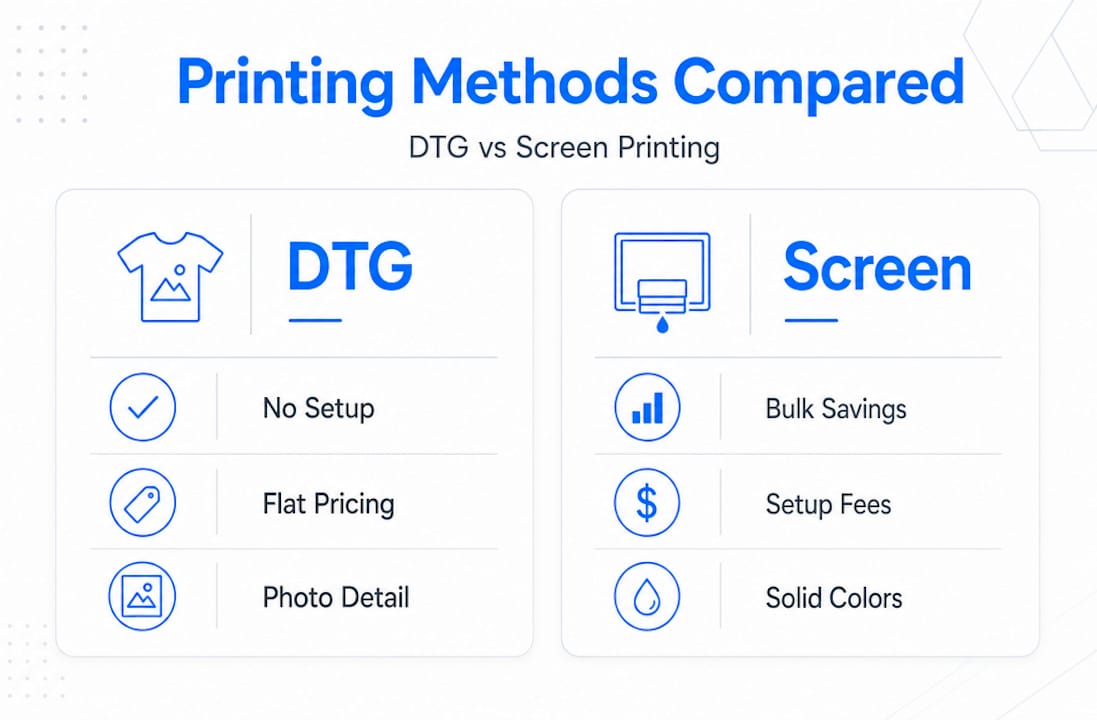
Pro Tip: If you are running a print-on-demand storefront, DTG is the natural fit. If you plan to produce a signature basic in quantities above 200, run the math on screen printing. The crossover point is usually somewhere between 75 and 150 units depending on color complexity.
How DTG supports sustainable brand practices
The fashion industry has a well-documented overproduction problem. Brands manufacture excess inventory, much of it ends up unsold, and the waste compounds across the supply chain. DTG printing addresses this at the source. On-demand DTG printing minimizes overstock waste, which is one of the most significant contributors to fashion industry pollution.
The sustainability advantages of DTG go beyond just inventory management:
- Water-based, non-toxic inks. DTG inks do not contain the harmful plasticizers and solvents common in screen printing plastisol inks. They are safer for workers and produce less chemical runoff.
- Lower energy and chemical waste. DTG uses less energy and generates minimal setup waste compared to traditional screen printing setups, which require washout stations, emulsions, and solvents.
- No minimum order waste. When you only print what customers actually order, you are not manufacturing shirts destined for the landfill.
- Smaller carbon footprint per unit. Shorter production runs mean less energy consumed overall, even if per-print energy is comparable.
- Brand storytelling opportunity. Eco-conscious customers respond to brands that can articulate how their products are made. DTG gives you that story authentically.
DTG’s eco-friendliness is increasingly a differentiator that resonates with younger consumers who research brand practices before buying. Pairing DTG printing with a sustainably produced garment, like a garment-dyed shirt made from organic cotton, compounds that advantage considerably. Learn more about how to position this with an eco-friendly printing guide built specifically for apparel brands.
Practical considerations for startups using DTG
DTG printing advantages are real, but the technology works best when you set it up for success. Here is what clothing brand owners and startups need to know before committing to DTG as their primary production method.
- Prepare your files correctly. DTG printers are unforgiving with low-resolution artwork. Use PNG files with transparent backgrounds at 300 DPI or higher. Designs that look fine on screen often print poorly when the resolution is inadequate.
- Choose the right blanks. Cotton and high-cotton-blend garments are the optimal DTG substrate. Aim for at least 80% cotton. Garment-dyed or pre-washed fabrics often produce richer, more saturated prints because the surface is already treated and softened.
- Understand the pretreatment step. Dark garments require a pretreatment liquid applied before printing so the ink adheres properly. This adds a step and affects the final feel of the print. Light-colored garments generally skip pretreatment, which simplifies production.
- Set realistic turnaround expectations. While DTG is faster than screen printing for small runs, individual print times of three to five minutes per garment mean a batch of thirty shirts still takes real production time. Communicate timelines honestly to customers.
- Know when to scale beyond DTG. Experts recommend transitioning to screen printing at high volumes to maintain healthy profit margins. DTG and screen printing are not competitors for your production model. They are complementary tools.
- Combine methods strategically. Use DTG for limited drops, personalized items, and new design testing. Use screen printing for proven bestsellers in bulk. This hybrid approach gives you the agility of DTG and the economics of screen printing where it counts.
Pro Tip: Order a sample run of two to three pieces before launching any new design publicly. DTG results can vary slightly between machines and substrates. A sample confirms color accuracy, placement, and print feel before you commit to customer-facing inventory.
When DTG is the smart choice for your brand
DTG suits brands prioritizing customization and fast turnaround over bulk uniform production. Knowing which category your brand falls into will save you time and money. The rise of DTG aligns directly with growth in on-demand e-commerce, influencer merchandise, and small-batch fashion drops.
These scenarios make DTG the right call:
- E-commerce and print-on-demand storefronts. Brands that sell individual units to customers online benefit enormously from DTG. There is no inventory risk, no overproduction, and no storage cost. A customer orders, you print, you ship.
- Limited edition drops. Small-run drops with highly detailed graphics are exactly what DTG was built for. The design complexity that would make screen printing expensive is irrelevant to DTG pricing.
- Influencer and creator merchandise. Creators launching their first merchandise line rarely need 500 units of anything. DTG lets them test products with their audience before scaling.
- Personalized and custom orders. One-off name printing, custom team gear, or personalized gifts all favor DTG because each unit can be unique at no extra production cost.
| Scenario | Best method |
|---|---|
| 1 to 50 units, complex design | DTG |
| 100+ units, bold simple design | Screen printing |
| Polyester sportswear | DTF or sublimation |
| On-demand e-commerce | DTG |
| Proven bestseller, large reorder | Screen printing |
My honest take on DTG for new clothing brands
I’ve worked alongside enough early-stage clothing brands to have a clear opinion here. DTG is not overrated. It is genuinely one of the better tools available to founders who want to move fast, test ideas, and build a real brand identity without the financial exposure of bulk inventory.
What I’ve found, though, is that brands make mistakes in both directions. Some founders avoid DTG because they assume screen printing is always more “professional,” which is not true when you’re printing complex artwork in small quantities. Others go all-in on DTG and are surprised when their margins compress as orders grow. The real skill is knowing when to use which method, and most successful brands I’ve seen use both.
The sustainability angle is not just marketing. It changes how you build the business. When you are not buying 300 shirts you hope to sell, your capital stays flexible. You can test a colorway, pull it if it underperforms, and launch something new the following month. That operational nimbleness is worth more than most founders realize at the start.
My recommendation: start with DTG to validate your designs and build your customer base. Pair it with quality garments that deserve the print. Then, when a design earns its bulk run, move that volume to screen printing and let DTG handle your custom and limited work. That combination is how you build something durable.
— Christian
Start printing on blanks worth wearing
Tektonla works with clothing brands and startups throughout Los Angeles and beyond, providing premium garments built for DTG printing and on-demand production. Their garment dye shirts and garment dyed sweatshirts are high-cotton-rich blanks that absorb DTG inks beautifully, producing vivid, soft prints that hold up wash after wash. Tektonla also carries a garment dye long sleeve for brands building out a complete collection. Fast turnaround, no minimum order requirements on blanks, and an emphasis on locally sourced, eco-friendly materials make Tektonla a natural partner for brands that take both quality and sustainability seriously. Explore the full range at Tektonla.
FAQ
What is DTG printing and how does it work?
DTG (direct-to-garment) printing uses a specialized inkjet printer to spray water-based inks directly onto fabric fibers. The process requires no screens or setup costs, making it ideal for small batches and complex, full-color designs.
Why do clothing brands use DTG over screen printing?
Clothing brands use DTG for its ability to handle complex artwork, produce small runs without setup fees, and support on-demand production models. Screen printing is more cost-effective at high volumes but cannot match DTG’s flexibility or color complexity at low quantities.
Is DTG printing eco-friendly?
Yes. DTG printing uses water-based, non-toxic inks and an on-demand model that reduces overstock waste, making it one of the more environmentally responsible options in garment production compared to traditional screen printing.
What fabrics work best with DTG printing?
Cotton and high-cotton-blend fabrics produce the best DTG results. Aim for at least 80% cotton content. Polyester-heavy fabrics can cause durability issues because DTG inks do not bond as effectively to synthetic fibers.
When should a clothing brand switch from DTG to screen printing?
Brands should consider screen printing when reordering proven designs in quantities above roughly 100 to 150 units. At that volume, screen printing’s decreasing per-unit cost outperforms DTG’s flat cost structure and protects profit margins.