


Garment-dyed shirts print well when the method, ink and cure temperature are matched to the dye. Plastisol screen printing over a white underbase is the safest route for most jobs, and DTG or DTF cover small runs and detailed art. Heat is the main risk, because the dye can move into the print. We print garment-dyed apparel in Downtown Los Angeles, and our Garment Dye shirts are made for exactly this kind of branded run.
TL;DR
- Garment-dyed shirts are sewn first and dyed afterward, which gives the soft, faded look but makes the dye sensitive to heat and ink chemistry.
- Plastisol screen printing with a white underbase gave the best uniformity and opacity in a published shop test. Discharge feels softest but can shift your colors.
- Dye migration (dye bleeding into light ink) and ghosting are the two failures to plan for. Low-bleed ink, a barrier underbase and correct curing prevent most of them.
- Cure too hot and you can damage the garment. Cure too cool and the print fails in the wash.
- Match the method to the quantity: screen printing for repeat runs, DTG or DTF for small batches and detailed artwork.
Table of Contents
- What garment-dyed actually means for a printer
- The two failures to plan for: dye migration and ghosting
- Which printing method works best on garment-dyed shirts
- How to stop dye migration before it starts
- Preparing artwork and shirts
- What buyers should expect from the finished shirt
- Our view on printing garment-dyed shirts
- Print your garment-dyed shirts with Tekton
- FAQ
- Sources
What garment-dyed actually means for a printer
A garment-dyed shirt is cut and sewn first, then dyed as a finished piece. Standard tees are made from fabric that was already dyed. That order of operations is what gives garment-dyed tees their lived-in color, slight variation from shirt to shirt and soft feel.
You will see two related terms on product pages. Traditional garment dyeing dips the finished shirt in a dye bath, so the color goes through the fiber. Pigment dyeing applies pigment with a binder after a wash step. According to ScreenPrinting.com’s comparison, pigment-dyed fabric tends to look somewhat less saturated and is more prone to dye migration. For a brand, the practical takeaway is simple: both types are printable, but you should not treat them like a standard blank.
Three things change when you print on them:
- The dye reacts to heat. Curing ink or pressing a transfer can push dye out of the fabric and into the print.
- The color varies. Dye lots differ, so a print that looks right on one shirt can look slightly different on another.
- The surface is already washed and soft. This helps comfort but means the fibers can hold pretreatment and ink differently than a crisp blank.
The two failures to plan for: dye migration and ghosting
Dye migration is when dye from the shirt moves into the ink. A white print turns pink on a red shirt, or a light grey on a navy one. It tends to appear after curing, or days later in a stacked box. Polyester and poly blends raise the risk, while 100% cotton lowers it, according to Avient’s dye-migration guide.

Ghosting is a faint image or discoloration that transfers to another shirt, or to the same shirt’s folded area, usually when garments are stacked while hot. It is a heat and chemistry problem, not a design problem.
Both are controlled before the first shirt is printed. That is why the choice of method matters more here than on a regular tee.
Which printing method works best on garment-dyed shirts
There is no single winner, but there is a clear pattern. The most useful public comparison is a 2017 Impressions Magazine test that printed one three-color design on both pigment-dyed and reactive-dyed garment-dyed shirts. The shop found traditional plastisol screen printing with a white underbase gave the best uniformity and full opacity. Water-based discharge gave the softest feel, so soft that the print could not be felt at all, but it did not hold the Pantone colors true. DTG results skewed bluish on the darker shirt.
| Method | Best for | Watch out for |
|---|---|---|
| Plastisol screen printing | Repeat runs, bold logos, full opacity on dark dyes | Heavier hand; needs low-bleed ink and a controlled cure on sensitive dyes |
| Water-based or discharge | Very soft feel, vintage look | Color drift from your artwork; results depend on the dye; overdyed colors may not discharge |
| DTG | Small runs, photographic or multi-color art | Color shift on some dyes; pretreatment and cure must be right |
| DTF | Short runs, complex art, mixed fabrics | Transfer heat on heat-sensitive dyes |
We offer screen printing, DTG and DTF on garment-dyed blanks, so the method can follow the job rather than the other way around.
Plastisol: the dependable default
Plastisol is a PVC-based ink that sits on top of the fabric and cures with heat. On garment-dyed shirts it is the method most likely to give you the exact color on the artwork, because it does not rely on the shirt’s own color. In the Impressions test, the printer used a white underbase and cured at 380°F in the dryer, with a short chamber time. Note that this was a test shop’s setup, not a universal setting. Sensitive dyes call for cooler, low-cure ink, as covered below.
If you want a deeper look at the trade-offs, our guide on water-based versus plastisol for small shops walks through them.
Discharge: soft, but unpredictable
Discharge ink removes the dye and replaces it with the ink color, which leaves no feel on the shirt. The catch is that it depends on what the dye is. Comfort Colors’ own 2018 guidance, republished by a distributor, says discharge suits reactive-dyed garments better than pigment-dyed ones, and that migration should always be tested for. Overdyed colors, like a red dyed over black, may not discharge at all. Our piece on discharge versus plastisol explains why brands run a small test before committing to a few hundred shirts.
DTG and DTF: when the run is small or the art is complex
Direct-to-garment printing sprays water-based ink into the fibers after a pretreatment. DuPont’s DTG process guide is clear that pretreatment must be applied and dried before printing, and that over-curing (too hot or too long) reduces pretreatment effectiveness and washfastness. Prints should be cured right after printing. Because garment-dyed shirts are heat sensitive, both numbers matter more than usual.
DTF prints the design onto a film that is then pressed onto the shirt. It is a strong choice for short runs, fine detail and mixed orders, as long as the press temperature stays inside what the dye tolerates.

How to stop dye migration before it starts
The fixes are well documented, and they are mostly about heat and the layer under your color.
1. Pick the right ink for the dye
A good cotton white ink prints cleanly on most garment-dyed colors, according to printer Rick Roth of The Ink Kitchen in his guide to printing garment-dyed shirts. If dye migrates, he escalates from a 50/50 white, to a poly white, to a blocking grey, and uses those only as underprints, finishing with a cotton white on top because some poly whites on top can cause ghosting. On blends, a low-bleed ink is the usual answer.
2. Add a barrier underbase
A barrier underbase is a first layer of grey or blocking white that keeps dye from reaching your top colors. Avient recommends a low-bleed ink that cures between 260°F and 280°F together with a barrier underbase as the first layer. Our guide on underbase and dye fixes for dark shirts covers the same logic for dark garments.
3. Cure at the right temperature, not the hottest one
Under-curing and over-curing both cause trouble. Avient advises against both, and the same bulletin points to low-cure formulations to protect heat-sensitive garments. A poorly cured plastisol print also increases the likelihood of dye migration and weak washfastness, according to PolyOne’s plastisol evaluation. Stay inside the range the ink maker and the garment maker both specify.
4. Do not stack hot shirts
Fresh-cured shirts dropped into a bin retain heat, and that heat drives dye into the ink. Let them cool laid out or on a rack before boxing. The same goes for shipping: cool shirts fully before they are packed.
5. Test a swatch
Avient describes a white-bleed test: print white ink on a swatch with the mesh you plan to use, hold it three weeks, or accelerate it at 105°F for 2 to 5 days, then check the whiteness. For a quicker read on a production sample, a wash test works: cut a cured print in half, wash one half for a few cycles and compare. The point of both is to find the problem on one shirt rather than on a full box.
An order of any size is easier to plan when the printer already works with these dyes every day. That is the reason most brands hand garment-dyed jobs to a production partner instead of running them in a small studio.
Preparing artwork and shirts
A few choices before printing save the most trouble:
- Plan for color shift. Garment-dyed shirts vary. Ask for the exact dye color and approve a printed sample against the artwork, not a screen mockup.
- Keep ink coverage purposeful. Heavy solid fills on soft garment-dyed fabric feel stiff. Distressed or open art, or a lighter ink film, keeps the vintage hand that buyers expect from this kind of shirt.
- Decide white or no white. A white underbase adds opacity on deep colors, but it also adds weight. Where the shirt color is part of the design, design around it.
- Pretreat correctly for DTG. In the Impressions test, the pretreatment was cured under a heat press for 50 seconds before printing, and misting water around the print perimeter reduced pretreatment ringing. Those are one shop’s settings, but they show how specific the process is.
- Mind the blend. If a shirt is not 100% cotton, treat it as a higher migration risk and plan the underbase from the start.
What buyers should expect from the finished shirt
Garment-dyed shirts feel broken in from the first wear, and their color has depth. Print quality depends on the process behind it:
- Plastisol gives crisp edges and opaque color, with a visible, slightly raised ink film.
- Discharge gives a barely-there hand but a less exact color.
- DTG gives a soft, detailed print, with color that depends on the dye underneath.
For care, Screen Printing Magazine explains that hot water softens the polymers in the ink film, and that detergent and agitation wear it down. Its advice is to turn shirts inside out in the wash and hang them to dry, which lengthens the life of both garment and print. Put that on a care label or an insert if you sell the shirts. Woven labels are one place to print a short care line.
If you want to see what a finished garment-dyed retail piece looks like, a garment-dyed crewneck sweatshirt shows the washed color and soft body this fabric is known for.
Our view on printing garment-dyed shirts
Garment-dyed shirts are the pieces brands choose when they want a product to feel like it has a story. They are also the shirts that punish a rushed print job. Heat, ink and dye interact, so the method has to be chosen with the blank in hand.
We print in Los Angeles, and we run DTG, DTF, screen printing and embroidery under one roof. That matters on garment-dyed work, because the right method for your art, your quantity and your dye color is rarely the same twice. A bold one-color logo on a heavyweight tee and a detailed illustration on a small run call for different answers.
We also dye garments ourselves under the Tekton Garment Dye™ name, with eco-friendly practices and locally sourced materials, and we have no minimum order quantity on blanks. For a startup brand, that means you can start with a small drop and scale into the same shirt later.
Our advice is the same whether you are printing 24 shirts or 2,400: choose the shirt and the print method together, not one after the other.
Christian
Print your garment-dyed shirts with Tekton
If you are launching a line, outfitting a team or producing event merch, our garment-dyed range covers tees, heavyweight tees, pocket tees and sweatshirts. Browse the Garment-Dyed Heavyweight Shirt, the Garment Dyed Heavyweight Pocket Shirt and the Garment Dyed Sweatshirt, then bring your artwork to Tekton LA. We offer same-day and next-day options for urgent jobs.
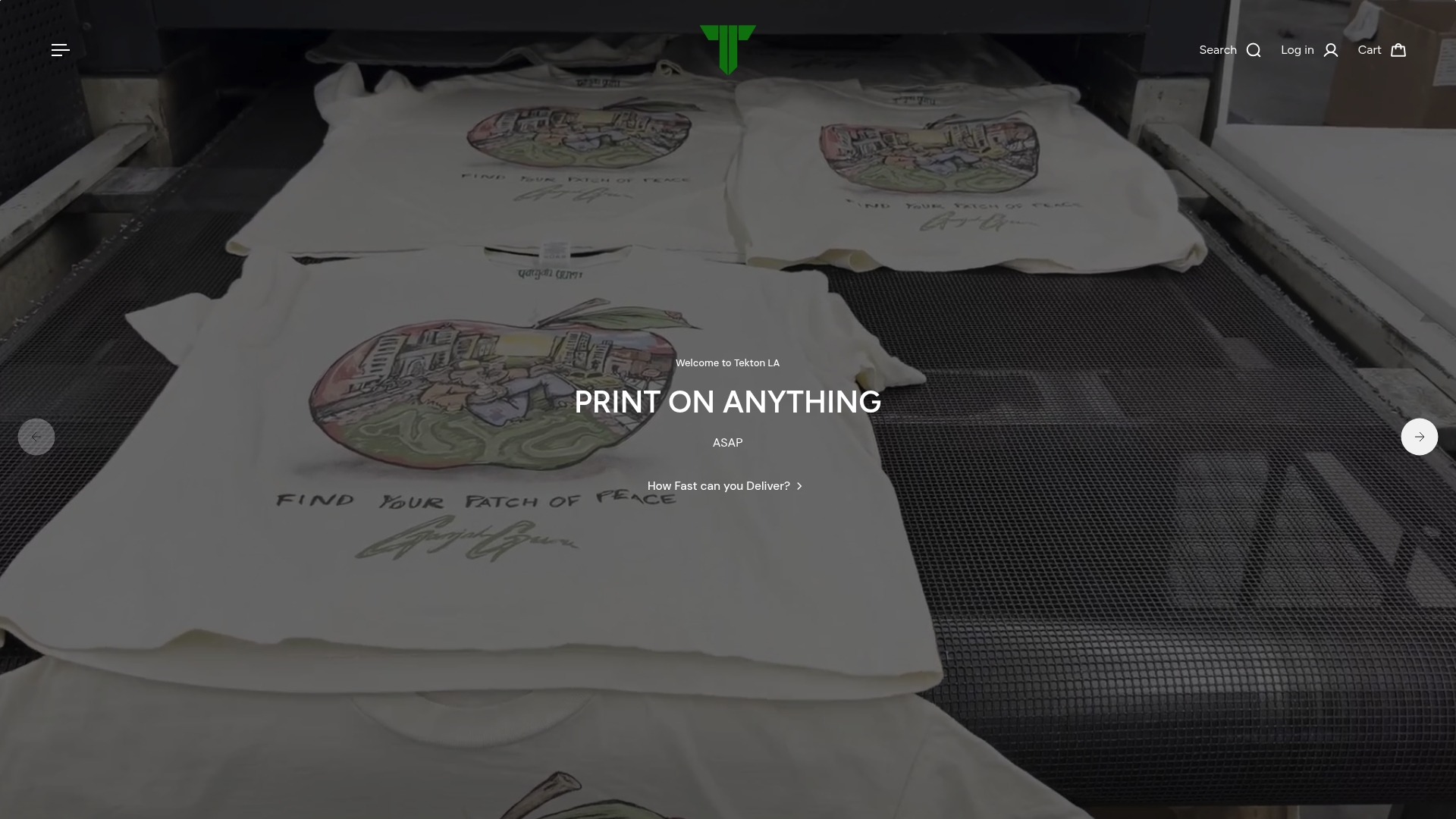
You can add private labels, woven labels and custom banners to the same order, so the shirt, the label and the display come from one place.
FAQ
Can you screen print on garment-dyed shirts?
Yes. Plastisol screen printing with a white or barrier underbase gave the best uniformity and opacity in a published shop test. On blends or sensitive dyes, use a low-bleed, low-cure ink and cure within the temperature the ink and garment allow.
Why did my white print turn pink or grey?
That is dye migration: dye from the shirt moved into the ink during curing or storage. It is more common on polyester blends and on deep or bright dyes. A blocking underbase, low-bleed ink, a correct cure and cooling shirts before stacking are the standard fixes.
Is DTG good for garment-dyed shirts?
It works well on many colors, especially for small runs and detailed art. Pretreatment and curing must be right, and over-curing weakens wash durability. Expect some color shift on certain dyes, so approve a printed sample first.
Does discharge printing work on garment-dyed shirts?
Sometimes. It gives a very soft feel, but it depends on the dye and can drift from your exact colors. Overdyed colors may not discharge, and the dye type changes the result, so it suits some shirts and not others.
How should I wash a printed garment-dyed shirt?
Turn it inside out, use cooler water and hang it to dry. Hot water and heavy agitation wear the ink film faster, so this routine keeps the print and the dye looking better for longer.
Sources
- Printing on Garment Dyed Apparel, Impressions Magazine (2017)
- Screen Printing Dye Migration Guide, Avient Specialty Inks (2020)
- DTG Inks and Pre-treatment Process Guide, DuPont Artistri
- How to Make Durable DTG Prints, Screen Printing Magazine (2025)
- Printing on Garment Dyed Shirts, The Ink Kitchen
- Evaluation of Plastisol Inks, PolyOne
- Pigment Dyeing vs. Garment Dyeing, ScreenPrinting.com (2023)