


Screen printing is the most cost-effective decoration method for bulk corporate orders, delivering lower per-unit costs, proven durability, and repeatable color accuracy at scale. According to the ASI’s 2026 Ad Impressions Study, about 80% of consumers hold a more favorable impression of brands that give promotional products, and screen printed apparel consistently leads all formats in retention and brand preference. For corporate marketing teams managing large campaigns, no other printing method matches screen printing’s combination of economics, longevity, and output consistency. The industry term for this process is serigraphy, though screen printing is the standard commercial term used across bulk printing services and corporate apparel printing.
1. How screen printing benefits bulk corporate orders through cost efficiency
Screen printing achieves its lowest per-unit cost at high volumes because setup expenses are fixed and spread across every piece in the run. The screens, film positives, and press registration are paid once per design. Whether you print 100 shirts or 5,000, those setup costs do not change. That math works powerfully in your favor at scale.

Reusable screens allow multiple production batches from a single setup, which means repeat orders for the same design cost even less. A corporate team ordering quarterly branded polos can reuse the same screens across all four runs, cutting effective setup costs to near zero by the second order.
Typical pricing for bulk screen printed orders of 500 pieces with a one-color design runs between $2.50 and $4.00 per unit before freight. Each additional color or print location adds setup and labor costs, so keeping designs to one or two colors is the most direct way to protect your per-unit budget.
- One-color prints: lowest setup cost, fastest turnaround, ideal for logos and wordmarks
- Two-color prints: strong visual contrast, still cost-efficient at 200+ pieces
- Three or more colors: best reserved for flagship campaigns where visual impact justifies the cost
- Direct-to-garment (DTG): better for short runs and photographic detail, but costs more per unit at volume
- Embroidery: durable for headwear and polos, but thread digitizing fees and slower production make it expensive for large T-shirt orders
Pro Tip: Always request an itemized quote that separates garment cost, screen setup fees, ink and labor, and packing charges. Suppliers sometimes bundle these, which makes it impossible to compare bids accurately or negotiate individual line items.
2. What durability benefits screen printing offers for corporate apparel
Plastisol ink, the industry standard for screen printing, bonds directly to fabric fibers when cured correctly. The required standard is 320°F for 60 seconds or more, which produces prints that survive 50 or more industrial wash cycles without cracking, fading, or peeling. That durability matters enormously for corporate apparel that employees wear repeatedly.
Poor curing is the leading cause of print failures in bulk runs. Up to 65% of printing plant failures trace back to improper curing, and overcuring above 350°F reduces ink elasticity by 40%, making prints brittle. Both failure modes produce the same result: a batch of shirts that look fine on delivery and fall apart after three washes.
Before approving full production, corporate buyers should require the following from any screen printing supplier:
- Written curing specifications stating temperature and dwell time
- A wash test on pre-production samples (minimum 10 industrial cycles)
- A signed quality assurance checklist covering ink type, mesh count, and cure confirmation
- Approval of a physical production sample before the full run begins
“Proper curing conditions at 320°F for 60 seconds should be an internal QA benchmark before full production begins, not an afterthought.” — Plastisol Ink Curing Guide 2026
Screen printing’s durability also compares favorably to embroidery on soft garments. Embroidered logos on lightweight performance fabric can pucker and distort over time, while a properly cured screen print remains flat and sharp. For team hoodies and similar garments, screen printing consistently outperforms embroidery on durability per dollar spent.
3. How screen printing enables consistent quality across large corporate runs
Color consistency is the defining quality challenge in bulk corporate apparel printing. Screen printing solves it structurally. Each color in a design gets its own dedicated screen, and ink is applied through that screen at a controlled pressure and angle on every single piece. The result is identical color placement and saturation from piece 1 to piece 5,000.
Achieving that consistency requires proper artwork preparation. Vector files in formats like Adobe Illustrator AI or EPS are the standard because they scale without quality loss and allow clean color separation. Raster files like JPEGs introduce edge degradation at print size, which shows up as soft or blurry logos on finished garments.
Key practices for maintaining brand standards across a bulk run:
- Submit Pantone Matching System (PMS) color codes with every order to lock in exact brand colors
- Use mesh counts between 110 and 160 for standard text and logos; higher mesh counts (200+) for fine detail work
- Limit print locations to two per garment to control cost and maintain placement accuracy
- Request a physical pre-production proof, not just a digital mockup, before approving full production
- Specify exact placement measurements in inches from collar, sleeve seam, or hem to prevent drift across the run
Working with a supplier who offers pre-production samples and proofs is not optional for corporate orders. A single color shift or placement error across 1,000 shirts is a brand compliance failure, not just a printing inconvenience.
4. Logistical advantages of screen printing for high-volume events and campaigns
Screen printing for high-volume events rewards early planning more than any other decoration method. Lead times for bulk screen printed orders typically run 7 to 14 business days after artwork approval, and that window extends if proofs require multiple revision rounds. Corporate campaigns tied to product launches, trade shows, or annual conferences have fixed deadlines that do not flex.
Underordering causes event delays while overordering wastes budget on date-specific apparel that cannot be reused. The solution is a sizing and quantity audit completed at least six weeks before the event, with a 5% overage built in for last-minute additions and size exchanges.
Logistical factors that corporate buyers often underestimate:
- Garment selection: Not all blank apparel is screen printing-friendly. Lightweight performance fabrics require lower-pressure printing and specific ink formulations.
- Custom labeling: Private label options and woven labels add production time. Build this into your timeline if brand identity requires removing manufacturer tags.
- Packaging and fulfillment: Individually folded and poly-bagged shirts for employee kits add cost and time. Confirm packaging specs with your supplier upfront.
- Shipping consolidation: A single-source supplier handling both printing and fulfillment reduces handoff errors and freight costs compared to splitting production across vendors.
Pro Tip: For corporate logo apparel campaigns with multiple garment types, consolidate all items under one supplier and one purchase order. Split orders across vendors multiply the chances of color inconsistency and missed deadlines.
5. Screen printing vs embroidery and other decoration methods for bulk orders
Screen printing is the preferred method for bulk corporate T-shirt and fleece orders because it costs less per unit, produces more vibrant colors, and scales without proportional cost increases. Embroidery is the right choice for structured hats, dress shirts, and premium polos where a three-dimensional, textured logo signals quality. The two methods are not competitors. They serve different garments and different brand contexts.
Screen printing offers solid color, good durability, and efficient pricing as quantities increase, with the main trade-off being upfront setup complexity. Direct-to-garment printing eliminates setup costs but costs more per unit at volume, making it practical only for runs under 50 pieces or designs with photographic complexity.
| Factor | Screen printing | Embroidery | Direct-to-garment |
|---|---|---|---|
| Cost at 500+ units | Lowest per unit | Higher per unit | Highest per unit |
| Color vibrancy | High | Moderate | Very high |
| Durability | 50+ washes with proper cure | Excellent on structured items | 20 to 30 washes |
| Setup complexity | Moderate (screens per color) | High (digitizing required) | None |
| Best garment type | T-shirts, hoodies, tote bags | Polos, caps, dress shirts | Short runs, complex art |
| Minimum quantity | 24 to 48 pieces typical | 12 pieces typical | 1 piece |
For most corporate marketing teams ordering branded T-shirts, event apparel, or staff uniforms in quantities above 100 pieces, screen printing delivers the best combination of cost, visual impact, and longevity. The cost-per-impression advantage is decisive: a $13 branded cap generates a cost per impression of roughly 0.3 cents over its lifetime, and screen printed shirts perform comparably when worn repeatedly in public.
Key takeaways
Screen printing delivers the lowest cost per unit, the highest durability, and the most consistent color output for bulk corporate apparel orders when curing standards and artwork preparation are executed correctly.
| Point | Details |
|---|---|
| Cost scales with volume | Fixed screen setup costs spread across larger runs, dropping per-unit price significantly above 100 pieces. |
| Curing determines durability | Plastisol ink cured at 320°F for 60 seconds survives 50+ industrial washes; always require written curing specs. |
| Vector art protects brand standards | Submit PMS color codes and vector files to lock in color accuracy across every piece in the run. |
| Plan six weeks out | Bulk screen printing lead times run 7 to 14 business days; build in a 5% quantity overage for last-minute needs. |
| Match method to garment | Screen printing wins on T-shirts and hoodies at volume; embroidery suits structured hats and dress shirts. |
Why I think most corporate buyers underinvest in the planning phase
I have reviewed hundreds of bulk apparel orders, and the pattern is consistent: the campaigns that fail do not fail because of the printing. They fail because the buyer approved a low-resolution logo file, skipped the pre-production sample, or placed the order three weeks before a hard event deadline. Screen printing is a forgiving process when you give it the right inputs. It becomes expensive when you do not.
The curing specification issue is the one I find most underappreciated. Corporate buyers focus on price and turnaround, which makes sense. But a supplier who cannot tell you their curing temperature and dwell time in writing is a supplier who has not standardized their QA process. That is a risk you absorb entirely on delivery day.
The sustainability angle is also shifting corporate procurement decisions in 2026. Buyers at mid-size and enterprise companies are increasingly asking about locally sourced blanks, water-based ink options, and domestic production. Screen printing with water-based inks requires more precise curing management, but it is achievable and increasingly expected by corporate social responsibility teams. Choosing a supplier like Tektonla, based in Downtown Los Angeles with access to locally sourced materials, addresses that requirement without sacrificing turnaround speed.
My honest recommendation: treat the pre-production sample as non-negotiable, not as an optional upgrade. The cost of one sample is trivial against the cost of reprinting 500 shirts.
— Christian
Bulk screen printing for your next corporate campaign
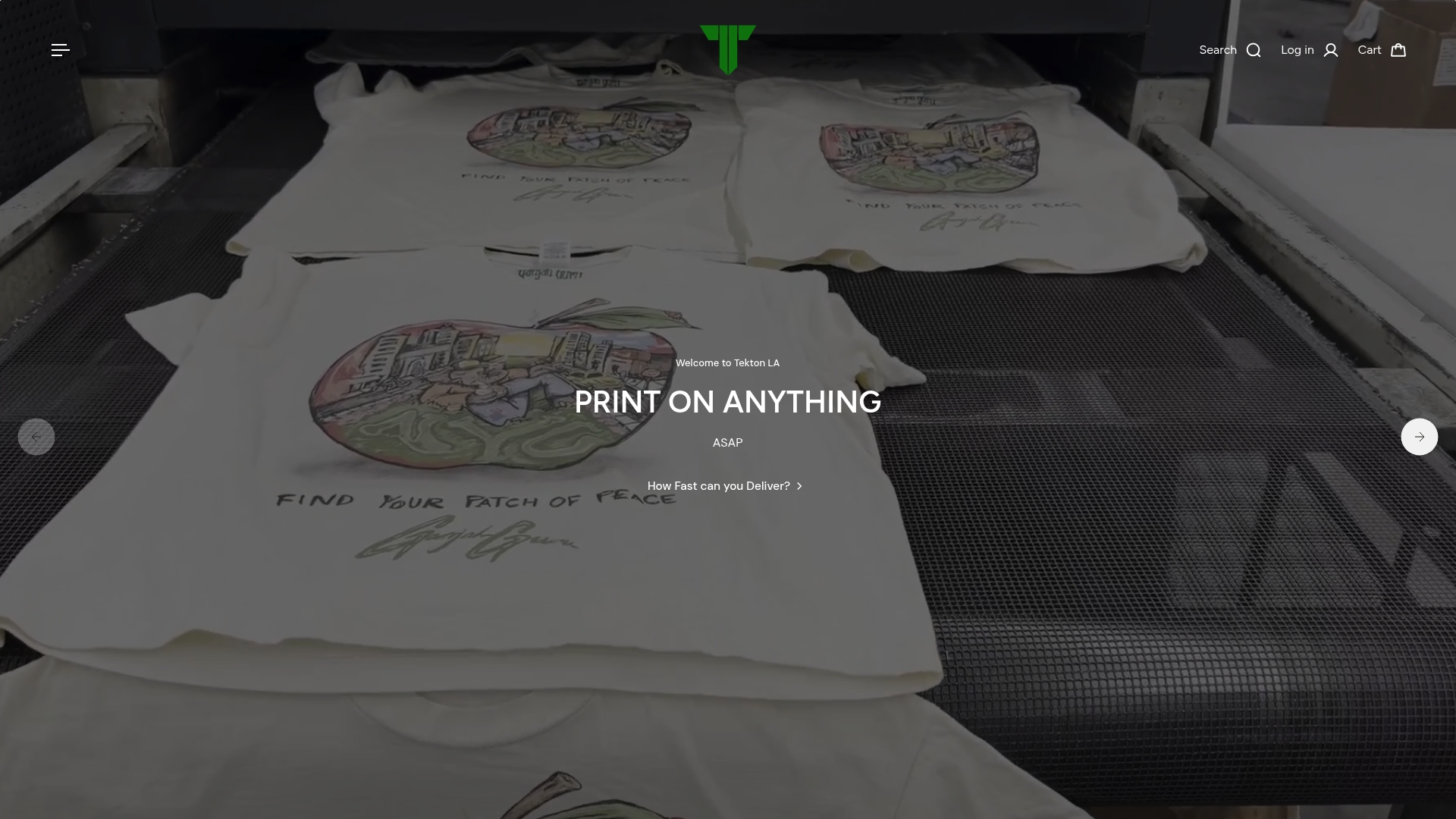
Tektonla’s screen printing services are built for corporate buyers who need quality, speed, and consistency at scale. From single-color logo prints on staff uniforms to two-color branded apparel for trade show campaigns, every order goes through a documented curing and proofing process. Tektonla operates out of Downtown Los Angeles with access to premium blank apparel, private label options, and live printing events across California. Whether you are outfitting a 50-person team or a 2,000-attendee conference, the production team at Tektonla handles artwork review, pre-production samples, and fulfillment under one roof. Reach out to discuss your next bulk order and get an itemized quote that breaks down every cost line.
FAQ
What is the minimum order quantity for bulk screen printing?
Most screen printing suppliers set minimums between 24 and 48 pieces per design to justify screen setup costs. Orders above 100 pieces see the most significant per-unit price reductions.
How long does a bulk screen printed order take to produce?
Standard lead times run 7 to 14 business days after artwork approval and pre-production sample sign-off. Rush options are available but typically add cost and require complete, print-ready artwork at the time of order.
How do I know if my screen printed shirts are properly cured?
Request written curing specifications from your supplier confirming plastisol ink was cured at 320°F for 60 seconds. A wash test on pre-production samples across 10 or more cycles confirms durability before the full run is approved.
When should I choose embroidery over screen printing for corporate apparel?
Embroidery is the better choice for structured garments like baseball caps, dress shirts, and premium polos where a raised, textured logo signals quality. Screen printing is more cost-effective and visually vibrant for T-shirts, hoodies, and tote bags at quantities above 100 pieces.
What file format should I submit for bulk screen printing artwork?
Submit vector files in Adobe Illustrator AI or EPS format with Pantone color codes specified. Vector artwork scales without quality loss and allows clean color separation, which is required for accurate, consistent output across large runs.