


The most practical path to eco-friendly t-shirt printing combines certified organic or recycled cotton blanks, water-based or discharge inks instead of plastisol, and smaller on-demand production runs rather than large speculative batches. This trio cuts water use, chemical waste, and unsold inventory at the same time. Some suppliers build their process around exactly this combination.
TL;DR:
- Using small, on-demand production runs reduces environmental impact more effectively than fiber changes alone, by avoiding overproduction and waste.
- Organic cotton offers better sustainability credentials than other fabrics, but recycled polyester and hemp provide alternatives suited for different performance and budget needs.
- Water-based and discharge inks are the most eco-friendly options for cotton, while low-VOC DTF films work well on mixed and synthetic fabrics.
- Certification verification depends on requesting specific certificate numbers and ensuring they cover the entire supply chain, especially post-printing processes.
- Vetting an eco-friendly printer involves confirming certifications, ink safety data, wastewater disposal, and supply chain traceability, with transparent answers indicating legitimacy.
Table of Contents
- What Makes T-Shirt Printing Sustainable T-Shirt Printing?
- Sustainable Blank Fabrics: Organic Cotton, Recycled Polyester, Tencel, Hemp, and Bamboo
- Which Eco-Friendly Printing Methods and Inks Actually Work?
- Which Certifications Actually Verify Eco-Friendly Claims?
- What Should You Ask an Eco-Friendly T-Shirt Printer?
- Packaging, Fulfillment, and Shipping That Actually Lower Impact
- What Do Eco-Friendly Printing Projects Cost and How Long Do They Take?
- How Tekton LA Implements Eco-Friendly Printing in Practice
- A Practitioner’s Take on Sustainability, Cost, and Quality
- How Tekton LA Can Help You Print Eco-Friendly Shirts
- Sources
What Makes T-Shirt Printing Sustainable T-Shirt Printing?
Sustainable t-shirt printing isn’t one material or one ink. It’s a chain of decisions, each with its own environmental cost, and the weakest link determines how “green” the finished shirt actually is. A GOTS-certified organic blank printed with solvent-heavy plastisol and shipped in single-use plastic mailers isn’t eco-conscious apparel. It’s a shirt with one good ingredient buried in three bad ones.
The industry’s bigger problem isn’t fiber choice at all. It’s volume. Fashion brands routinely overproduce, and that oversupply drives some of the sector’s worst environmental damage, from landfill waste to wasted water and energy on garments nobody ever wears, according to reporting from The Guardian. That single insight reframes the whole conversation: printing on-demand or in small, accurately forecasted batches often does more for the planet than swapping one fiber for another.
Sustainable Blank Fabrics: Organic Cotton, Recycled Polyester, Tencel, Hemp, and Bamboo
Your blank matters more than most buyers assume, because it sets the ceiling on how sustainable the finished shirt can be, no matter how clean the printing process is.
Organic cotton is the default recommendation for most custom apparel projects. It’s grown without synthetic pesticides and typically uses far less water than conventional cotton, which also means fewer chemical residues for certification bodies to track. It prints beautifully with water-based and discharge inks, holds detail well on light and mid-weight fabrics, and reads as premium at retail. Expect to pay more per blank than conventional cotton, varying depending on weight and mill.
Recycled polyester (rPET) diverts plastic bottles or textile waste from landfill and cuts virgin-fiber production impacts. It’s a reasonable choice for performance blends and athletic cuts. But it still sheds microplastics in the wash and isn’t biodegradable at end of life, so treat it as a harm-reduction option rather than a perfect one, per Good On You’s analysis.
Tencel/lyocell, made from wood pulp in a closed-loop process, drapes softer than cotton and resists wrinkling, but it’s pricier and less common in bulk custom runs.
Hemp needs minimal irrigation and pesticides and gets softer with every wash, though sourcing at scale is still limited.
Bamboo blends feel silky but often rely on chemically intensive viscose processing, so verify the specific production method before trusting the “bamboo is green” label.
- Best for photographic detail and DTG: 100% organic cotton, combed, 30-single or finer
- Best for durability and athletic cuts: rPET blends, 50/50 or tri-blend
- Best for premium hand-feel: Tencel or hemp/cotton blends
- Best budget-conscious eco option: recycled cotton/poly blends at 5.5-6 oz
Which Eco-Friendly Printing Methods and Inks Actually Work?
The blank is half the equation. The ink and method decide the rest, and this is where most “eco” claims quietly fall apart.
Water-based screen printing replaces PVC-heavy plastisol with pigment suspended in a water carrier. It soaks into the fibers instead of sitting on top as a plastic film, which means a softer hand feel and better biodegradability at end of life, according to supplier documentation from Linushi Manufacturer. It’s the strongest all-around choice for cotton and cotton blends.
Discharge printing actually removes the fabric’s dye in the print area before depositing new pigment, which is why it produces such soft, almost vintage-feeling prints on dark cotton.
DTF (direct-to-film) prints onto a film that’s then heat-pressed onto the garment. It works on almost any fabric, cotton or synthetic, but check whether the printer uses low-migration, low-VOC film adhesives, since not all DTF films are created equal.
Reactive and pigment printing on organic fabrics trade off differently: reactive dyes bond chemically with the fiber for brighter color and better wash-fastness, while pigment sits closer to the surface and is gentler on the process overall, per Prinfab’s product documentation.
- Dark cotton tees needing a soft print: discharge ink
- Photo-realistic art on light cotton: DTG
- Mixed-fiber blanks or synthetic blends: DTF with low-VOC film
- Multi-color logos at scale: water-based screen printing
Pro Tip: Ask any printer for their ink’s safety data sheet (SDS) and where wastewater from cleanup goes. A shop proud of its process will hand this over without hesitation.
Which Certifications Actually Verify Eco-Friendly Claims?
Three labels matter, and none of them cover the whole supply chain by themselves.
GOTS (Global Organic Textile Standard) certifies the fiber was grown organically and tracks processing chemicals through dyeing and finishing. It does not automatically cover what happens during printing after the fact.
OEKO-TEX Standard 100 tests the finished product for harmful substances, regardless of whether the fiber is organic. It’s a safety check, not a sustainability certification.
Global Recycled Standard (GRS) verifies recycled content percentage and tracks chain of custody, useful for rPET and recycled cotton blends.
Here’s the catch most buyers miss: printing with the wrong ink can void a certification’s validity even on an already-certified blank, because incompatible chemistry or prohibited additives can strip the garment of its certified status, according to CottonBee’s process notes. Vendors building around this constraint typically design their entire workflow, fiber sourcing through finishing, to protect the claim rather than treating the blank and the print as separate transactions, as Contrado’s process documentation illustrates.
- Always ask for the certificate number, not just the logo
- Verify the number directly on the certifying body’s public database
- Confirm the certification covers the specific product batch, not just “the mill”
What Should You Ask an Eco-Friendly T-Shirt Printer?
Vetting a printer takes fifteen minutes of direct questions. Here’s the exact order to ask them in.
- What certifications do you hold, and can I verify the certificate number myself? A real answer includes a number you can look up, not just a logo on a website.
- What ink systems do you use, and do you have SDS sheets available? Water-based, discharge, and low-VOC DTF film should all have documentation on request.
- Where does your wastewater go? Screen printing rinses screens and equipment. A printer with a real answer, filtration, reclamation, municipal treatment partnership, isn’t guessing.
- Can you trace this blank back to its mill? Traceability separates printers who verify their supply chain from those reselling unverified “eco” stock.
- What’s your minimum order quantity, and do you offer samples? Small eco-conscious screen printing runs are increasingly feasible, with some shops offering usable minimums around 30 pieces, per Linushi’s operational details.
- What’s your packaging policy? Recycled poly bags, paper mailers, or compostable options should be a quick, confident answer.
Red flag: vague answers to any of these, or a printer who can’t produce a certificate number on request. A legitimate operation answers all six without hesitation.
Packaging, Fulfillment, and Shipping That Actually Lower Impact
Printing choices don’t operate in isolation. Packaging and fulfillment decisions can undo, or reinforce, everything you got right on the blank and the ink.
- Recycled poly mailers or FSC-certified paper packaging beat virgin plastic on nearly every metric
- Print-on-demand fulfillment eliminates unsold inventory risk, directly addressing the oversupply problem The Guardian identifies as a core driver of fashion waste
- Bulk production still makes sense for guaranteed high-volume orders, where the per-unit shipping footprint drops significantly
- Consolidated shipping and carbon-neutral carrier options reduce the transportation slice of the footprint, though they add modest cost
Choose POD for uncertain demand and testing new designs. Choose bulk runs only when you have confirmed orders in hand.
What Do Eco-Friendly Printing Projects Cost and How Long Do They Take?
Costs run higher than conventional printing, mostly because of the raw materials, not the printing process itself.
- Organic cotton blanks typically run 20-40% above conventional cotton equivalents
- Water-based and discharge printing carry modest labor premiums over plastisol due to longer curing and cleanup
- Small eco screen-printing runs are increasingly accessible, with some suppliers offering workable minimums near 30 pieces for testing new designs, per Linushi’s supplier data
- Sample orders add a few days but save you from a full-batch mistake
- Lead times extend when certification documentation, specialty low-VOC inks, or small color separations are involved, since these steps require extra verification before production starts
Budget for samples first. A $20-40 sample order that reveals a fit or color issue is far cheaper than discovering it on 200 units.
How Tekton LA Implements Eco-Friendly Printing in Practice
Some companies build eco offerings around the same three levers this guide walks through: certified-friendly blanks, lower-impact inks, and production flexibility that avoids overordering.
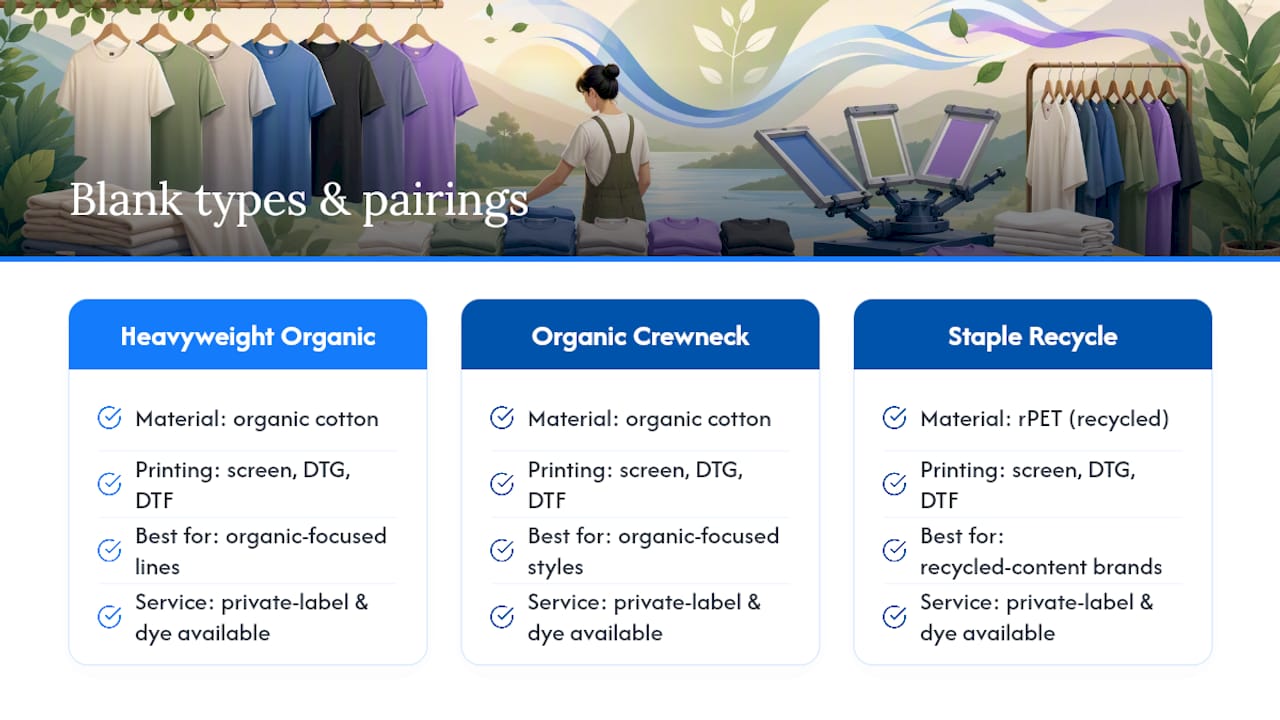
The Heavyweight Organic Cotton T-shirt and Organic Cotton Crewneck anchor the organic side of the catalog, while the Staple Recycle Tee covers rPET-based blanks for brands prioritizing recycled content. All three pair with screen printing, DTG, and DTF depending on the design.
Some service providers operate on a no-minimum model for blanks, letting brands test a design without committing to inventory they might not sell, and offer private-label and garment-dye finishing for brands wanting a cohesive line rather than a single tee.
Locally sourced materials and on-demand production aren’t a marketing footnote. They’re the operational choice that keeps a small brand from printing 500 shirts to guess at demand.
A Practitioner’s Take on Sustainability, Cost, and Quality
Most brands overthink fiber selection and underthink batch size. Start with a certified organic or recycled blank and water-based ink. Save reactive dyes or Tencel blends for a signature product where the premium price is justified by the story you’re telling.
Three moves before you place a real order: request fabric swatches, ask for SDS sheets and certificate numbers in writing, and run a small sample batch before committing to volume.
— Christian
How Tekton LA Can Help You Print Eco-Friendly Shirts
Some providers offer organic and recycled blanks, water-based and discharge printing, and private-label finishing under one roof, with no minimum order on blanks.
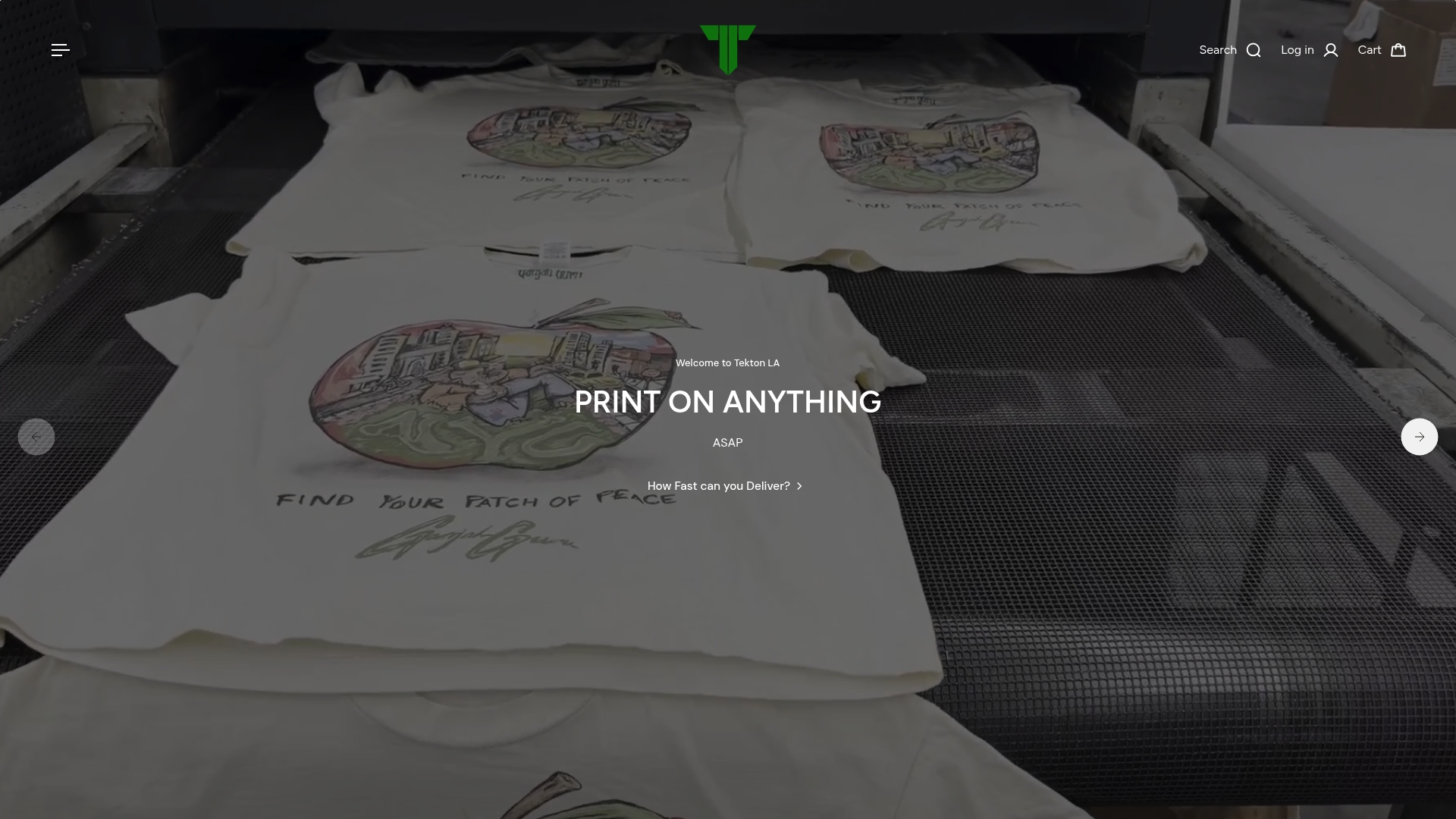
That means you can test a design on a handful of shirts before committing to a full run, order a Printers Shirt sample to check hand-feel and print quality firsthand, or explore garment-dyed options if you want a softer, lived-in finish on an organic base. Screen printing runs from one-color to two-color setups, and brands building a full line can add custom woven labels for a finished, private-label look.
Requesting a quote starts with sending your design and target quantity. From there, Tekton LA walks you through blank options, ink recommendations, and turnaround. Visit Tekton LA to start a quote or request samples for your next eco-conscious run.
Sources
For deeper reading beyond this guide: The Guardian’s investigation explains fashion’s oversupply crisis, Good On You breaks down polyester’s real trade-offs, and The Cork Store’s materials primer covers fabric selection across the wider ethical fashion category.
- It’s the industry’s dirty secret: why fashion’s oversupply problem is an environmental disaster — The Guardian
- How sustainable is polyester? — Good On You
- Eco Friendly Screen Printing Services: Best 30-Pc MOQ — LinushiManufacturer
- Printing on organic cotton fabric — CottonBee