


Private label packaging for apparel means the woven labels, printed neck tags, hangtags, and branded packaging that carry your brand name into a customer’s hands rather than a manufacturer’s. The immediate next step is simple: draft a one-page spec sheet with your exact measurements, materials, and colors, then order a physical sample before committing to a bulk run. A supplier like Tekton LA can walk you through both stages without forcing a high minimum order.
TL;DR:
- Most woven labels should measure between 1 and 2 inches by 3 inches, with a 2mm safe margin to prevent trimming issues during finishing.
- Digital proofs cannot accurately convey color matches or weave density; a physical sample is essential for reliable quality control before bulk orders.
- Label material choices like damask, satin, or taffeta impact brand perception, with damask ideal for premium brands and taffeta suited for budget options.
- Customization techniques such as foil stamping, embossing, and spot UV coating can elevate packaging appearance and tactile feel with minimal added costs.
- Working with suppliers like Tekton LA enables small brands to order low-volume or no-minimum labels and packaging, reducing upfront investment risks.
Table of Contents
- What Private Label Packaging Actually Covers
- Label and Tag Specs: Sizes, Margins, and File Formats
- Choosing Materials and Finishes That Match Your Brand
- What to Budget for Labels, Tags, and Packaging
- How to Order Private Label Packaging Without Costly Mistakes
- Sustainability and Compliance Basics for U.S. Apparel Labels
- Best Practices for Packaging That Actually Builds Your Brand
- Common Pitfalls That Derail a First Label Order
- Customization Options and Printing Techniques Worth Knowing
- A Publisher’s Take on Getting This Right the First Time
- How Tekton LA Helps You Get Labels and Packaging Right
- Sources
- FAQ
What Private Label Packaging Actually Covers
Private label packaging is not shipping cartons for a warehouse. For a clothing brand, it’s every physical touchpoint that carries your name from the sewing line to the customer’s closet. Getting the scope right up front keeps you from overspending on pieces your customer will never notice, or worse, forgetting the ones they will.
Here’s what typically falls under this umbrella:
- Main woven label: the label sewn into the neck or side seam carrying your logo, often the single highest-impact branding item on the garment.
- Care and content label: fiber content, washing instructions, and origin information, usually required by regulation rather than optional.
- Size label: separate from the care label in most production runs, though sometimes combined.
- Printed neck tag: a flat, printed alternative or supplement to a woven label, cheaper for smaller runs.
- Hangtag: the swing tag attached by a plastic tack or string, carrying story, sizing, and often a barcode.
- Polybag, tissue, and box: the unboxing layer, ranging from a simple poly sleeve to a branded box with tissue.
- Stickers and inserts: thank-you cards, discount codes, or care cards tucked into the packaging.
For a first production run, most small apparel brands can skip the box and tissue entirely. A main woven label, a hangtag, and simple branded polybagging cover the essentials without inflating your per-unit cost before you’ve proven the product sells.
Label and Tag Specs: Sizes, Margins, and File Formats
Getting specs wrong is the single most common reason a first label order gets rejected or reprinted. Woven main labels typically run between 1 inch by 1.5 inches and 2 inches by 3 inches, and factories generally hold to a minimum 2mm safe margin on every side so text and logo details don’t get trimmed off during finishing. If your brand mark has fine serifs or thin strokes, size up rather than shrink your logo to fit a smaller label.
File requirements matter just as much as dimensions. Submit vector files (.ai, .svg, or a print-ready .pdf) with all text outlined, never a raster JPEG or PNG. Specify Pantone colors where exact brand-color matching matters, and provide CMYK builds for anything printed rather than woven. Line weights thinner than about 0.25pt tend to disappear in the weaving or printing process, so keep fine details bold enough to survive production.
Before you send anything to a factory, build a spec sheet covering:
- Finished dimensions (width and height, to the millimeter)
- Material choice (satin, damask, taffeta, or printed stock)
- Thread colors by Pantone reference
- Fold style (straight, center-fold, loop-fold, or manhattan-fold)
- Edge finish (heat-cut versus merrowed edge)
- Attachment method (sew-in, tack pin, or adhesive)
- Order quantity
- Intended placement on the garment
Pro Tip: Always confirm fold style in writing before production starts. A center-fold label sewn where you expected a straight-cut label is one of the most common and most avoidable reprint causes in the industry.
Choosing Materials and Finishes That Match Your Brand
Material choice signals brand positioning almost as loudly as your logo does. A streetwear label and a resort-wear label should not feel the same in the hand, and the weave or stock you pick is what creates that difference.
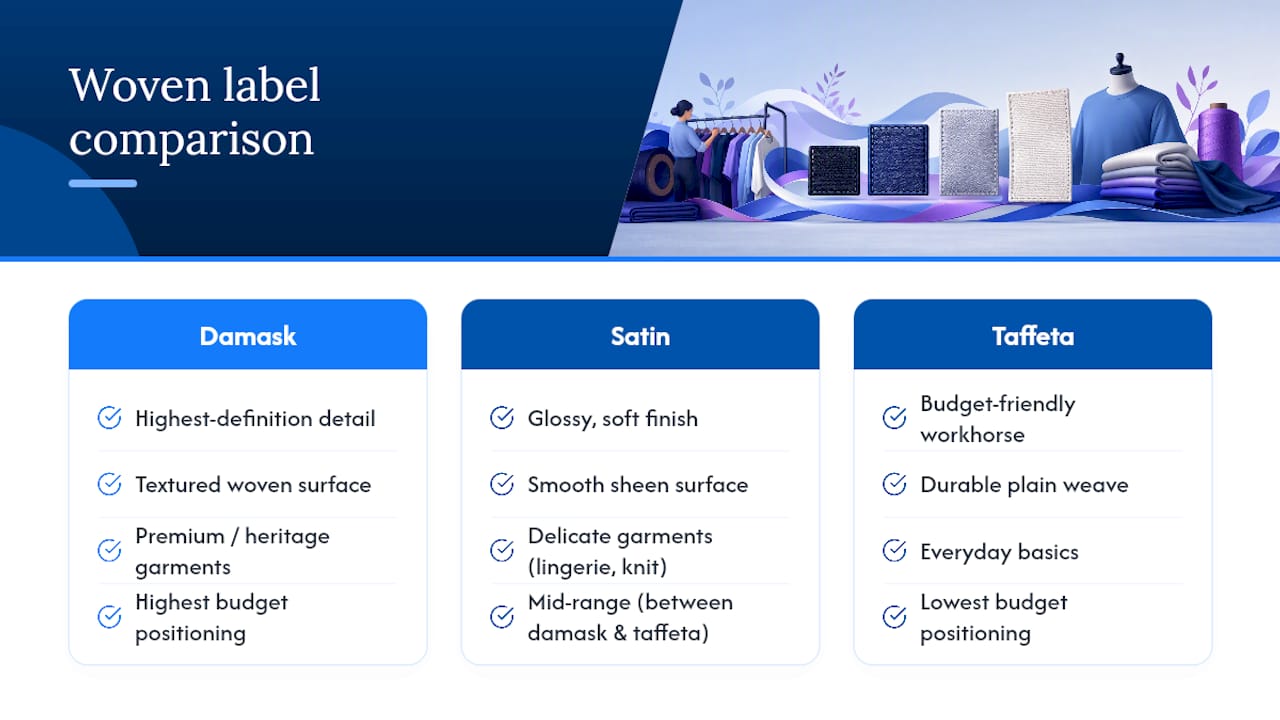
For woven labels, you’re generally choosing between three options. Damask offers the highest-definition detail and handles intricate logos well, making it the common pick for premium or heritage-styled brands. Satin gives a glossy, soft finish suited to delicate garments like lingerie or lightweight knitwear. Taffeta is the budget-friendly workhorse, durable enough for everyday basics without the cost premium of damask.
Hangtags bring their own set of decisions. Stock commonly runs from kraft (rustic, sustainability-forward) to matte or gloss cardstock, with most brands specifying 14pt to 18pt weight for a substantial feel that doesn’t bend in a customer’s hand. Add embossing or spot UV for a tactile upgrade, or an eyelet-and-cord attachment for a more finished look than a plastic tack.
Packaging follows the same logic: start with a polybag, add tissue as your margins allow, and reserve a custom box for a flagship product or a limited drop. Recycled yarns for labels and FSC-certified paper for hangtags cost slightly more per unit but increasingly matter to customers checking a brand’s sustainability claims.
What to Budget for Labels, Tags, and Packaging
Private-label unit costs vary widely by garment type, but the ranges are predictable enough to plan around. Basic private-label apparel in the USA, think tees, hoodies, and joggers, typically runs $12 to $45 per unit in production cost alone. On top of that, branding elements including woven labels, hangtags, and packaging typically add another $0.50 to $3.00 per unit, depending on material and finish choices.
Cost driver check: A basic printed neck tag on cardstock sits at the low end of that range. A woven damask label with a custom foil hangtag and branded polybag pushes you toward the top.
Minimum order quantities shape your per-unit math more than almost anything else. Many label suppliers offer workable pricing at a few hundred units, but per-unit cost drops meaningfully once you clear larger production thresholds, since setup costs (loom programming for woven labels, plate costs for foil stamping) get spread across more pieces. If you’re testing a small collection before committing capital, look for suppliers willing to work at lower volumes rather than forcing a factory-standard MOQ on a first run.
Lead times follow a similar pattern: expect roughly two to four weeks for woven labels once artwork is approved, often faster for printed tags, and packaging timelines that depend heavily on whether you’re ordering stock polybags or custom-printed boxes.
How to Order Private Label Packaging Without Costly Mistakes
Ordering private label packaging is a five-step process, and skipping a step is where most first-time brands lose money on reprints.
- Draft your spec sheet. Cover every field from the checklist above before you contact a supplier.
- Submit vector artwork with the spec sheet attached. Sending art without specs, or specs without art, guarantees a round of clarifying emails you could have avoided.
- Request a physical pre-production sample. This step is not optional for woven labels specifically.
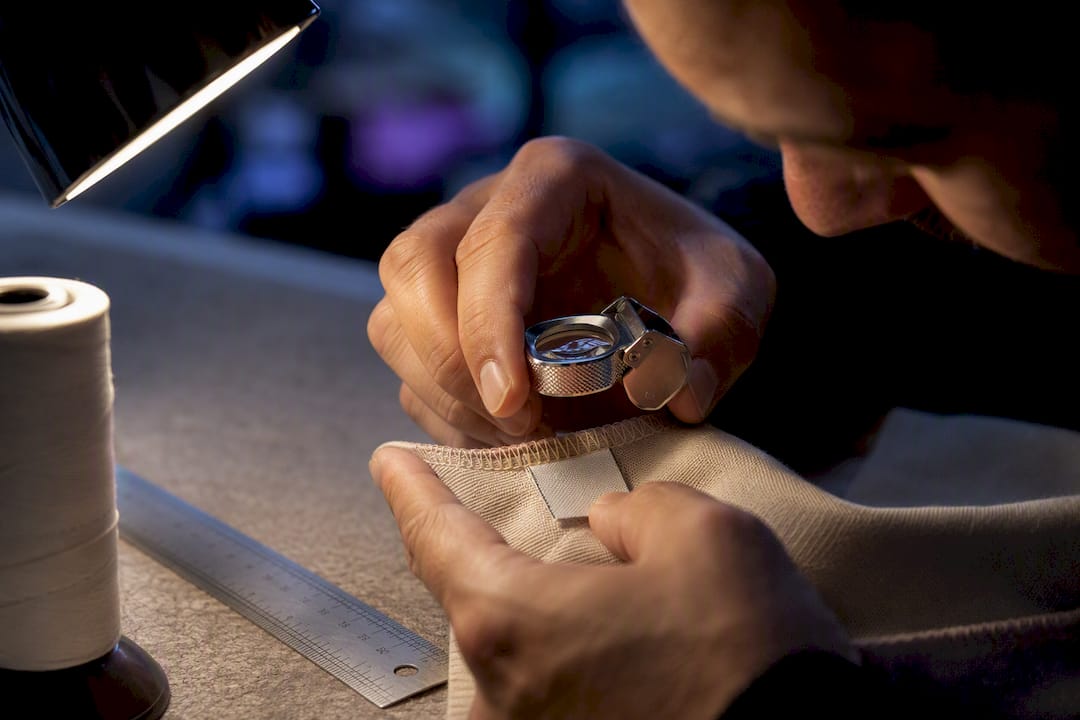
- Inspect the sample against your spec sheet. Check color match under natural light, weave detail sharpness, edge finish quality, and how the label behaves when sewn into a seam.
- Approve in writing, then move to bulk production or a pilot run.
Step three deserves emphasis. Color shifts and weave density can only be judged accurately on a physical sample, because a digital proof shows you a flat color simulation, not how thread catches light or how dense a weave feels against fabric. A Pantone reference that looks perfect on-screen can read noticeably different once it’s actually woven.
Your inspection checklist should confirm color match, weave or print detail, edge finish (no fraying on a heat-cut edge), and sew-in behavior, whether the label lies flat or puckers once stitched into a seam.
Pro Tip: Document your approval with a timestamped photo and a signed or emailed confirmation. If a bulk order comes back different from the sample, that paper trail is what gets you a reprint instead of an argument.
Sustainability and Compliance Basics for U.S. Apparel Labels
U.S. apparel labeling isn’t optional decoration, it’s regulated. Under FTC guidance, care and content labels must disclose fiber content, country of origin, and manufacturer or dealer identity. Requirements shift depending on product category, so confirm the specifics for your exact garment type before finalizing label art rather than assuming a template from another brand’s product line applies to yours.
If you plan to market a garment as Made in USA, that claim carries its own substantiation standard separate from the basic content label, and getting it wrong opens you to real regulatory risk. Tekton LA’s Made in USA labeling guidance walks through what that claim actually requires before you print it.
On the sustainability side, recycled yarns for woven labels and FSC-certified paper for hangtags are increasingly available at a modest cost premium. Neither choice is free, but both give you a genuine claim to make to customers rather than a vague “eco-friendly” label with nothing behind it.
Best Practices for Packaging That Actually Builds Your Brand
Good private label packaging does one job: it makes a customer remember your brand after the transaction is over. That starts with consistency, your woven label, hangtag, and packaging should share a visual language (same logo treatment, same color palette, same typographic voice) rather than looking like three different vendors touched three different parts of the order.
Hierarchy matters more than most brands realize. Your main woven label carries the weight of permanent brand identity, since it stays on the garment for its entire life. Your hangtag and packaging are temporary, seen once and then discarded or recycled, so that’s where you can afford to experiment with a seasonal message, a limited color, or a QR code linking to a styling video without touching your permanent label design.
Function should never lose to form. A hangtag string that snags on other garments in a warehouse bin, or a woven label with thread so stiff it irritates skin at the neckline, undoes whatever good design work went into the visual. Test the physical feel of a sample before greenlighting a full run, not just the visual proof.
Finally, treat packaging as a chance to communicate something a retail shopper can’t get from a photo online, fiber origin, a founder note, a sizing tip specific to your cut. A hangtag with a QR code linking to a styling guide or brand story does real work that a plain price tag never will.
Common Pitfalls That Derail a First Label Order
Most private label packaging mistakes trace back to skipped steps, not bad taste. The most frequent one is approving artwork from a digital mockup alone and skipping the physical sample, which is exactly the gap that leads to a woven label arriving in a color visibly off from what you approved on-screen.
A close second: vague spec sheets. “Make it look nice” is not a specification. Missing a fold style, an attachment method, or a thread color reference forces the factory to guess, and their guess rarely matches what you pictured.
Ordering too much too soon is another common trap. Committing to a large MOQ on packaging before your product line is finalized means reprinting boxes or hangtags the moment you tweak a logo or add a new size range. Start with a smaller, flexible order until your branding is locked.
Ignoring compliance until the last minute causes real delays. Discovering that your care label is missing required fiber content disclosure after a production run is finished means reprinting labels and, in some cases, re-tagging finished garments by hand.
Last, brands frequently underestimate how attachment method affects perceived quality. A hangtag on a flimsy plastic tack reads cheap even when the printing itself is excellent. Small hardware choices, cord versus tack, eyelet versus punch hole, shape how premium a product feels before a customer even reads the tag.
Customization Options and Printing Techniques Worth Knowing
Beyond basic weaving and printing, several finishing techniques let you push branded packaging further without redesigning the product itself. Embossing presses your logo into cardstock or leather patches for a tactile, dimensional effect that reads premium on hangtags and woven leather patches alike. Debossing does the reverse, pressing the design inward for a subtler, more understated look.
Foil stamping applies a metallic or matte foil layer to cardstock, commonly gold, silver, or rose gold, and works especially well combined with embossing for a two-layer effect on a hangtag. Spot UV coating adds a glossy layer over specific design elements against a matte background, drawing the eye to a logo without changing the tag’s overall material cost by much.
For woven labels specifically, thread count and weave density determine how sharp fine details render, denser weaves reproduce small text and thin lines more accurately than basic weaves, which matters if your logo includes a tagline or fine linework. Printed neck tags offer more color flexibility at a lower cost than weaving, useful for brands running frequent seasonal color changes.
Screen printing, embroidery, and heat transfer round out the toolkit for garments themselves rather than just labels, and pairing your chosen decoration method with a matching label finish keeps the whole package feeling like one coherent product rather than mismatched parts.
A Publisher’s Take on Getting This Right the First Time
The brands that get private label packaging right treat the label and hangtag as part of the product, not an afterthought bolted on after production. At Tekton LA, working with no-minimum blanks and locally sourced materials has shown us that a fast, correct first sample saves more money than any bulk discount. Get the spec sheet right, and everything downstream gets easier.
— Christian
How Tekton LA Helps You Get Labels and Packaging Right
Tekton LA produces custom woven labels, printed neck tags, hangtags, and branded packaging for apparel brands, alongside the direct-to-garment, DTF, screen printing, and embroidery services that turn your blanks into finished product. If you’re planning your first private label run, come prepared with vector logo files, your target quantities, and a rough spec sheet, even an incomplete one gives a faster starting point than a verbal description.
Our team works from your spec sheet through sample approval before any bulk production starts, and because we don’t enforce high minimums on blanks, you can test a small packaging concept before scaling it. Browse our custom woven label options to see available sizes and materials, or start with our guide to woven label sizing for small brands if you’re still finalizing dimensions. When you’re ready to talk specifics, visit Tekton LA to start your order.
Sources
- How To Design Clothing Labels For Your Brand And Factory – Manludini
- What is private label clothing? – MakersRow
- Custom woven labels for clothing: design, types and ordering guide – Packlove
FAQ
What Is Private Label Packaging for Apparel?
It’s the woven labels, printed neck tags, hangtags, and branded packaging that carry a clothing brand’s identity, distinct from generic retail product packaging used in other industries.
How Big Should a Woven Label Be?
Most woven main labels range from 1 inch by 1.5 inches to 2 inches by 3 inches, with a 2mm safe margin held on all sides.
How Much Does Private Label Packaging Add to Unit Cost?
Branding elements like labels, hangtags, and packaging typically add $0.50 to $3.00 per unit on top of base production costs of $12 to $45 for basics.
Why Do I Need a Physical Sample Instead of a Digital Proof?
Digital proofs can’t show accurate color or weave density, both of which shift once thread is actually woven, so a physical sample is the only reliable check before bulk production.
Does Tekton LA Offer Low Minimum Order Options for Labels?
Yes, Tekton LA supports no-minimum blanks and works with small apparel brands on woven labels, hangtags, and packaging without forcing high-volume commitments upfront.