


Sublimation wins for photo-quality, all-over designs on polyester or polymer-coated items, especially in small to mid runs. Screen printing wins for bold spot-color logos on cotton or blend fabrics, large runs, and jobs that need specialty ink effects. Your fabric, artwork complexity, order size, and finish all point you toward one or the other before you even get a quote.
TL;DR:
- Sublimation is ideal for full-bleed photo-quality designs on polyester or poly-coated items, especially for small to medium runs, but it cannot work on cotton or dark fabrics.
- Screen printing excels with bold, flat spot colors on cotton and blends, becomes more cost-effective at higher volume orders, and allows for specialty inks like metallic or puff effects.
- The quality of sublimation depends on temperature, dwell time, and substrate compatibility, requiring testing on actual blanks before a full order; screen printing quality hinges on proper curing and registration.
- Small runs under a few dozen units often favor sublimation due to low setup costs, while larger orders typically benefit from screen printing’s economies of scale.
- Properly requesting samples, running wash tests, and understanding your fabric and artwork complexity are crucial for choosing the right method and avoiding costly mistakes.
Table of Contents
- What Is Sublimation Printing and Which Projects It Fits
- How Sublimation Printing Works: Process, Equipment, and Key Variables
- What Is Screen Printing and Which Projects It Fits
- How Screen Printing Works: Equipment, Inks, Curing, and Quality Factors
- Sublimation vs Screen Printing: Side-by-Side Differences That Matter
- How to Choose the Right Printing Method for Your Order
- Shop-Tested Notes From Tekton LA on Choosing the Right Method
- The Real Gap Between Marketing Claims and Shop Reality
- Get a Quote or Sample From the Provider
- Sources
- FAQ
What Is Sublimation Printing and Which Projects It Fits
Dye sublimation turns ink into a gas that bonds directly into polyester fibers under heat, rather than sitting on top of the fabric like a coating. That’s the core mechanical difference from almost every other printing method, and it’s why the results feel and behave the way they do.
Sportswear brands, teams needing all-over jersey patterns, mugs, phone cases, and photo-quality tote bags are the classic sublimation jobs. Anywhere a design needs a full-bleed photo, gradient, or complex color blend, sublimation is usually the right call. The dye becomes part of the fabric itself, so sublimation prints resist cracking or peeling in a way surface-level inks can’t match, and there’s zero raised texture or “hand feel” on the finished piece.
That durability comes with real fabric restrictions:
- Sublimation needs polyester or a polymer coating to bond properly. Cotton simply won’t hold the dye.
- Dark garments are a dead end. There’s no white ink layer, so the base fabric color always shows through.
- Poly/cotton blends under roughly 65% polyester tend to produce washed-out, faded results.
- Cheap or uncoated blanks can cause dye migration, where color bleeds or shifts after heat pressing, especially with synthetic dyes already present in the fabric.
If your product lives in the polyester world, sublimation is often the best-looking option available.
How Sublimation Printing Works: Process, Equipment, and Key Variables
The workflow itself is fairly linear once you understand the four checkpoints that make or break quality.
- Design and print. Artwork is mirrored and printed onto special transfer paper using sublimation ink.
- Align. The printed paper is positioned precisely on the polyester blank, since any shift here shows up permanently in the final piece.
- Heat press. A heat press applies controlled temperature and pressure, turning the ink into gas that penetrates the fibers.
- Peel and inspect. The paper is removed once cooled, revealing the finished print embedded into the fabric.
Getting there requires a sublimation printer (often a converted inkjet), sublimation ink, transfer paper, a heat press, and polyester or poly-coated blanks. Entry-level setups run a few hundred dollars for a basic printer and small press; production-grade equipment climbs into the low thousands. Per-print consumable costs are modest, usually a dollar or two in paper and ink per garment at small scale.
Temperature, dwell time, and pressure are the variables that actually decide quality. Controlled testing on transfer papers found that higher temperature and longer dwell time increase color transfer and improve colorfastness, which means a rushed press cycle is often the real reason a print looks faded, not the ink or the blank. Ink brands like InkTec’s SubliNova line advertise fast-drying formulas with RoHS-compliant, VOC-free profiles, which matters if you’re marketing an eco-conscious product line.
Pro Tip: Run a test press on a scrap swatch of your actual blank before committing to a full order. Paper, ink, and polyester content interact differently across suppliers, and a five-minute test saves an entire batch.

What Is Screen Printing and Which Projects It Fits
Screen printing pushes ink through a stencil mesh onto the garment surface, using one screen per color in the design. It’s the oldest reliable method in the custom apparel world, and for good reason: it’s built for volume and boldness.
Cotton t-shirts, hoodies, and large corporate or event runs are where screen printing dominates. A stencil-based approach like this delivers opaque, vibrant spot colors that show up crisp even on black or navy fabric, something sublimation simply cannot do without a white base. It also opens the door to specialty inks like metallic, puff, and discharge finishes that add texture and dimension.
The trade-off shows up early in the process:
- Every color requires its own screen, which means setup labor and cost scale directly with the color count in the design.
- Small orders absorb that setup cost per unit, making screen printing expensive for a single shirt or a handful of samples.
- Extremely fine gradients or photorealistic detail are difficult to reproduce cleanly, since each screen prints a flat, solid color.
- Registration errors, where colors misalign slightly between screens, become more likely as designs get more complex.
Screen printing rewards scale. The more units you print, the more that setup investment pays off.
How Screen Printing Works: Equipment, Inks, Curing, and Quality Factors
The process starts well before ink ever touches fabric, with a step most buyers never see: color separation.
- Artwork separation. The design is split into individual color layers, each becoming its own screen.
- Screen preparation. Screens are coated with light-sensitive emulsion and exposed to burn the stencil pattern.
- Registration. Screens are aligned on the press so every color layer lands in the exact right spot.
- Printing. Ink is pushed through each screen onto the garment, one color layer at a time.
- Curing. The garment passes through a heat tunnel or conveyor dryer to cure the ink permanently into place.
Plastisol ink is the workhorse for most shops because it’s forgiving and durable. Water-based ink soaks into the fabric for a softer feel, discharge ink removes the garment’s original dye for a vintage look, and specialty additives create puff, metallic, or glow effects. Mesh count and ink formulation significantly affect the final look and durability, and under curing is the single most common cause of prints that crack or fade after a few washes.
Pro Tip: Ask your shop what curing temperature and dwell time they run for plastisol. If they can’t answer specifically, that’s a red flag for durability.
Typical shop lead times run anywhere from a few days for simple one-color jobs to two weeks for multi-color designs requiring new screens.
Sublimation vs Screen Printing: Side-by-Side Differences That Matter
Here’s where the two methods actually diverge once you get past the marketing language.

Print quality and durability. Sublimation embeds dye into the fiber itself, so there’s nothing to crack or peel. Screen printing ink sits on top of the fabric, and while both methods showed strong wash and abrasion resistance compared to some digital printing alternatives, plastisol can crack over years of heavy washing if curing was rushed.
Design complexity and color. Photo-realistic images, gradients, and unlimited color blends are sublimation’s home turf, since it embeds color with no per-hue cost penalty. Screen printing handles bold, flat spot colors beautifully, but every additional color adds a screen and a cost.
Fabric and substrate compatibility. Sublimation needs polyester or a poly coating, full stop. Screen printing works across cotton, blends, canvas, and most woven substrates, which is why it stays the default for general apparel.
Cost and order size. This is where the crossover math actually lives. Screen printing’s setup costs get absorbed as order size grows, and most shops see the economics tip in screen printing’s favor once orders climb into the hundreds, depending on how many colors are in the design. Below that, sublimation’s low per-unit setup often makes it the cheaper path for small runs.
Sublimation and screen printing both outperform many digital printing alternatives on wash and abrasion resistance, according to comparative testing on textile printing methods.
Special effects and finishes. Puff, metallic, glitter, and discharge effects belong to screen printing’s ink chemistry. Sublimation can’t replicate raised texture, but it can print full-bleed, edge-to-edge graphics that screen printing struggles to match without extra setup.
Turnaround and scale. Sublimation is digital and on-demand, so a single unique shirt prints just as easily as fifty. Screen printing needs screens burned before the first unit ever prints, but once that’s done, an automated press can crank out hundreds of units per hour.
Care, washability, and environmental impact. Sublimation prints generally hold up as long as the polyester garment itself lasts, since there’s no separate ink layer to degrade. Screen prints last well with proper curing, though heavy dryer heat accelerates wear on plastisol over time. On the environmental side, water-based screen inks tend to have a lighter footprint than plastisol, and some sublimation ink lines market themselves as free of VOCs and formaldehyde, which is worth asking about if sustainability matters to your brand.
How to Choose the Right Printing Method for Your Order
Run through this before you ever request a quote:
- Check your fabric. Polyester or poly-coated? Sublimation is on the table. Cotton or a blend under 65% polyester? Screen printing is the safer bet.
- Look at your artwork. Gradients, photo elements, or dozens of colors point to sublimation. Two or three flat spot colors point to screen printing.
- Count your units. Orders below small double digits tend to favor sublimation or digital methods because there’s no setup cost to amortize. Orders in the range from a few dozen to a few hundred are a toss-up depending on color count. Larger orders often favor screen printing.
- Decide on finish. Want a soft, printless hand feel and all-over color? Sublimation. Want raised puff ink or a metallic accent? Screen printing.
- Ask for a sample first. Running a wash test and color proof before committing to a full run catches dye migration or color drift while it’s still cheap to fix.
When you’re vetting a print shop, ask directly: What’s their minimum order? Do they offer sample runs before full production? How do they proof colors, physically or digitally? What’s their real lead time, not the marketing estimate? And what wash and care instructions come with the finished product?
Pro Tip: If a shop hesitates to answer questions about minimums or sample policy, that’s usually a sign their process isn’t as flexible as their website claims.
Watch for these pitfalls specifically: a shop pushing sublimation onto a cotton blend, insufficient curing that leads to cracked plastisol within a few washes, and skipping a color proof step entirely on a large order.
Shop-Tested Notes From Tekton LA on Choosing the Right Method
Tekton LA runs both DTF and screen printing production out of Los Angeles, along with embroidery and private label services, and the choice between methods usually comes down to the same handful of questions every time.
- Some providers offer no minimum order quantities on blanks, allowing small brands to test designs on small runs before committing to larger orders.
- A basic protocol works for almost any order: run one wash test, check for color migration around seams, and request a proof photo shot in daylight, not under shop lighting.
- Sublimation gets the recommendation for full-color, all-over graphics on polyester athletic wear or drinkware.
- Screen printing gets the recommendation for cotton tees with one to three color logos, especially for team or event orders over 100 units.
- Garment care instructions differ enough between the two methods that private label clients often request both printed on the same care tag for clarity.
The Real Gap Between Marketing Claims and Shop Reality
Most comparison guides treat sublimation and screen printing like a features chart: check the boxes, pick a winner. That’s backwards. The honest starting point is your fabric, not your design file. A gorgeous gradient logo means nothing if it’s headed for a cotton hoodie, because sublimation physically cannot bond dye to cotton fibers, full stop.
Where conventional advice really falls short is the order-size conversation. Guides love to cite one clean crossover number, but the real threshold shifts with color count. A three-color design might tip toward screen printing at 80 units. A single-color design might not tip until 150. Anyone giving you one fixed number without asking about your artwork is guessing.
What actually deserves priority: the sample test. Not the ink chemistry, not the printer model, the sample. A wash test and a daylight color proof catch dye migration and color drift before they become 200 ruined shirts. Shops that skip this step, or clients who refuse to pay for it, are the ones who end up with a return shipment and a bad review.
— Christian
Get a Quote or Sample From the Provider
Choosing between sublimation and screen printing shouldn’t require guesswork, and you don’t have to make that call alone. A provider offering both methods in house, embroidery, private label, and no-minimum blanks enables testing a design in small batches before scaling to full production.
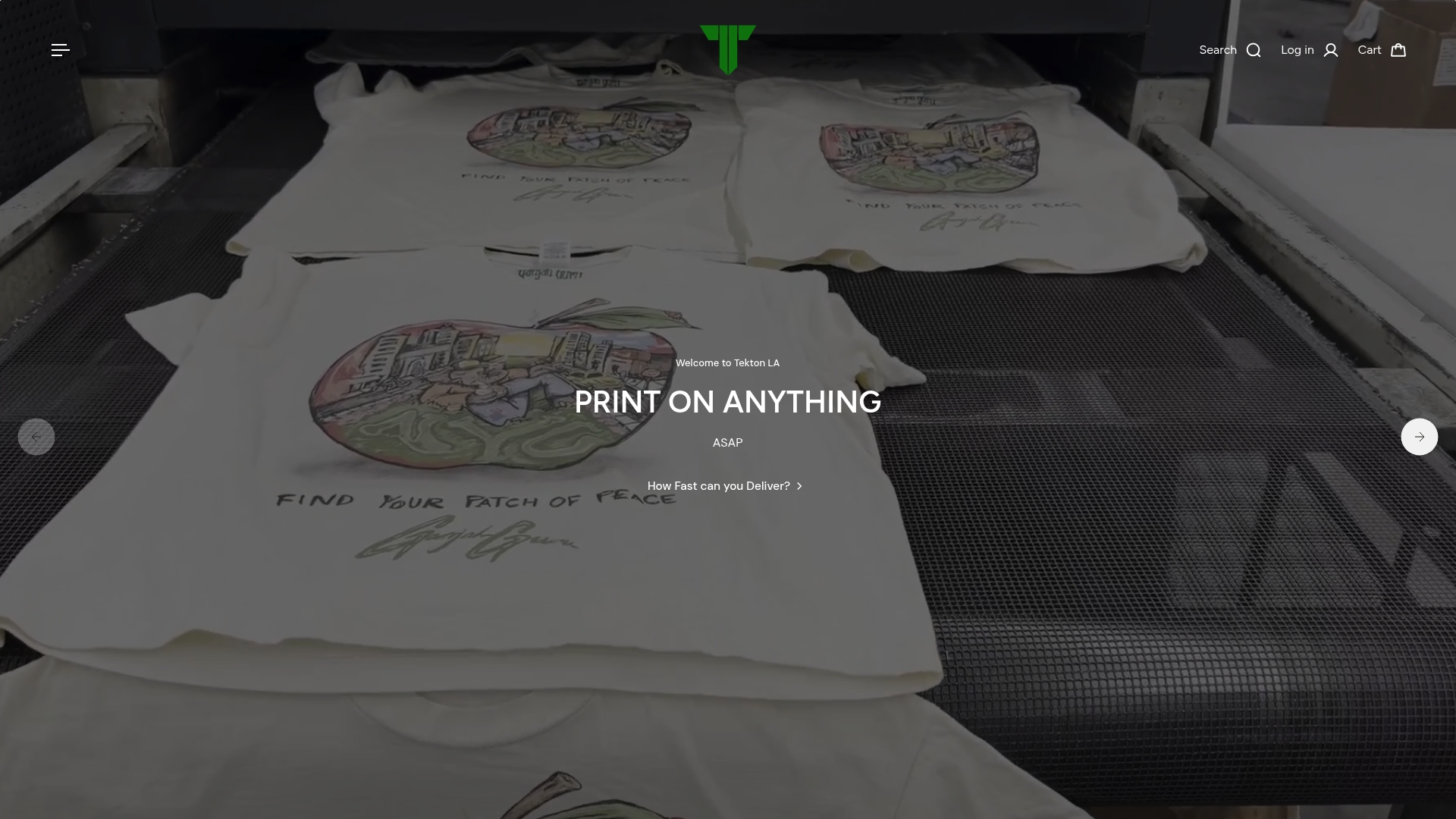
Requesting a quote is straightforward: send over your garment type, artwork file, target quantity, and deadline, and you’ll get a realistic recommendation on which method actually fits your project instead of the one that’s easiest to upsell. If you’re weighing a small batch of custom tees, the 1 color screen print option is a solid starting point for single-logo designs, while multi-color logos fit the 2 color screen print line. Ready to move forward? Head to Tektonla and submit your project details to get a sample started this week.
Sources
- Sublimation printing guide (Shopify)
- Analysis of methods of printing images on textile materials and evaluation of their quality (Academic paper)
- Exploration on ability of printable modified papers for the application in heat sublimation transfer printing of polyester fabric (PMC)
- SubliNova Smart technical data (InkTec PDF)
FAQ
Can Sublimation Work on Cotton Shirts?
No. Sublimation dye needs polyester or a polymer coating to bond, and it produces little to no visible print on cotton fibers. For cotton shirts, screen printing is the reliable choice.
What’s the Order Size Where Screen Printing Gets Cheaper Than Sublimation?
There’s no single fixed number, but shops typically see screen printing’s setup cost pay off once orders climb into the hundreds, with fewer colors tipping the crossover point lower and more colors pushing it higher.
Does Sublimation Fade Faster Than Screen Printing?
Not typically. Both methods show strong resistance to washing and abrasion in textile testing, and sublimation’s embedded dye resists cracking or peeling since there’s no ink layer sitting on the fabric surface.
Does Tekton LA Offer Both Sublimation and Screen Printing?
Yes. Tekton LA produces DTF, screen printing, DTG, embroidery, and private label work out of its Los Angeles shop, with no minimum order quantities on blanks. Current pricing for each service is available directly on Tektonla.
Should I Request a Sample Before a Large Print Order?
Yes, always. A wash test and a color proof shot in daylight catch dye migration and color shifts while it’s still a small, inexpensive fix rather than a ruined production run.