


Most coaches assume all hoodie printing methods are roughly equal until game day reveals otherwise. Cracked numbers after three washes, faded logos that looked sharp in the mockup, colors that bleed into each other on dark fabric. The reason why screen printing is used for team hoodies comes down to three things that actually matter on the field: durability, color impact, and cost per unit at scale. This guide breaks down the technical and financial logic behind that choice, compares it honestly against newer methods, and gives you a framework for making the right call for your team.
Table of Contents
- Understanding screen printing and its benefits for team hoodies
- Why screen printing is cost-effective for sports teams’ bulk hoodie orders
- How design complexity impacts screen printing for team hoodies
- Screen printing versus alternative printing methods for sports team hoodies
- Choosing the best hoodie fabric and style for screen printing
- Our take: the method that fits your team, not the trend
- Get your team hoodies printed right with Tekton LA
- Frequently asked questions
Key Takeaways
| Point | Details |
|---|---|
| Durability and vibrancy | Screen printing delivers durable, vibrant prints that resist fading and cracking on team hoodies. |
| Bulk cost efficiency | Setup costs make screen printing affordable for large quantity orders, lowering per-item price. |
| Design complexity impact | More colors increase screen printing cost and production time; simpler designs optimize savings. |
| Fabric and style matter | Midweight cotton-poly blend pullovers provide the best surface and durability for screen printing. |
| Printing method choice | Screen printing suits bulk simple designs, while DTF/DTG serve small or complex order needs better. |
Understanding screen printing and its benefits for team hoodies
Screen printing is a process where ink is pushed through a mesh screen directly onto fabric, one color at a time. Each pass deposits a thick, consistent layer of ink that physically bonds with the fibers rather than sitting on top like a sticker. That bond is what makes screen-printed prints durable and wash-resistant, resisting cracking and fading even after repeated game-day and practice use.
Most team hoodies use plastisol ink, which is the industry standard for screen printing. Plastisol is opaque, meaning it covers dark fabric completely without the color washing out or looking muddy. If your team wears navy or charcoal hoodies and you want a bright gold or white logo, plastisol delivers that pop. Water-based inks are softer to the touch but less opaque, making them better suited to lighter garments.
Here is what makes screen printing technically strong for team apparel:
- Thick ink layers bond with fabric fibers for long-lasting adhesion
- Plastisol opacity ensures colors stay vivid on dark hoodie materials
- Consistent placement across large batches because each screen is fixed
- Batch efficiency means every hoodie in a 50-piece order looks identical
- Cured prints withstand high-heat drying, which is standard in team laundry
“Screen-printed hoodies are built for repeated use. When prints are properly cured, the ink forms a bond with the fabric that resists both cracking and fading through wash after wash.”
For teams ordering a heavyweight hooded sweatshirt in bulk, that consistency matters. You cannot have player 12’s logo looking sharper than player 7’s at a tournament.
Now that we understand screen printing’s technical strengths, let’s explore the cost and design factors that influence its popularity for team hoodies.
Why screen printing is cost-effective for sports teams’ bulk hoodie orders
Here is the financial reality most print shops do not explain upfront. Screen printing has fixed setup costs. Creating each physical screen takes time and materials, and you pay for that regardless of order size. But once those screens are made and the press is running, the cost per hoodie drops sharply as quantity increases.
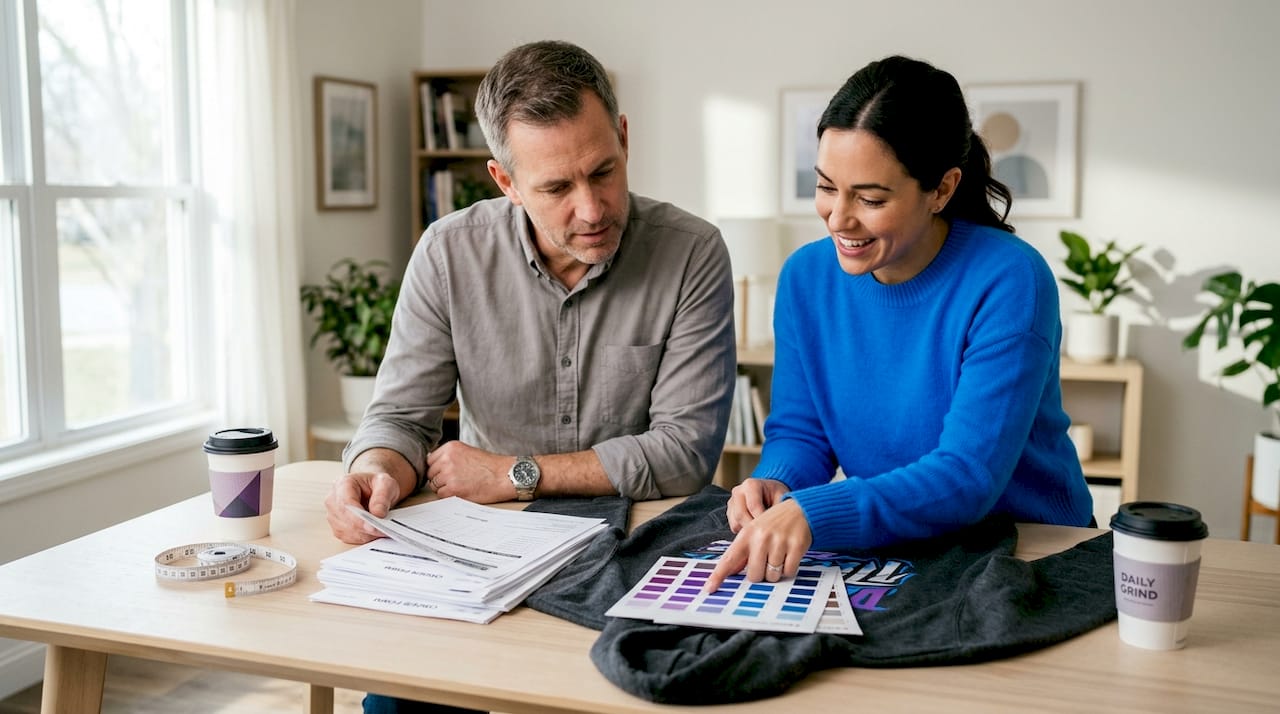
For a 12-piece order, the setup cost per unit feels painful. For a 48-piece order, that same setup cost becomes almost invisible. This is why screen printing is optimized for bulk runs and why it remains the standard choice for sports teams ordering full rosters at once.
Here is how the cost structure typically breaks down:
- Screen creation costs are fixed per color, usually $20 to $50 per screen depending on the shop
- Press setup time is charged once per run, not per garment
- Ink and labor per unit decreases as quantity increases
- Artwork preparation is a one-time cost you can reuse for future seasons
- Quantity thresholds often exist at 24, 48, and 72 pieces where pricing drops noticeably
A two-color design on 48 hoodies will almost always beat any other method on price per unit. That math is why coaches and team managers keep coming back to screen printing season after season.
Pro Tip: Ask your printer for a tiered quote at 24, 36, and 48 pieces. The jump from 24 to 36 units often cuts your per-unit cost by 15 to 20 percent, which can offset the cost of upgrading to a heavier blank.
Choosing the right blank matters here too. A pullover hoodie gives you a large, flat chest area that prints cleanly in one pass, while a vintage hoodie offers a more relaxed fit that works well for lifestyle-oriented team gear off the field.
With cost structure clear, let’s consider design complexity and how it impacts printing choices for your team hoodies.
How design complexity impacts screen printing for team hoodies
Screen printing is not the right answer for every design. The method’s core limitation is that every color requires its own physical screen. A three-color logo means three screens, three setups, and three passes on the press. A seven-color sponsorship crest means seven of everything.
Multi-color designs raise both cost and lead time because each screen needs to align precisely with the others, a process called registration. Misregistration by even a millimeter creates blurry edges. That is why teams with complex sponsor logos often simplify their color palette or split print locations across the garment.
Practical strategies for managing design complexity:
- Limit colors to two or three for the primary chest or back graphic
- Use a separate print location (sleeve or hem) for smaller, simpler sponsor marks
- Convert gradients to halftone patterns which simulate color blending with fewer screens
- Separate detailed elements into a different printing method for that location only
| Design type | Screen printing suitability | Recommended approach |
|---|---|---|
| Bold team name, 1 to 2 colors | Excellent | Standard screen print |
| Logo with 3 to 4 solid colors | Good | Simplify palette if possible |
| Photographic or gradient design | Poor | Consider DTF or DTG instead |
| Sponsor crest, 5 or more colors | Challenging | Split locations or reduce colors |
| Large back graphic, simple | Excellent | Standard screen print |
Pro Tip: If you have a sponsor logo with gradients or more than four colors, consider screen printing the main team name on the chest and using DTF for the sponsor mark on the sleeve. You get the best of both methods without sacrificing quality anywhere.
A varsity hoodie or a reverse weave hooded sweatshirt both offer structured surfaces that handle multi-location printing well, giving you flexibility to split your design across the garment without losing visual cohesion.
Having assessed design constraints, let’s compare screen printing with other popular printing methods for sports team hoodies.
Screen printing versus alternative printing methods for sports team hoodies
The honest answer is that no single method wins across every scenario. Screen printing dominates bulk orders with bold graphics. But DTF printing has no setup fees, handles complex full-color designs easily, and works on polyester blends and synthetic fabrics that screen printing struggles with.
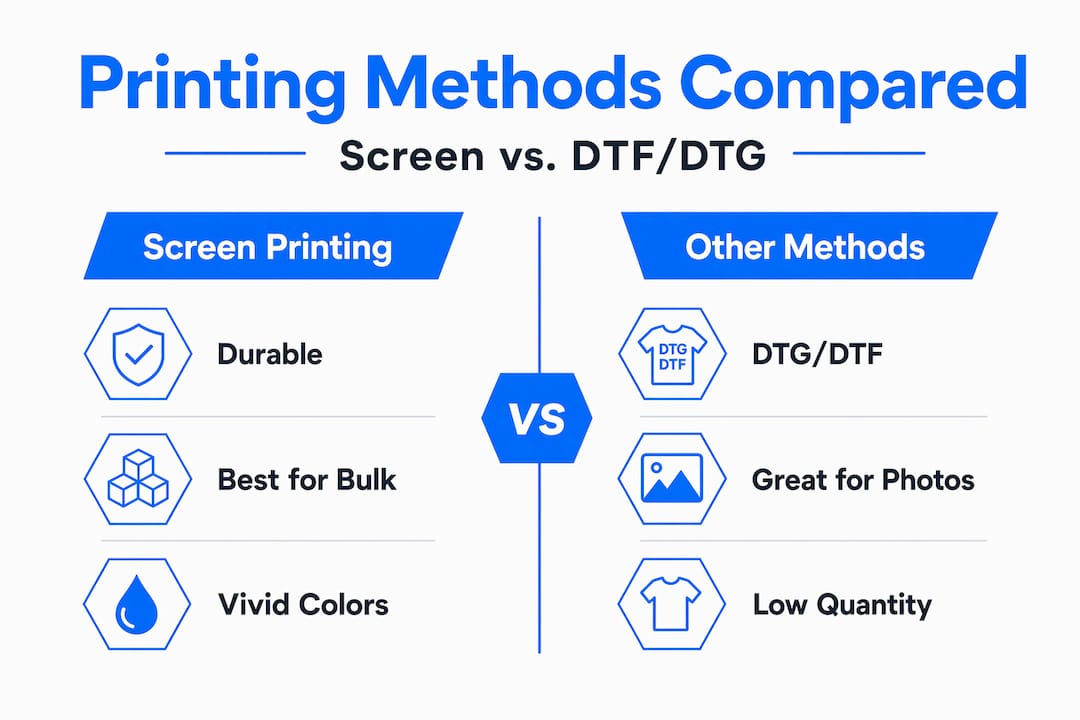
Here is a direct comparison:
| Factor | Screen printing | DTF printing | DTG printing |
|---|---|---|---|
| Minimum order | Usually 12 to 24 pieces | No minimum | No minimum |
| Cost at 48 units | Lowest per unit | Moderate | Higher per unit |
| Color complexity | Limited by screen count | Unlimited colors | Unlimited colors |
| Fabric compatibility | Best on cotton and blends | Works on most fabrics | Cotton preferred |
| Print durability | Excellent when cured | Very good | Good |
| Vibrancy on dark fabric | Excellent (plastisol) | Good | Can be inconsistent |
| Turnaround speed | Moderate | Fast | Moderate |
- Screen printing is the clear winner when you are ordering 36 or more hoodies with a clean, bold design in two to four colors
- DTF makes more sense for small squads, complex artwork, or performance fabrics with polyester content above 50 percent
- DTG works well for individual player gifts or one-off pieces but is rarely the right call for a full team order
“For large team runs with bold graphics on cotton or cotton-blend hoodies, screen printing delivers the best combination of color vibrancy and cost efficiency. For smaller runs or complex artwork, DTF removes the barrier of per-color setup costs.”
A heavyweight 14oz hoodie in a cotton-rich blend is the ideal canvas for screen printing because the dense weave holds ink firmly and the weight prevents shifting on the press.
Understanding printing options helps you make informed choices, but selecting the right hoodie blank is also critical.
Choosing the best hoodie fabric and style for screen printing
Fabric is not a secondary decision. It directly determines how sharp your print looks, how long it lasts, and how the hoodie performs through a season of use. Cotton-poly blends in the 280 to 350 GSM range are the preferred choice for screen-printed team hoodies because they balance ink absorption, shape retention, and wash durability.
Key fabric and style considerations:
- 280 to 350 GSM weight gives the hoodie enough body to stay flat on the press and resist pilling after washing
- Cotton-poly blends (60/40 or 80/20) absorb plastisol ink well while the polyester content helps the hoodie hold its shape
- 100% cotton delivers the most vibrant colors but risks shrinkage, which can distort a printed graphic over time
- Pullover styles offer a large, uninterrupted front and back panel that is ideal for bold team graphics
- Zip-up styles split the front panel, limiting print area and requiring design adjustments
Pro Tip: Always ask for a pre-production sample on the exact blank you plan to order. Ink behavior varies between fabric weights and blends, and a sample lets you confirm color accuracy and print sharpness before committing to a full run.
A premium pullover hoodie in a 300 GSM cotton-poly blend gives you the flat surface and fabric density that screen printing performs best on. For teams that want something heavier and more structured, a heavyweight hoodie in the 400 GSM range adds durability and a premium feel that holds up through an entire competitive season.
Our take: the method that fits your team, not the trend
Here is something most print guides will not tell you. Screen printing is not the default choice because it is old or because shops have the equipment. It is the default because it is genuinely the best method for the most common team hoodie scenario: a roster-sized order, a bold two or three color design, on a cotton-blend blank.
The mistake we see coaches and managers make is chasing newer methods because they sound more advanced. DTF and DTG are real tools with real advantages. But they are not upgrades to screen printing. They are alternatives for different scenarios. Choosing DTF for a 60-piece team order with a simple logo because it sounds more modern will cost you more money and give you a thinner, less durable print.
The smarter move is to match the method to the job. If your team is ordering 40 or more hoodies with a clean logo in two colors, screen printing will give you the sharpest result at the lowest per-unit cost. If you are ordering 10 hoodies for a coaching staff with a complex crest that includes gradients, DTF is the right call. These are not competing philosophies. They are tools.
What actually differentiates great team apparel is not the printing method. It is the combination of the right blank, the right method for that design, and a print shop that executes both with precision. That is where the quality gap shows up.
Get your team hoodies printed right with Tekton LA
Your team deserves hoodies that look as sharp in week 12 as they did on day one. At Tekton LA, we handle screen printing, DTF, DTG, and embroidery from our Downtown Los Angeles facility, so you get the right method for your specific design and order size without the guesswork.
Whether you need a full roster run of screen-printed pullovers or a small batch of detailed staff jackets, we work with you to match the printing method to your design, your fabric, and your budget. Our team reviews your artwork before production starts, flags potential issues, and delivers consistent results across every piece in the order. Explore our custom team apparel options and get a quote built around your actual order, not a generic price sheet.
Frequently asked questions
Why is screen printing preferred for large team hoodie orders?
Screen printing spreads fixed setup costs across many units, making the cost per hoodie drop sharply at quantities of 24 or more, which is why it remains the standard for full roster orders.
Can screen-printed hoodies handle frequent washing without fading?
Yes. When properly cured, screen prints form a strong bond with fabric fibers that resists both cracking and fading through repeated high-heat washing cycles.
Are multi-color designs more expensive to screen print?
Yes. Each color requires its own screen and setup, so a five-color design costs significantly more to set up than a two-color version, and lead time increases accordingly.
How do screen printing and DTF printing differ for sports apparel?
Screen printing is the most cost-efficient choice for large runs of simple designs on cotton blends, while DTF handles complex colors and small batches on multiple fabric types without any per-color setup fees.