


You’ve designed the perfect tee, built your brand identity, and you’re ready to launch. Then reality hits: traditional custom apparel manufacturing takes 8 to 18 weeks just to get from sample to shipment. For independent clothing brands and startups, that timeline can kill momentum, miss seasonal windows, and drain cash before a single unit sells. The role of fast turnaround clothing brand partners is to eliminate that bottleneck entirely, making small batch, high-quality custom production accessible without locking you into large minimum orders or endless waiting.
Table of Contents
- Understanding fast turnaround clothing brands
- Key components driving speed and quality in fast turnaround apparel
- On-demand and made-to-order models: reducing waste and boosting speed
- How fast turnaround impacts business strategy for independent brands
- Why speed alone isn’t enough: the hidden factors behind successful fast turnaround branding
- Explore Tekton LA’s fast turnaround apparel solutions for independent brands
- Frequently asked questions
Key Takeaways
| Point | Details |
|---|---|
| Faster production cycles | Fast turnaround brands enable custom apparel delivery within 8 to 12 weeks domestically, accelerating startups’ time to market. |
| Quality through process rigor | Using detailed tech packs and binding pre-production samples ensures speed does not compromise quality. |
| Small batch flexibility | Low minimum order quantities allow independent brands to test designs and reorder frequently without excess inventory. |
| On-demand manufacturing benefits | Made-to-order models reduce waste, lower markdown risk, and improve environmental sustainability. |
| Strategic supplier relationships | Consistent, predictable speed builds trust, enabling brands to optimize promotional and branding strategies effectively. |
Understanding fast turnaround clothing brands
Traditional apparel manufacturing was built for volume. The entire system, from factory scheduling to material sourcing, assumes you’re ordering thousands of units and can afford to wait. That model simply does not work for an indie brand testing a new colorway or a startup launching its first promotional drop.
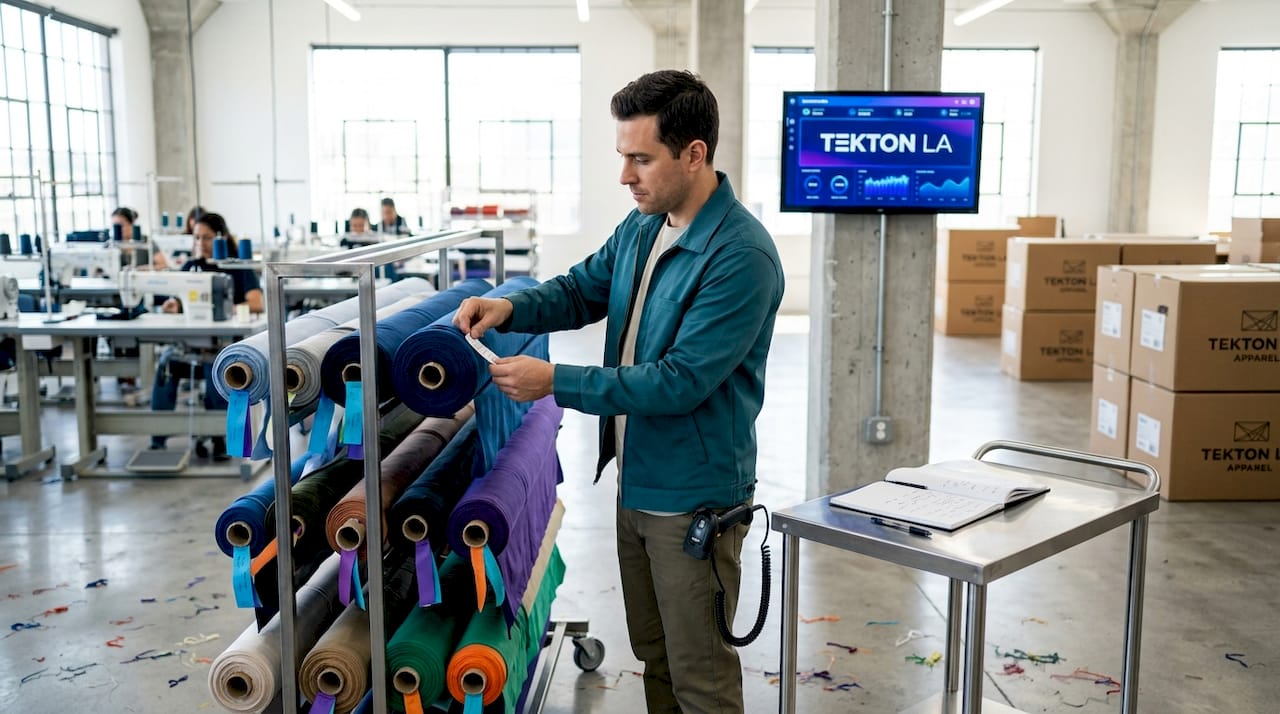
Fast turnaround clothing brands operate on a fundamentally different logic. Instead of building production around large, infrequent orders, they design their workflows around speed and flexibility. At Tekton LA, for example, the production process is built specifically for creators and startups who need quality without the wait or the bulk commitment.
Here is what sets fast turnaround brands apart from traditional manufacturers:
- Compressed sample-to-ship cycles. While traditional bulk runs land between 8 to 12 weeks domestically and 12 to 18 weeks internationally after the first prototype, fast turnaround brands target significantly shorter windows through streamlined approvals and pre-staged materials.
- Low or no minimum order quantities (MOQs). You can order a single run of 12 units to test a design before committing to a larger drop.
- Frequent reorder capability. Factories that market fast turnaround explicitly promote smaller batches and frequent reorder cycles as a core sourcing advantage, not an afterthought.
- Faster approvals and less commitment risk. When you are not locked into a 500-unit minimum, you can pivot based on real customer feedback rather than guessing six months in advance.
- Agile response to trends. A fast turnaround partner lets you drop a limited run tied to a cultural moment while it is still relevant, not three months after the conversation has moved on.
Pro Tip: Before you contact any fast turnaround brand, know your design intent clearly. The more defined your brief, the faster the first sample cycle moves. Vague briefs are the single biggest cause of timeline blowouts on small runs.
Key components driving speed and quality in fast turnaround apparel
Speed without quality is just chaos. The brands that actually deliver fast turnaround without sacrificing garment integrity do it through disciplined process, not just faster machines. Here are the production elements that make it work:
- Complete tech pack. A complete tech pack is the single most important document to reduce revisions and speed up sampling. It includes every measurement, construction detail, material specification, and graphic placement. Skipping this step is the fastest way to add weeks to your timeline.
- First prototype (proto sample). This early-stage sample tests construction and fit. It does not need to use final fabrics, but it should reflect the intended silhouette and structure accurately.
- Fit sample. Adjustments from the proto are applied here. This is where you lock in sizing and proportion before moving to final materials.
- Pre-production sample (PPS). The PPS is made from the exact fabrics, trims, and packaging that will go into your bulk run. As a binding contract, the PPS ensures bulk production matches the approved standards. No PPS approval means no bulk production, full stop.
- Bulk production. Once the PPS is signed off, production runs against that approved standard. Any deviation is a defect, not a variation.
“The brands that move fastest are not the ones cutting corners on sampling. They are the ones who invest in documentation upfront so there is nothing to argue about downstream.” This is the counterintuitive truth about fast turnaround apparel: rigor at the start creates speed at the end.
Two additional factors compress timelines significantly. First, using stock materials rather than custom-developed fabrics eliminates lead time for material production. Second, limiting design variance on your first run, meaning fewer colorways, fewer silhouettes, reduces the number of approval cycles needed. Adding custom woven labels to a run is a great example of a branding upgrade that adds almost no time when it is planned from the start but causes delays when added as an afterthought.
Pro Tip: Set a 24-hour internal approval rule. The biggest timeline killer in fast turnaround production is not the factory. It is the client taking five days to approve a sample. Assign one decision-maker and commit to same-day or next-day responses.
On-demand and made-to-order models: reducing waste and boosting speed
On-demand apparel manufacturing takes the fast turnaround concept one step further. Instead of producing a batch and hoping it sells, you produce only what has already been ordered or is immediately needed. This model aligns production with actual demand rather than forecasted demand.
The benefits are real and measurable. On-demand models significantly reduce overproduction and waste by making garments closer to actual paid orders. For a startup watching every dollar, not sitting on 200 unsold units is a meaningful financial advantage.
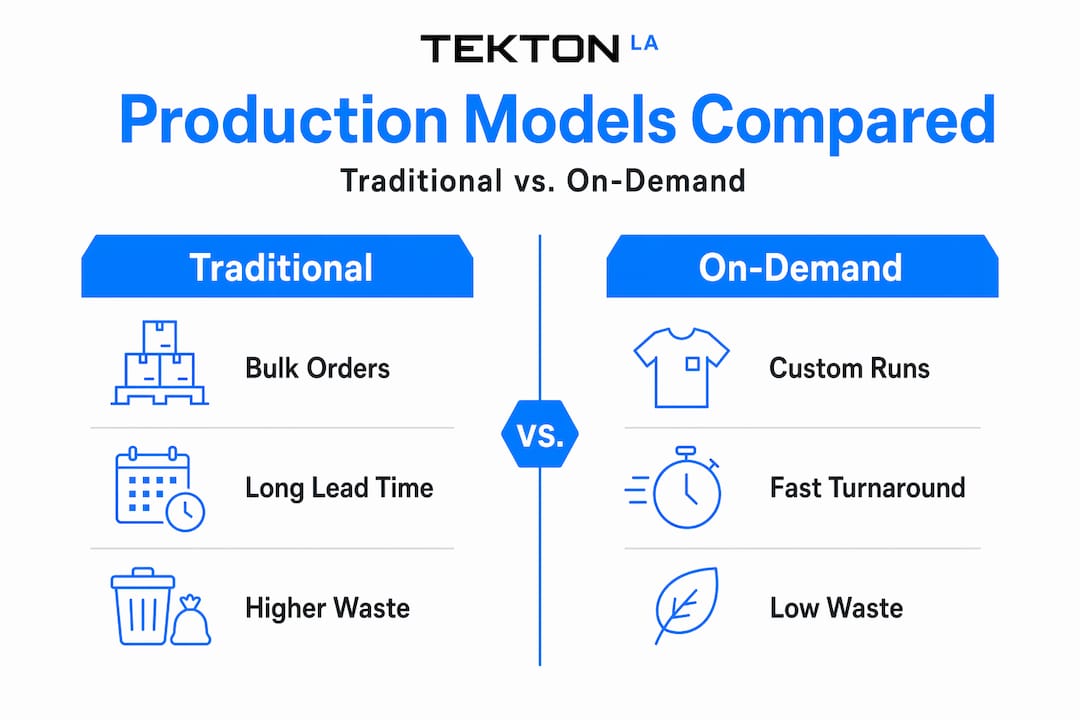
The environmental upside matters too. Overproduction is one of the largest sources of waste in the apparel industry. On-demand production, combined with apparel sustainability principles like local sourcing and garment dyeing, dramatically cuts the carbon footprint of each unit produced. If your brand values align with sustainability, this is not just good ethics. It is a marketable differentiator.
Here is how the two models compare directly:
| Factor | Traditional bulk production | On-demand production |
|---|---|---|
| Lead time | 12 to 18 weeks | Days to a few weeks |
| Minimum order | Often 300 to 500+ units | 1 to 50 units |
| Inventory risk | High (unsold stock) | Very low |
| Per-unit cost | Lower at scale | Slightly higher per unit |
| Waste | Significant overproduction | Minimal |
| Flexibility | Low | High |
The trade-off is real: per-garment costs run higher with on-demand production. But for a startup, paying slightly more per unit to avoid $8,000 in unsold inventory is not a trade-off. It is a sound financial decision. Products like garment dye shirts are a strong fit for this model because the dyeing process itself can be done in small batches without quality loss.
How fast turnaround impacts business strategy for independent brands
The operational benefits of fast turnaround are clear. But the strategic advantages are where things get genuinely interesting for young brands.
Here is how faster production timelines translate into real business leverage:
- Lower inventory risk. Smaller, more frequent orders mean you are never overexposed. If a design does not connect, you learn that after 30 units, not 300.
- Real-time market testing. Drop a small run, read the response, and adjust the next batch accordingly. This is a feedback loop that traditional bulk production makes impossible.
- Better cash flow management. Large upfront production commitments tie up capital for months. Smaller, faster runs keep cash moving and reduce the financial pressure on early-stage brands.
- Seasonal and cultural relevance. A brand that can drop a limited run in two weeks can respond to a trend while it is peaking. That is a competitive advantage most large brands simply cannot match.
- Stronger supplier relationships. Faster turnaround reduces decision friction, allowing brands to place more frequent smaller orders and adapt quickly to market demand. Over time, that frequency builds real supplier trust.
The relationship piece matters more than most startups realize. Speed creates opportunity but requires predictability and consistency to build trusted supplier relationships over time. A supplier who knows you will approve samples quickly, pay on time, and communicate clearly will prioritize your orders. That informal priority is worth more than any contract clause.
For promotional and branding purposes specifically, fast turnaround opens up options that simply did not exist before. Consider these practical applications:
- Event-specific drops. Produce branded premium tees for a specific event or pop-up without over-ordering.
- Seasonal campaigns. Launch a fall colorway of your heavyweight shirts in September, not July.
- Influencer seeding. Send a small curated run to creators without committing to a full production cycle.
- Limited edition releases. Create genuine scarcity by producing exactly what you intend to sell, not what the factory minimum forces you to order.
Why speed alone isn’t enough: the hidden factors behind successful fast turnaround branding
Here is the uncomfortable truth most articles about fast turnaround apparel skip entirely: speed is not a property of the factory. It is a property of the entire system, including you.
We have seen brands partner with genuinely fast manufacturers and still end up with 16-week timelines because their internal approval process was a disaster. Three stakeholders with conflicting opinions, no single decision-maker, and a habit of requesting “just one more tweak” after every sample. The factory was ready in 48 hours. The brand took three weeks to respond each time.
Incomplete tech packs and inefficient approvals destroy turnaround speed despite initial appearances. Documentation quality is not a bureaucratic formality. It is the foundation that every hour of production speed is built on. A manufacturer cannot move fast on a vague brief. No one can.
The brands that genuinely benefit from fast turnaround production share a few non-obvious traits. They have one person who owns decisions. They treat the PPS as final, not as an invitation to renegotiate. They accept that the first run may involve limited design variance, because reducing complexity is how you get first-time-right production. And they choose manufacturers based on consistent, predictable speed rather than whoever promises the fastest possible output.
That last point is worth sitting with. A manufacturer who promises two-week turnaround but delivers in six is worse than one who promises four weeks and hits it every time. Predictability is what lets you plan launches, coordinate marketing, and build a brand calendar. Unpredictability, even fast unpredictability, is just chaos with better marketing.
At Tekton LA, the production approach is built around that consistency. The goal is not to promise the fastest possible timeline. It is to deliver a reliable, quality-controlled process that independent brands can actually plan around.
Explore Tekton LA’s fast turnaround apparel solutions for independent brands
If this article has clarified anything, it is that fast turnaround apparel production is a system, and you need a partner who has built that system deliberately.
Tekton LA specializes in exactly what independent brands and startups need: small batch, low MOQ custom apparel with the quality controls and production discipline that make fast turnaround actually work. From garment dye shirts and heavyweight shirts to branding details like custom woven labels, every element of your brand’s apparel can be produced quickly without cutting corners. Whether you are planning a promotional drop, a brand launch, or a seasonal campaign, Tekton LA’s integrated process is built to move at the speed your brand actually needs.
Pro Tip: Reach out to Tekton LA early with your tech pack and launch timeline in hand. The more prepared you are at first contact, the faster your onboarding moves and the sooner your product ships.
Frequently asked questions
What is a pre-production sample and why is it important?
A pre-production sample (PPS) is the final approved garment made from the exact fabrics, trims, and packaging going into bulk production. The PPS acts as a binding contract that holds bulk production to approved standards, preventing costly surprises at delivery.
How quickly can fast turnaround clothing brands deliver custom apparel?
Most programs land between 8 to 12 weeks domestically after the first prototype, depending on complexity and materials, though on-demand partners can often move significantly faster for simpler designs.
Can independent brands order small quantities without penalties?
Yes. Factories market fast turnaround specifically as an advantage that enables smaller batch and frequent reorder strategies, making low or no minimum order quantities a core feature, not an exception.
What are common pitfalls in fast apparel production to avoid?
Skipping the PPS, submitting incomplete tech packs, and slow internal approvals are the three most common ways brands accidentally destroy their own fast turnaround timelines before production even begins.