


Choose DTF for small runs, full-color designs, and mixed fabric orders. Choose screen printing when you need the lowest cost per shirt on a big order and the toughest, most durable spot-color print. Most working print shops run both, switching methods based on the job in front of them rather than picking a single favorite.
TL;DR:
- DTF is more cost-effective for small orders, full-color designs, and fabric versatility, while screen printing offers lower per-unit costs for large, two-color runs.
- DTF handles photorealistic images on various fabrics easily, whereas screen printing excels in durability and cost when printing high-volume, fewer-color designs.
- The typical break-even point favors DTF at low quantity, multi-color jobs, and mixed fabrics, with screen printing becoming cheaper at higher quantities and fewer colors.
- Proper care involves cold washing and minimal heat, with DTF being slightly more sensitive to heat and friction than screen printing.
- Many shops use both methods, switching based on order size, color complexity, and fabric type, rather than relying on a single preferred printing process.
Table of Contents
- DTF vs Screen Printing at a Glance
- What Is DTF Printing and How Does It Work?
- What Is Screen Printing and Why Does It Last Longer?
- DTF or Screen Print: Comparing Cost, Quality, and Speed
- How to Choose Between DTF and Screen Printing
- How Tekton LA Decides Between DTF and Screen Printing
- How to Wash and Care for Each Print Type
- Why the “Which Is Better” Question Misses the Point
- Get a Fast Quote From Tekton LA for Your Next Print Run
- Sources
DTF vs Screen Printing at a Glance
The two methods split cleanly along a few lines: how much a job costs up front, how many colors it needs, and how long you plan to reorder it. Here’s the fast version before the deeper breakdown.
- Setup cost: DTF has close to none per design; screen printing needs a new screen (and cost) for every color.
- Best order size: DTF wins on small batches and one-offs; screen printing wins once you’re past a few dozen units per design.
- Color handling: DTF prints photos and gradients with no added cost; screen printing gets pricier with every extra spot color.
- Fabric range: DTF transfers press onto cotton, poly blends, nylon, and more without much fuss; screen printing prefers cotton and cotton-heavy blends for best ink adhesion.
- Feel and durability: Screen printing lasts longer under heavy washing when cured correctly; DTF holds up well too but can feel slightly heavier on large solid areas.
If you’re launching a startup line with five designs and small quantities, DTF is the practical pick. If you’re printing a large quantity of event T-shirts in one color, screen printing will save real money.
What Is DTF Printing and How Does It Work?
DTF, or direct-to-film printing, moves a design from a digital file onto fabric using a plastic film as the middleman rather than printing straight onto the shirt. The process follows a fixed sequence, and each step affects the final print quality and cost.
- Print the design onto PET film. A specialty printer lays down CMYK ink plus a white ink layer, which is what makes DTF prints pop on dark garments.
- Apply adhesive powder. While the ink is still wet, a hot-melt adhesive powder is dusted over the design and the excess is shaken off.
- Cure the film. Heat sets the powder into a stable, ready-to-transfer layer.
- Heat-press onto the garment. The film gets pressed onto the shirt under heat and pressure, then peeled away, leaving the design bonded to the fabric.
This is the workflow that gives DTF its two biggest advantages, according to Shopify’s guide to direct-to-film printing: strong color saturation on dark shirts and compatibility with a wide range of fabric types, from cotton to polyester to blends that screen printing struggles with.
The equipment stack matters for cost. A DTF setup needs a dedicated printer with white ink channels, film stock, powder, a curing unit, and a heat press. None of that changes per design, which is why shops can print a single shirt as cheaply, per unit, as printing fifty. Transfers can also be printed in batches ahead of time and stored, according to Next Level Apparel’s guide to DTF printing, which lets a shop press orders on demand without re-running the printer for every job.
What Is Screen Printing and Why Does It Last Longer?
Screen printing pushes ink through a fine mesh screen, using a stencil to block ink everywhere except the design area. It’s the oldest method in commercial apparel decoration, and it earned that staying power through sheer durability.
- Build a screen for each color. Every spot color in the design gets its own physical screen with its own stencil, according to the mechanics described on Wikipedia’s screen printing entry.
- Load ink and pull the squeegee. A squeegee drags plastisol or water-based ink across the mesh, forcing it through the open areas and onto the garment underneath.
- Flash cure between colors. Multi-color jobs need a quick heat flash after each pass so colors don’t smear into each other.
- Final cure. The finished print runs through a conveyor dryer or oven to fully cure the ink and lock it into the fibers.
Press type changes the math on bigger jobs. A manual press works fine for small teams and short runs. Semi-automatic and fully automatic presses rotate multiple screens on one carousel, letting a shop print hundreds of shirts an hour once everything is set up and registered correctly.
That thicker ink deposit is also why screen prints tend to outlast other methods, especially on heavy-use items like team jerseys and workwear, and why they hold their color and opacity through repeated washing far better than a thin ink layer would, per Atomm’s cost and quality breakdown.
DTF or Screen Print: Comparing Cost, Quality, and Speed
The two methods diverge the hardest on cost structure. Screen printing is front-loaded: you pay for screen setup before you print a single shirt, and that cost multiplies with every additional color in the design. DTF flips that model. There’s no per-design setup fee, so the first shirt and the fiftieth shirt cost close to the same amount per unit.
Here’s the math that actually decides most orders. Say a two-color design costs roughly $40 in screen setup, plus $3 per shirt to print. A DTF transfer for the same design runs about $6 per shirt with zero setup. At 10 shirts, DTF costs $60 total against screen printing’s $70. At 50 shirts, screen printing drops to $190 against DTF’s $300. The break-even point typically lands somewhere in the dozens to low hundreds depending on how many colors the design carries, according to Atomm’s cost comparison.
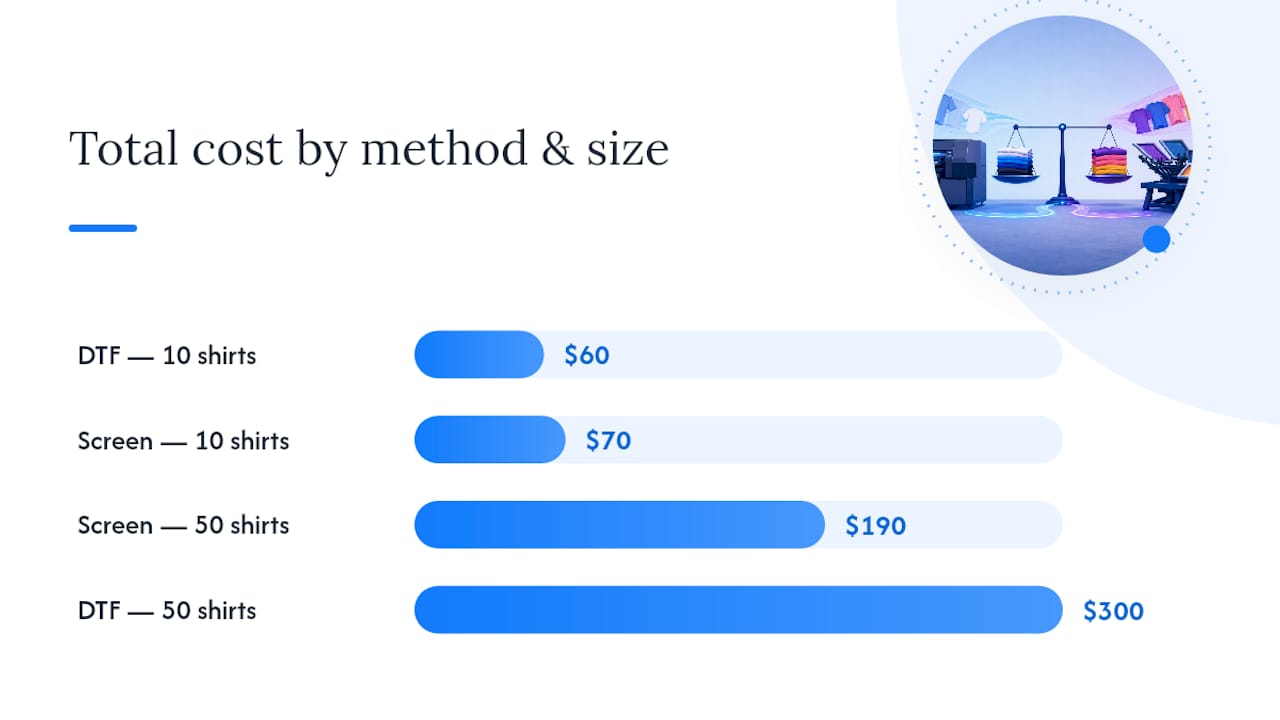
The break-even math in one line: more colors and lower quantities favor DTF; fewer colors and higher quantities favor screen printing.
A few other dimensions matter just as much as raw cost:
- Design complexity: DTF handles photorealistic art, gradients, and unlimited colors at one flat price. Screen printing charges per color, so a six-color photo reprint gets expensive fast.
- Fabric and dark garments: DTF’s white ink underlayer makes it reliable on black and navy shirts and on synthetic blends that resist plastisol ink. Screen printing needs a white ink underbase for dark garments too, but it performs best on cotton and cotton-heavy blends.
- Hand and feel: Screen printing on lighter designs can feel almost part of the fabric. DTF is generally soft but can feel slightly stiff or plasticky on large, solid-color areas, an effect that shows up most on big prints rather than small logos, per Shopify’s DTG vs. DTF comparison.
- Durability: Properly cured screen prints generally win on long-term wash life, particularly for garments that see heavy use like uniforms or event apparel that gets washed weekly for a season.
- Speed at scale: DTF wins on turnaround for one-offs since transfers can be pre-printed and pressed on demand. Screen printing wins on throughput once a job is set up, since an automatic press can output hundreds of identical shirts per hour.
Order size before checking either method against your budget: run the break-even math for your actual color count before assuming one method is cheaper.
How to Choose Between DTF and Screen Printing
Work through the decision in order rather than picking a method first and justifying it after.
- Count your order size. Under a few dozen units per design, DTF almost always wins on total cost and flexibility.
- Count your colors. A one or two-color design tips the math toward screen printing once quantities climb past 100 or so. A five-plus color photo design favors DTF regardless of quantity.
- Check your fabric mix. If you’re printing across cotton, poly, and blends in the same order, DTF’s flexibility avoids compatibility headaches.
- Decide how much hand matters. Athletic wear and large chest logos that touch skin directly do better with a lighter feel; screen printing generally wins here for big solid shapes.
- Weigh budget against turnaround. If you need shirts fast without committing to inventory, DTF transfers can be pressed on demand.
Order-size thresholds shift with color count, so treat “dozens” as a starting range rather than a hard line. The break-even point varies with the number of colors in the design.
Pro Tip: Ask any print shop for a wash test before committing to a large order. A shop that can’t tell you their cure temperature or hasn’t run a five-wash test on their own stock doesn’t have their process dialed in yet.
Vague answers about curing, no sample transfer to inspect, and pricing that doesn’t change with quantity are all signs to keep shopping.
How Tekton LA Decides Between DTF and Screen Printing
A print shop that runs both methods daily usually chooses based on factors such as order size, color count, and fabric. Many offer multiple printing and decoration services with flexible order quantities.
A five-color streetwear drop of 20 pieces on mixed cotton and poly blanks goes to DTF. A 300-unit corporate order in one or two colors goes to screen printing, where the per-unit savings at that volume are hard to beat. Mixed fabric orders, dark garments, and small test batches for a new brand almost always route to DTF first.
Hybrid workflows aren’t a compromise. They’re how a shop that prints hundreds of different jobs a week actually keeps both cost and quality in line, running DTF for the odd sizes and colors a screen run can’t justify, and screen printing for the bestsellers that reorder month after month.
Industry commentary backs this pattern up: Screen Printing Magazine’s analysis notes that DTF hasn’t replaced screen printing so much as it’s let shops take on jobs they used to turn away.
How to Wash and Care for Each Print Type
Both print types survive years of washing if you treat them right, but the rules differ slightly.
For DTF prints, wash inside out in cold or warm water, never hot. Skip the dryer’s high heat setting if you can, since prolonged high heat softens the adhesive layer over time. Avoid ironing directly on the print. If you must iron the shirt, flip it inside out or place a cloth between the iron and the design. Fabric softener isn’t necessary and can make the print feel gummier over time.
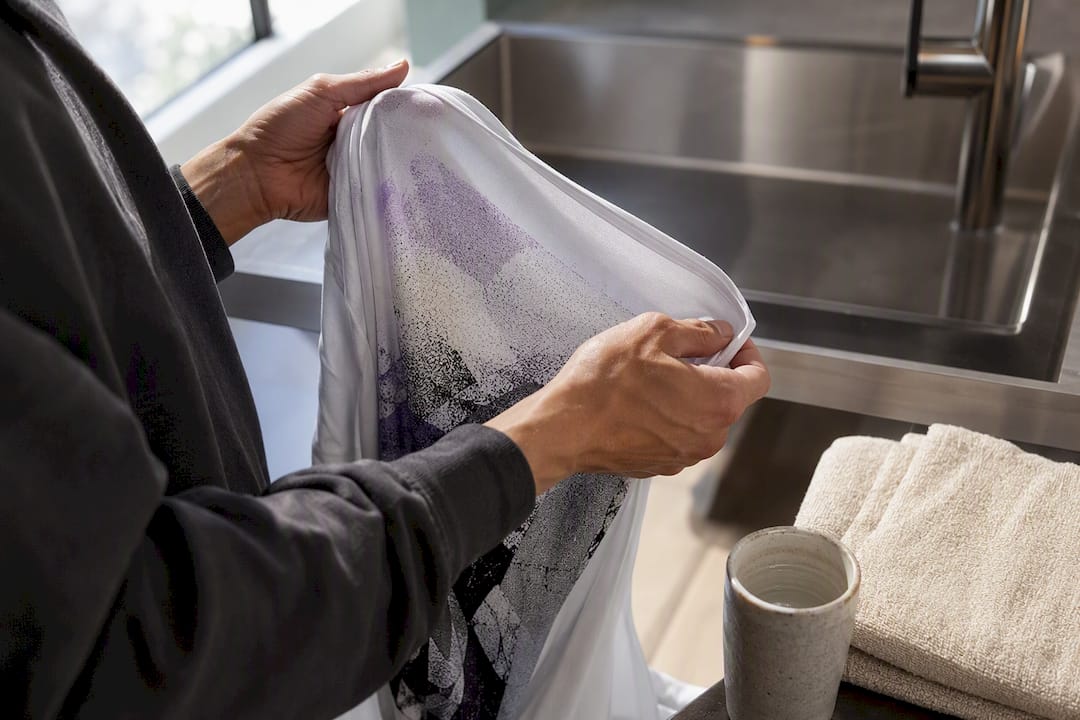
For screen prints, the rules are similar but slightly more forgiving because plastisol ink cures into a tougher, more heat-resistant layer. Wash inside out in cold water when possible, and avoid bleach, which breaks down ink pigment over repeated cycles. Air drying extends the life of any print, but a properly cured screen print can handle moderate dryer heat better than most other methods.
Both prints benefit from waiting 24 to 48 hours after pressing before the first wash, giving the ink or adhesive full-time to set. Skipping that window is one of the more common reasons a print peels or cracks early, regardless of which method produced it.
Why the “Which Is Better” Question Misses the Point
Most articles frame this as a battle with one winner, and that’s the wrong lens. The real question isn’t which method is better. It’s which method fits the order in front of you right now. A shop that only offers one method is going to talk you into that method regardless of fit, and that’s the pattern worth watching for when you’re shopping for a print partner.
What gets underestimated most is the break-even math. Buyers tend to assume screen printing is always cheaper because it’s the “bulk” option, but run the numbers on a four-color design under 50 units and DTF usually wins outright. The reverse mistake happens too, where brands stick with DTF for a bestseller that’s reordering monthly and quietly bleeding margin they’d keep with a screen setup.
Prioritize color count and reorder frequency before anything else. Those two numbers, more than fabric type or feel preference, decide which method actually saves money on a given job.
— Christian
Get a Fast Quote From Tekton LA for Your Next Print Run
Tekton LA runs both methods in-house, so you’re not stuck fitting your order into whichever machine a shop happens to own. Small full-color drops, mixed fabric orders, and dark garment runs go to DTF. High-volume spot-color jobs, team orders, and corporate bulk runs go to screen printing, where the per-unit savings show up fast once you clear a few dozen pieces. For simpler one or two-color designs at real scale, the 1 color screen print option keeps setup costs to a minimum.
To get a fast, accurate quote, have four things ready: garment type, order size, final artwork, and how you want the print to feel on the fabric. Some print shops also handle blanks with no minimum order quantity, private labels, woven labels, and custom banners, so a single order can cover apparel and branding in one pass. Browse the Printers Shirt lineup or head to Tekton LA’s site to start your order today.
Sources
- DTF vs. Screen Printing: Cost, Quantity and Quality (2026)
- DTF vs. Screen Printing: Why Both Technologies Will Shape the Future - Screen Printing Magazine
- Screen printing - Wikipedia