

DTG wins for one-off, photorealistic, or multi-color short runs under about two dozen shirts; screen printing wins for bulk orders, specialty inks, and the longest-lasting print. Tekton LA runs both processes daily out of its Downtown Los Angeles shop, and the honest answer depends less on which method is “better” and more on your order size, fabric, and whether you need effects like puff or metallic ink.
TL;DR:
- Orders under 25 shirts with complex, multi-color, or photographic designs are best suited for DTG, especially for fast turnaround needs.
- Screen printing becomes more cost-effective and scalable for bulk orders of 25 or more shirts, with prices dropping as volume increases.
- DTG excels on high-cotton fabrics and can produce detailed images, gradients, and precise color matches, while screen printing is better for specialty effects and solid colors.
- Screen printing generally offers longer-lasting prints with durability over multiple wash cycles, especially on 100% cotton garments.
- Always request a physical sample before bulk production to ensure color accuracy, fabric compatibility, and proper curing, regardless of the chosen method.
Table of Contents
- DTG vs Screen Printing at a Glance
- How Pricing Works and Where the Crossover Hits
- Print Quality: Detail, Gradients, and Color Matching
- Which Print Lasts Longer in the Wash
- Fabric Choice and What Pretreatment Really Costs
- Specialty Inks and Textured Effects
- Turnaround Time and Scaling Up
- How to Choose Between DTG and Screen Printing
- How Tekton LA Puts Both Methods to Work
- The Bottom Line on DTG vs Screen Printing
- What I’ve Learned Running Both Sides of This Job
- Get a Quote or Sample From Tekton LA
- Sources
DTG vs Screen Printing at a Glance
Most decisions come down to two questions: how many shirts, and how many colors. Everything else is detail work.
Choose DTG when:
- You need 1 to 24 shirts, especially with photographic detail or gradients
- Your design has five or more colors, or changes per shirt (like personalized names)
- You’re testing a design before committing to a bulk run
- Turnaround needs to be fast with zero setup lag
Choose screen printing when:
- You’re ordering 25+ shirts of the same design
- You need Pantone-matched brand colors or heavy ink opacity
- The job calls for specialty effects like metallic, puff, or discharge ink
- Long-term wash durability matters more than upfront speed
Cost behaves in opposite directions for each method. DTG holds a flat per-shirt price no matter the quantity, while screen printing gets cheaper per unit the more you print, since setup costs get spread across the run. Fabric compatibility follows a similar split: DTG performs best on high-cotton blends, while screen printing tolerates polyester, blends, and performance fabrics with far fewer surprises.
How Pricing Works and Where the Crossover Hits
Screen printing carries a fixed setup cost per color, per design. That expense (burning screens, mixing ink, dialing in the press) gets amortized across every shirt in the run. Print 12 shirts and that setup cost eats a big chunk of your budget. Print 200 and it barely registers. DTG skips the setup step entirely. Each shirt gets printed individually, so the price per unit stays roughly flat whether you order 1 or 100.
The crossover point: Industry pricing data puts the break-even around two dozen shirts. DTG usually wins for orders of 1 to 12, stays competitive up to about 24, and screen printing takes over from there. That number shifts based on color count, garment type, and whether your design needs a white underbase.
A few ways to push the math in your favor:
- For DTG: Stick to designs that don’t need heavy pretreatment, and batch similar orders together to save on labor time.
- For screen printing: Limit your color count. Every additional color means another screen, another setup charge, and another chance for registration issues.
- For both: Ask your printer whether they charge per color, per side, or a flat design fee. That structure changes the real crossover point more than people expect.
If you’re building a small apparel brand and unsure which side of that line you’ll fall on, this breakdown of when startups lean on DTG walks through the early-stage math in more detail.
Print Quality: Detail, Gradients, and Color Matching
DTG is a digital printer. It sprays ink directly onto fabric the same way an inkjet printer lays ink on paper, which means it handles photorealistic images, subtle gradients, and unlimited colors without any added cost. If your design looks like a photograph, or has shadows and blends that would require dozens of screens to replicate, DTG is the only practical choice.
Screen printing works differently. Ink gets pushed through a mesh stencil onto the shirt, one color per screen. That process produces bold, opaque color with a satisfying weight to the touch, and it’s the only reliable way to hit an exact Pantone match for brand colors. Higher mesh counts, in the 305 to 355 range, can reproduce fine halftone detail that rivals digital printing, but it takes a skilled printer to pull off.
File prep differs too:
- DTG: Submit files at 150 to 300 dpi, in PNG or PSD format with a transparent background if possible.
- Screen printing: Vector files (AI or EPS) are strongly preferred since each color gets separated into its own layer.
Some jobs benefit from combining both. A brand might screen print a bold logo on the chest in Pantone-matched ink, then use DTG for a photorealistic graphic on the back. Comparing DTF against screen printing is worth a look too if you’re weighing a third option for detailed, multi-surface designs.
Which Print Lasts Longer in the Wash
Screen printing is the industry standard for longevity, and it isn’t particularly close. DTG prints typically hold up for numerous wash cycles with proper care, while a properly cured screen print regularly outlasts that by a wide margin, especially on 100% cotton.
50 wash cycles is the rough benchmark for a well-made DTG print. That’s roughly a year of weekly washing before you’ll notice real fading or cracking, assuming the shirt was cured correctly and cared for the way we describe below.
Curing temperature makes or breaks either method. Under-cured DTG ink washes out fast; under-cured plastisol on a screen print cracks and peels within a few washes. Pretreatment on DTG also plays a role: too much pretreat spray leaves a stiff, crusty hand-feel, while too little means the ink doesn’t bond properly to the fibers.
A few habits stretch print life on either method:
- Wash cold, always inside-out
- Skip the dryer when you can, or use low heat
- Avoid fabric softener, which breaks down ink bonding over time
- Don’t iron directly over a print
Fabric Choice and What Pretreatment Really Costs
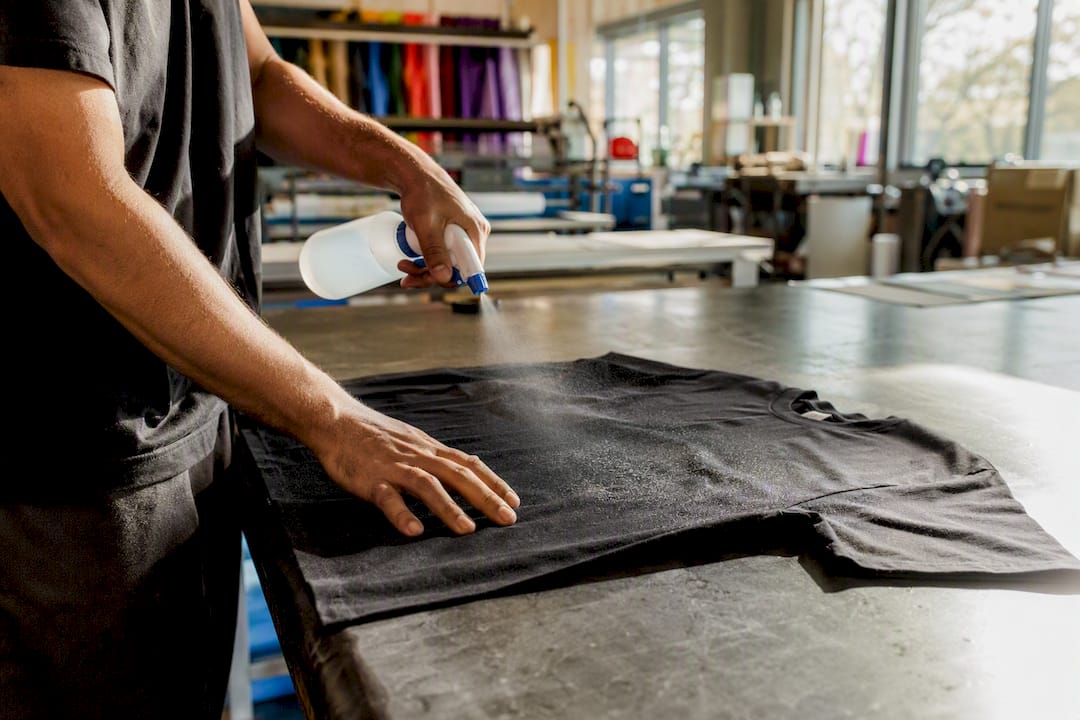
Lower-cotton blends and performance fabrics tend to reject the ink or produce a duller finish. Dark garments add another wrinkle: DTG needs a white ink underbase sprayed first, plus a pretreatment solution to help that white ink bond, which adds a real cost and an extra curing pass to every dark shirt.
Screen printing tolerates a wider range of substrates. Polyester, tri-blends, performance athletic fabrics, and even some nylon products take plastisol or specialty inks reliably. That flexibility is one reason team uniforms and athletic apparel lean heavily on screen printing rather than DTG.
Curing temperature also shapes the finished feel. Higher cure temps set the ink more permanently but can stiffen thinner fabrics, while lower, longer cure cycles preserve a softer hand at the cost of production speed. For a deeper look at how pretreatment affects the final product, this guide to the DTG process covers the mechanics step by step.
Specialty Inks and Textured Effects
If your design calls for metallic ink, puff (raised texture), discharge printing, foil, or reflective ink, screen printing is essentially the only route. These effects rely on ink formulations and mesh techniques that DTG’s inkjet process can’t replicate, or can only approximate poorly.
That’s a real limitation to plan around, not a dealbreaker. Plenty of brands run a hybrid production: a screen-printed metallic logo on the front, paired with a DTG’d photographic graphic elsewhere on the same run. Specialty inks generally add cost and sometimes require gentler washing (puff ink in particular can flatten under high heat), so factor that into your care instructions before you ship the order.
Turnaround Time and Scaling Up
DTG has close to zero setup time. Load the file, load the shirt, print. That makes it the natural choice for rush jobs, single samples, or a print-on-demand storefront where every order is a different design.
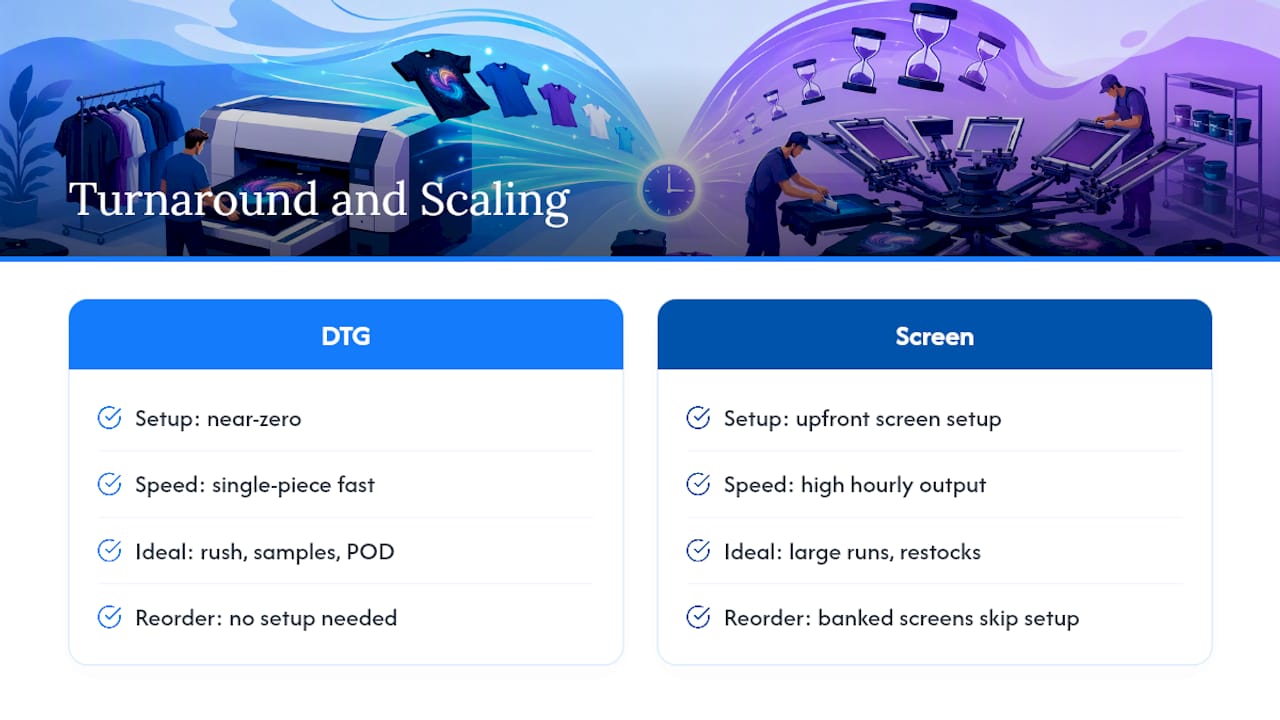
Screen printing needs setup time upfront: burning screens, registering colors, and dialing in the press before the first shirt even prints. Once that setup is done, though, screen printing moves fast, often outputting hundreds of shirts an hour on an automatic press.
Pro Tip: If you’re planning a launch with both a small pre-order batch and a larger restock later, ask your printer whether they can bank the screens after the first run. Reordering the same design skips setup costs entirely on round two.
A few operational realities worth knowing: DTG printers need regular head-cleaning maintenance or ink clogs slow down every job behind yours. Screen printing presses have a fixed number of platens, so a shop’s daily capacity is a hard ceiling, not a flexible one. Ask about both before committing to a deadline.
How to Choose Between DTG and Screen Printing
Work through this order, and the right method usually becomes obvious by step four.
- Count your quantity. Under 24 shirts, DTG is almost always the more sensible call. Above that, start pricing screen printing seriously.
- Look at your design complexity. Photorealistic, gradient-heavy, or multi-color designs favor DTG regardless of quantity. Simple one or two-color logos favor screen printing.
- Check your fabric. High-cotton content works for either method. Poly-blends, performance wear, or dark garments needing crisp white ink lean toward screen printing.
- Decide if you need specialty effects. Metallic, puff, discharge, or foil narrows you straight to screen printing.
- Set your budget and timeline. Rush jobs and small batches favor DTG’s zero setup. Planned, larger runs favor screen printing’s per-unit savings.
- Weigh sustainability priorities, if that matters for your brand positioning.
When you call a printer, ask these questions directly: What’s your minimum order for screen printing? Can I see a physical sample before committing to the full run? What’s your cure confirmation process, and do you test wash your prints? A printer who can’t answer the cure question clearly is a red flag, since under-cured ink is the single biggest cause of premature print failure.
Pro Tip: Always ask for a physical sample, not just a digital mockup, before approving a bulk order. Screen color and DTG color can shift slightly between a monitor and fabric, and that gap is nearly impossible to catch on-screen.
Watch for vague pricing quotes that don’t separate garment cost from print cost, and any shop that won’t confirm cure temperature or wash-test results in writing.
How Tekton LA Puts Both Methods to Work
Tekton LA runs DTG, screen printing, DTF, embroidery, and sublimation out of one Downtown Los Angeles shop, which means the recommendation you get isn’t tied to only owning one machine. No minimum order quantities apply to blanks, and eco-friendly practices, including locally sourced materials and garment dyeing, run through the whole operation.
In practice, that split looks like this:
- Independent artists and small drops: DTG handles one-off photorealistic prints and short runs without forcing a big upfront commitment. This guide to DTG for art prints covers the design considerations in more depth.
- Event teams, sports squads, and corporate orders: Screen printing covers bulk quantities with consistent color matching across every shirt in the batch.
- Brand launches: A hybrid run, screen print for the core logo and DTG for limited variant graphics, is common for startups scaling from a first drop into a full line.
For a side-by-side on where embroidery and tackle twill fit into that picture too, this comparison of decoration methods rounds out the full toolkit.
The Bottom Line on DTG vs Screen Printing
If you’re ordering fewer than two dozen shirts with a detailed or multi-color design, go DTG. If you’re ordering in bulk, need Pantone-matched brand colors, or want specialty ink effects, go screen printing. Three moves to make right now: request a physical sample from your printer, confirm your file specs match the method you’re choosing, and get a firm quote that spells out cure and wash-test details before you sign off.
What I’ve Learned Running Both Sides of This Job
The most common mistake I see isn’t picking the wrong method. It’s picking the right method and then skipping the sample step. A client once approved a DTG mockup on-screen for a design with deep navy tones, and the printed color shifted noticeably once it hit cotton under real lighting. That’s not a DTG flaw. It’s a monitor-to-fabric gap that catches almost everyone once.
My honest take: don’t optimize for the method that sounds more premium. Screen printing isn’t “better” than DTG, and DTG isn’t the lazy shortcut some old-school shops make it out to be. Match the method to the order in front of you, ask for the sample, and confirm the cure. That’s the whole game.
— Christian
Get a Quote or Sample From Tekton LA
Tekton LA runs DTG and screen printing under one roof, so you’re not stuck guessing which shop to call for which job. Small batch with a photo-detail design? DTG handles it with no setup fee. Bulk order for a team or event? Tekton LA’s 1-color and 2-color screen print options scale with no minimum order quantity on blanks.
If you’re still deciding, request a physical sample before committing to a full production run. It’s the fastest way to confirm color, hand-feel, and fabric compatibility before your budget is locked in. Browse the Tekton LA product catalog to see available blanks, or check the Printers Shirt if you want to test both print methods on the same substrate. Get a firm quote before your next production deadline creeps up on you.
Sources
- DTG vs. Screen Printing: Factors to Consider for Your Brand (2025) - Shopify
- DTG Printing vs Screen Printing | Kornit Digital
- DTG vs. Screen Printing | Pros, Cons, How Much It Costs - Printavo