


For a single photo-quality shirt, pick DTG. For a bulk branded run, silkscreen wins on cost. For hats and fine logos, embroidery holds up best. For large block letters and jersey numbers, tackle twill is lighter, cleaner, and cheaper than dense embroidery fills. The simplest decision rule: let quantity, fabric type, and design complexity point you to the method before you even call a printer.
- Photo or gradient artwork, small quantity → DTG
- Spot colors, large run (mid-double digits and up) → silkscreen
- Structured logo on a hat, polo, or fleece → embroidery
- Large letters, numbers, varsity or jersey applications → tackle twill
- Polyester performance fabric → sublimation or DTF (DTG and silkscreen both carry risks on poly)
Key Takeaways
The right decoration method depends on three things above all: your fabric content, your order quantity, and whether your design needs photographic detail or bold, readable shapes.
| Point | Details |
|---|---|
| Match method to fabric first | DTG needs high-cotton content; silkscreen on poly requires low-bleed inks; tackle twill works on athletic mesh. |
| Quantity drives the cost crossover | Silkscreen becomes more cost-effective than DTG somewhere in the mid-double to low-triple digit range, depending on color count. |
| Tackle twill beats embroidery for large fills | For jersey numbers and large block letters, tackle twill is lighter, less stiff, and less expensive than dense embroidery. |
| Always request a sample or proof | A wash test on the first production piece catches most quality issues before the full run ships. |
| Tektonla covers all four methods | Tektonla in Downtown Los Angeles offers DTG, silkscreen, embroidery, and tackle twill with no blank minimums and fast turnaround. |
Table of Contents
- How silkscreen, DTG, embroidery, and tackle twill actually work
- Comparing all four methods side by side
- What actually drives price and turnaround time
- How each method holds up after washing
- How to choose: questions to ask your printer
- How Tektonla evaluates and routes a job in the shop
- The trade-off most people learn too late
- Ready to print? Here’s how Tektonla can help
- Sources
How silkscreen, DTG, embroidery, and tackle twill actually work
These four decoration methods cover the vast majority of custom apparel printing in the United States, but they work through completely different physical processes. Picking the wrong one costs money, time, or both.
Silkscreen (screen printing)
Screen printing pushes ink through a mesh stencil onto the garment, one color per screen. The ink film is thick, which gives silkscreen its signature opacity and vibrancy on dark garments. Plastisol is the dominant ink type in U.S. shops because it sits on top of the fabric and cures with heat. Water-based inks absorb into the fiber and produce a softer hand feel, though they require more precise curing.
Pros: Unmatched opacity on darks, exact Pantone matching, very low per-unit cost at volume, specialty inks (puff, metallic, discharge) available.
Cons: Each color requires a separate screen, so setup costs are real. Photographic gradients and complex multicolor artwork get expensive fast. Minimum order quantities are common.
Substrate compatibility: Works on cotton, cotton-poly blends, and most woven fabrics. On polyester or poly-heavy blends, low-bleed inks are technically required to prevent dye migration. Skipping the correct ink chemistry on poly leads to prints that discolor within weeks.
Best for: Promotional tees, retail streetwear, event shirts, corporate uniforms in quantities of 24 or more.
DTG (direct to garment)
DTG uses aqueous inkjet technology to print directly onto the fabric surface, essentially running the garment through a specialized printer. It handles photographic detail, unlimited colors, and complex gradients without any screen setup. For dark garments, a pretreatment step is required so the white underbase bonds properly. The print area is limited to the printer’s platen size, which rules out true all-over printing.
DTG prints are soft to the touch, suit natural fibers, and handle complex multicolor artwork well. They are generally cheaper than screen printing for small quantities. The tradeoff: DTG is slower per unit and performs poorly on polyester, where the aqueous inks struggle to bond.
Pros: No minimums, photographic quality, fast turnaround for one-offs, no setup fee per color.
Cons: Higher per-unit cost at volume, limited to natural or high-cotton-content fabrics, pretreatment adds time and cost for dark garments, platen limits print area.
Best for: Art prints, on-demand merch, single samples, small-batch designer drops.
Pro Tip: For DTG on dark garments, always ask your printer about their pretreatment process and whether they cure it before printing. Inconsistent pretreatment is the single most common cause of faded or cracked DTG prints after the first wash.
Embroidery
Embroidery stitches thread directly into the garment using a digitized file that tells the machine exactly where each needle pass goes. The result is dimensional, textured, and premium-looking in a way no ink process can replicate. Stitch count drives cost: a small left-chest logo might run 5,000–8,000 stitches, while a large back design can exceed 50,000 stitches and get expensive quickly.
Pros: Extremely durable, professional appearance, works on structured items (hats, polos, bags, fleece) where ink processes fail.
Cons: Not suited for photographic detail or fine gradients. Large filled areas become heavy and stiff. High stitch counts on thin fabrics can cause puckering.
Substrate compatibility: Works on most wovens and knits. Structured caps and polo shirts are the sweet spot. Thin, stretchy fabrics need proper stabilizer backing to prevent distortion.
Best for: Corporate logos, team hats, polo shirts, premium branded apparel where texture and longevity matter.
Tackle twill
Tackle twill is an appliqué method where pre-cut fabric pieces are sewn onto the garment, then finished with border stitching around the edges. The fabric pieces are typically twill, felt, or similar woven materials, cut precisely by laser or heat to keep edges clean. It is the standard for athletic jersey numbers and varsity letters because it holds its shape, reads clearly at distance, and is lighter and less stiff than a dense embroidery fill covering the same area.
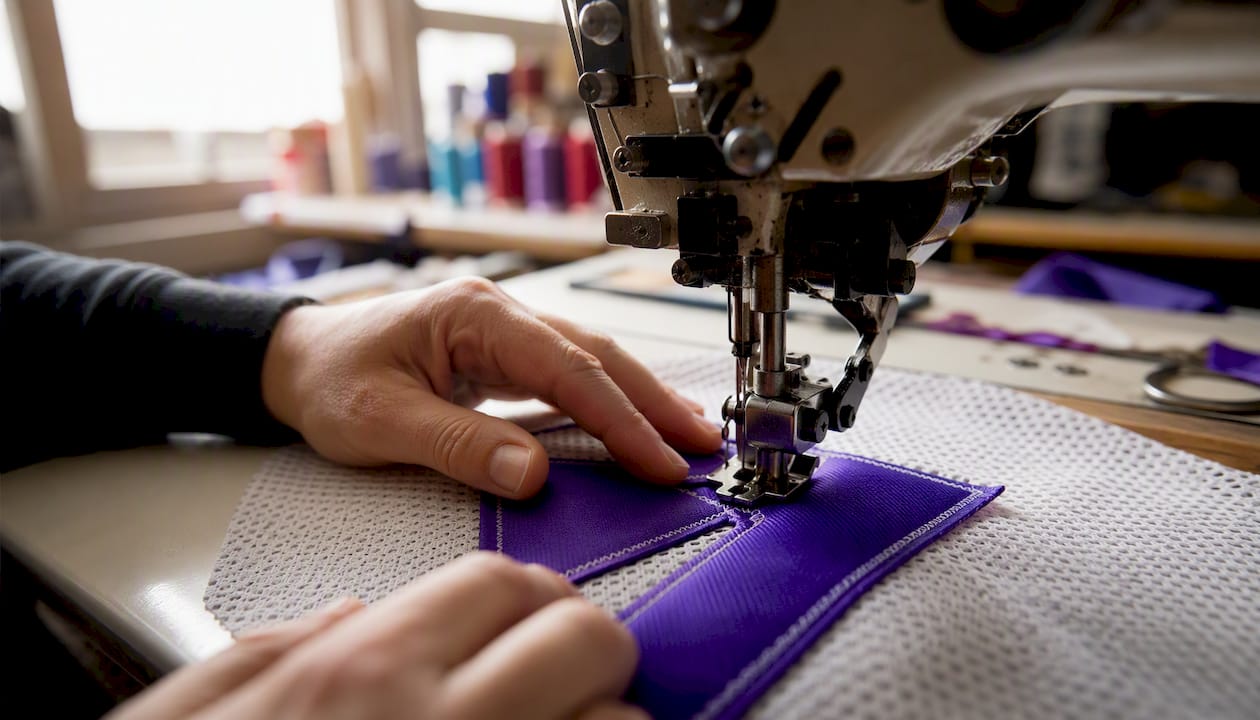
Professional tackle twill workflows use placement guide stitches first, then secure the pre-cut piece with attachment stitching, then finish the edge. For multi-layer designs, the finishing order matters: smaller pieces get locked down after the base layer is secure. Laser- or heat-cut edges are the standard for clean borders; hand-cut edges are a common source of fraying.
Pros: Lightweight for large fills, durable, bold and readable, works on heavy athletic fabrics.
Cons: Limited to block shapes and letters; not suited for fine detail or photographic imagery. Requires accurate digital cut files.
Best for: Jersey numbers, varsity jackets, team uniforms, large letter logos on athletic wear.
Comparing all four methods side by side
| Dimension | Silkscreen | DTG | Embroidery | Tackle Twill |
|---|---|---|---|---|
| Best for | Bulk branded tees, event shirts | Art prints, on-demand, samples | Hats, polos, structured logos | Jersey numbers, varsity letters |
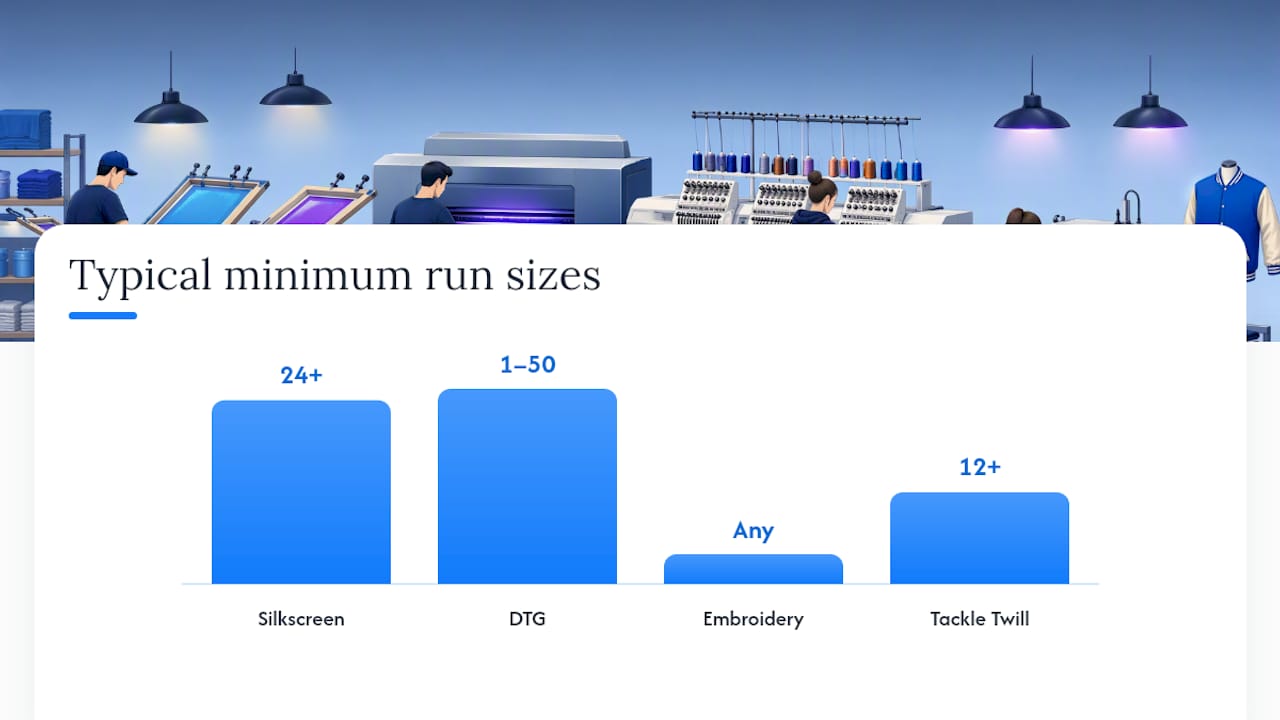
| Ideal run size | 24+ (cost-effective) | 1–50 | Any (cost scales with stitch count) | 12+ typical |
| Cost shape | High setup, low per-unit at volume | No setup, higher per-unit | Digitizing fee + per-unit | Digitizing + cut + stitch |
| Color/detail | Spot colors, Pantone, limited gradients | Photographic, unlimited colors | Limited color, no gradients | Solid fabric colors only |
| Substrate | Cotton, blends (poly needs low-bleed ink) | High-cotton preferred; poor on poly | Most wovens, knits with backing | Athletic fabrics, heavy knits |
| Durability | Excellent with proper cure; plastisol lasts | Good on cotton; fades faster on poly | Excellent; thread outlasts most inks | Excellent; fabric pieces hold shape |
| Hand feel | Heavier ink deposit; softer with water-based | Soft; inks absorb into fiber | Raised, textured, dimensional | Flat fabric feel with raised edge |
| Turnaround | 5–10 business days (screens + production) | 2–5 business days | 5–10 business days | 7 business days |
Key trade-offs to understand before you quote:
- The cost crossover for silkscreen vs. DTG typically lands somewhere in the mid-double digits to low triple digits per order, depending on the number of ink colors and design complexity. A two-color design on 48 shirts almost always costs less per unit via screen printing. A 10-shirt run with a six-color design almost always costs less via DTG.
- Embroidery stitch count is the hidden variable. A logo that looks simple can digitize into 15,000 stitches, which changes the price significantly.
- Tackle twill and embroidery are often confused, but they solve different problems. Tackle twill is the right call for large filled areas; embroidery is the right call for fine detail and premium texture on smaller designs.
For a broader look at how digital and analog production methods compare in cost and scaling, digital vs. offset printing economics follows a similar logic to DTG vs. screen printing.
What actually drives price and turnaround time
Several variables push cost up or down in ways that aren’t obvious from a quote sheet.
For silkscreen: The number of colors is the primary cost driver because each color requires a separate screen. A one-color print on 100 shirts is dramatically cheaper per unit than a six-color print on the same run. Specialty inks (puff, metallic, discharge) add cost. Setup fees typically run per screen, so a two-color design carries two screen fees regardless of quantity.
For DTG: Pretreatment adds both time and material cost on dark garments. Ink coverage matters too: a design that floods the entire chest uses more ink than a small logo. Per-unit cost stays relatively flat regardless of quantity, which is why DTG makes sense for small runs but loses to silkscreen at volume.
For embroidery: Stitch count is everything. Digitizing (converting your artwork into a stitch file) is a one-time fee, but the per-unit cost scales with how many stitches the design requires. A 5,000-stitch left-chest logo costs far less per piece than a 40,000-stitch back design.
For tackle twill: You pay for digitizing the border stitch file, cutting the fabric pieces, and the stitching labor. Multi-color designs require multiple fabric pieces, each cut and applied separately.
Turnaround windows:
Rush fees apply across all methods. Screen printing shops often need 5–7 business days minimum just for screen prep and approval, so plan accordingly if you have a hard event deadline.
How each method holds up after washing
Durability differences between these methods are real, and they show up fast when care instructions are ignored.
Silkscreen care and failure modes:
- Wash inside-out in cold water, gentle cycle.
- Avoid high-heat dryers; tumble low or line dry.
- Plastisol prints crack when exposed to repeated high heat or harsh detergents over time.
- On poly blends, dye migration can cause a ghosting effect under the print if the wrong ink was used during production. Mesh count, off-contact distance, and ink chemistry all affect how well the print holds up through repeated washing.
- Do not iron directly on the print.
DTG care and failure modes:
- Cold wash, inside-out, gentle cycle.
- Tumble dry low or line dry. High heat degrades the ink bond.
- On dark garments, inadequate pretreatment during production is the most common cause of premature fading. This is a production issue, not a care issue, but it shows up in the wash.
- DTG on polyester fades faster than on cotton because the aqueous inks don’t bond as well to synthetic fibers.
Embroidery care and failure modes:
- Machine wash cold, gentle cycle; avoid aggressive agitation.
- Thread wear and puckering are the two most common long-term issues. Puckering usually traces back to insufficient stabilizer backing during production.
- Avoid bleach, which degrades thread color over time.
- Structured hats with embroidery should be hand-washed or placed in a cap cage to maintain shape.
Tackle twill care and failure modes:
- Machine wash cold, inside-out.
- Edge fraying is the primary failure mode, and it almost always traces back to low-quality cutting during production. Laser- or heat-cut edges resist fraying far better than hand-cut edges.
- Avoid high-heat dryers; the adhesive used during application can weaken with repeated heat exposure.
- Do not iron directly over the twill pieces.
Pro Tip: When ordering screen prints on poly-blend garments, specifically ask your printer whether they use low-bleed or poly-blocker inks. It’s a quick question that prevents a very expensive problem.
How to choose: questions to ask your printer
Turn the comparison above into a practical checklist before you commit to a quote.
Decision questions to ask any printer:
- What are your minimums for each method?
- Can you show me wash-test samples of this method on this specific fabric?
- For embroidery: what is the stitch count on my design, and is the digitizing fee included?
- For DTG: what is your pretreatment process for dark garments, and do you cure before printing?
- For silkscreen: what ink type are you using, and is it appropriate for my fabric content?
- For tackle twill: are edges laser- or heat-cut, and what backing do you use?
- What does your proofing and approval process look like before production starts?
- Are setup fees itemized on the quote?
File preparation by method:
- Silkscreen: Vector files (AI, EPS, PDF) preferred. Separate layers per color. Minimum 1/16-inch gaps between color areas. Avoid raster gradients unless the shop offers halftone printing.
- DTG: High-resolution raster files (300 DPI minimum at print size), PNG with transparent background preferred. RGB color mode. Text should be at least 0.5 inches tall to remain legible.
- Embroidery: Vector files are ideal for digitizing. Text below 0.25 inches tall typically loses legibility in stitch form. Fine lines under 1mm often need to be simplified.
- Tackle twill: Vector files required for accurate cut paths. Each color layer needs a separate cut file. Text should be bold and blocky; thin serifs don’t translate well.
Red flags on quotes and proofs:
- No stitch count listed on an embroidery quote.
- Ink type not specified on a screen print quote for a poly-blend garment.
- No pretreatment process described for dark-garment DTG.
- Setup fees listed as “varies” with no per-screen or per-color breakdown.
- No physical or digital proof offered before production.
- No wash-test policy or samples available.
For brands preparing a full production run, a pre-launch production checklist can help you organize artwork, approvals, and timelines before you go to print.
How Tektonla evaluates and routes a job in the shop
At Tektonla in Downtown Los Angeles, every new job starts with the same intake questions: What fabric? What quantity? What does the design look like, and what’s the deadline? Those four answers route most jobs before any artwork is even reviewed.
Two real-world examples from the Tektonla workflow:
A designer came in with a 12-piece art tee run featuring a full-chest watercolor illustration in eight colors. DTG was the clear call: no screen setup cost, the watercolor gradients printed cleanly, and the soft hand feel matched the aesthetic. Screen printing the same design would have required eight screens and a minimum order that didn’t make sense for 12 pieces.
DTG was ruled out immediately because of the poly substrate. Screen printing on mesh fabric carries its own challenges. Tackle twill was the right answer: the numbers held their shape, stayed lightweight on the mesh, and the laser-cut edges kept the finish clean through a full season of washing.
Tektonla’s production routing checklist:
- Confirm fabric content before any method is quoted.
- For DTG on darks: pretreat, cure, then print. No shortcuts.
- For silkscreen on poly blends: specify low-bleed ink in the work order, not as an afterthought.
- For embroidery: run a stitch-out sample on the actual garment before full production.
- For tackle twill: confirm cut file accuracy before cutting fabric. One bad cut file wastes an entire material run.
- QA checkpoint: every method gets a wash test on the first production piece before the full run ships.
For a deeper look at how Tektonla approaches DTG specifically for small brands and on-demand production, the DTG startup guide covers the practical economics and workflow in detail.
The trade-off most people learn too late
The most common mistake in custom apparel decoration isn’t picking the wrong method. It’s picking the right method for the wrong reason, usually cost, without accounting for what the garment actually needs to do.
Clients often push for DTG on polyester performance wear because it’s fast and has no minimums. The prints look fine on day one. By wash five, the ink has faded noticeably because aqueous inks and synthetic fibers don’t bond the way they do on cotton. The per-unit savings evaporate when the client has to reorder.
The same logic applies to embroidery on large fills. A 4-inch block letter in embroidery looks premium, but it adds weight, stiffness, and cost that tackle twill handles better at a fraction of the stitch count. Tackle twill is a practical substitute when embroidery fill would be too heavy or expensive, and it reads just as well at distance for sportswear applications.
The rule worth remembering: always sample the hardest case first. If the garment is an unusual fabric, an unusual color, or an unusual size, run one piece through the full production process before committing to the full order.
Ready to print? Here’s how Tektonla can help
Tektonla handles all four decoration methods from one shop in Downtown Los Angeles, with no minimum order quantities on blanks and fast turnaround on both single pieces and production runs. Whether you need a two-color screen print for a bulk corporate order or a single DTG art tee to test a design, the process starts the same way: a quote with your specs.
To get a fast, accurate quote, have these ready before you reach out:
- Garment blank (style, color, fabric content)
- Artwork file (vector preferred; 300 DPI raster for DTG)
- Quantity and size breakdown
- Preferred decoration method, if you have one
- Deadline
Tektonla’s team will confirm the right method for your fabric and design, flag any file issues before production, and send a proof for approval before anything goes to press. Browse the full range of custom apparel services at Tektonla to see what’s available, or order a sample piece to test the finish before committing to a full run.
Sources
- What Is Silk Screen Printing, and How Does It Really Work? - Moda Material
- SCREEN PRINTING TECHNIQUE GUIDE - Avient Specialty Inks (PDF)
- What is Tackle Twill? — Printable Press
- What Is Tackle Twill? Features, Uses and Benefits - Impact Digitizing