


Embroidery in corporate apparel is defined as the process of stitching logos and brand marks directly into fabric, creating a permanent finish that outlasts surface printing by a significant margin. This technique, also called logo embroidery or workwear decoration, is the preferred choice for corporate branding because it combines durability, a three-dimensional texture, and a professional appearance that no printed method can replicate. When you are deciding how to brand your team’s uniforms, understanding why embroidery used corporate apparel so consistently across industries comes down to three factors: longevity, perception, and cost-effectiveness over time.
Why is embroidery used for corporate apparel branding?
Embroidery is the dominant decoration method for corporate uniforms because it stitches logos into fabric, creating a permanent finish that withstands industrial work environments better than any surface printing alternative. That permanence is not a minor detail. It is the foundation of every branding argument for embroidery.
The most compelling evidence is durability. Embroidered logos last up to 50 industrial wash cycles, while vinyl transfers begin cracking after just 22 washes. For a company outfitting 50 or 500 employees, that difference translates directly into fewer replacement orders and lower total cost per uniform.
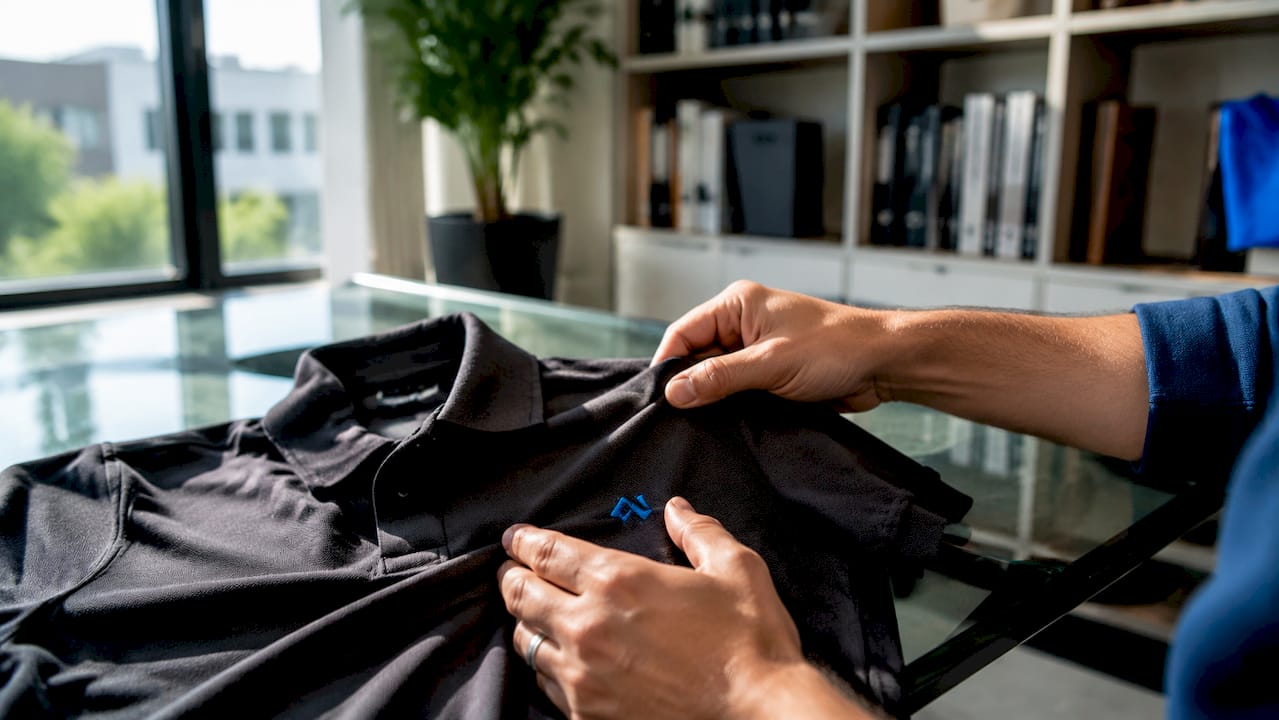
Beyond durability, embroidery delivers a physical branding dimension that printing simply cannot. The tactile texture signals professionalism and company stability to clients and customers at first glance. When a service technician, hotel staff member, or financial advisor walks into a room wearing an embroidered polo, the raised logo communicates quality before a single word is spoken.
Here are the core benefits that explain why corporate buyers consistently choose embroidery:
- Durability: Logos survive the garment’s full lifespan, especially on cotton piqué, fleece, and polyester oxford fabrics.
- Professional appearance: The three-dimensional texture reads as premium in client-facing and executive settings.
- Brand consistency: Every garment across every location carries an identical, color-accurate logo.
- Wash resistance: No cracking, peeling, or fading through repeated laundering cycles.
- Perceived value: Employees and clients both associate embroidered workwear with a serious, established company.
Pro Tip: Order a single embroidered sample before committing to a bulk run. The way a logo sits on the actual fabric tells you more than any digital mockup.
How does embroidery compare to screen printing and DTF?
Corporate apparel customization involves several decoration methods, and choosing the right one depends on your garment type, design complexity, and budget. The table below compares embroidery, screen printing, and Direct-to-Film (DTF) transfer across the factors that matter most to corporate buyers.
| Factor | Embroidery | Screen Printing | Direct-to-Film (DTF) |
|---|---|---|---|
| Durability | 50+ industrial wash cycles | Fades after 30–50 washes depending on ink | Less durable on some fabrics; can peel |
| Appearance | 3D texture, premium look | Flat, vibrant color | Photographic detail, full color |
| Best fabric | Polos, fleece, oxford, denim | T-shirts, cotton, canvas | Lightweight synthetics, cotton blends |
| Design complexity | Simple to medium logos | Complex graphics, gradients | Photographic or highly detailed art |
| Cost per unit | $2.50–$4.00 for simple logos | Lower for large runs | Moderate, no setup fees |
| Minimum orders | Flexible; single pieces possible | Often requires minimums | No minimums typically |
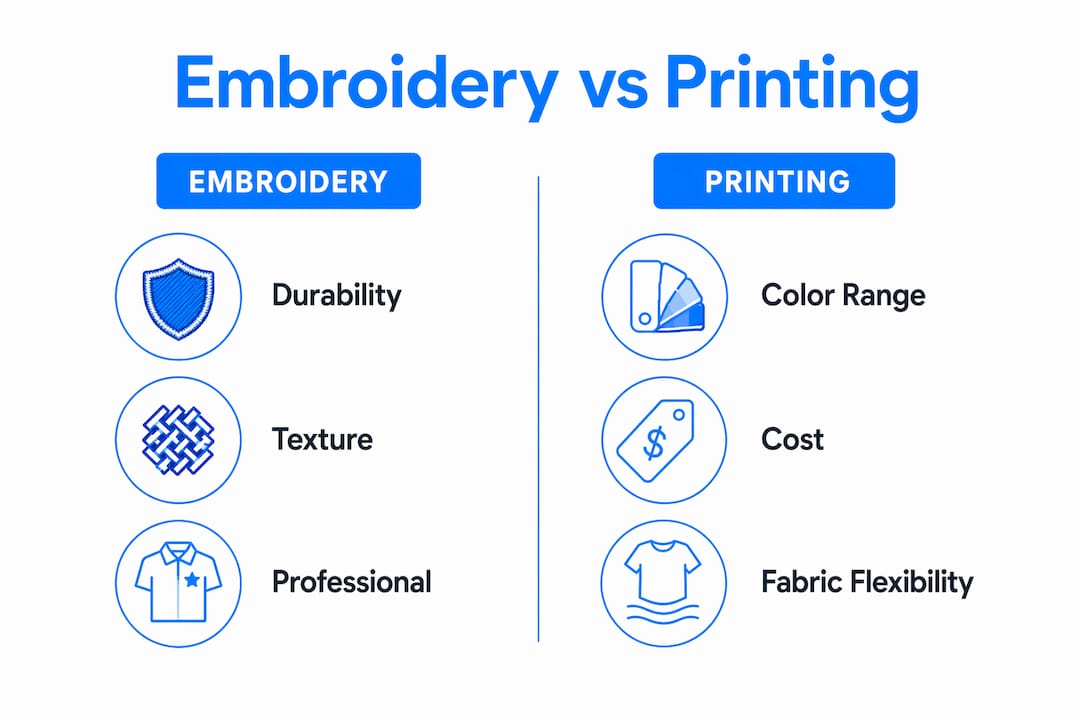
Embroidery is generally superior for polos and thicker fabrics because the stitching holds its form where printed logos crack or peel. Screen printing, on the other hand, works well for large-format graphics on T-shirts where flat color and fine detail matter more than texture. You can explore screen printing for bulk orders when your design includes gradients or photographic elements that embroidery cannot reproduce accurately.
DTF is the right call for lightweight technical fabrics or garments where embroidery would cause puckering. The key is matching the method to the garment, not defaulting to one technique for everything.
Pro Tip: For corporate programs that include both polos and T-shirts, use embroidery on the polos and screen printing or DTF on the tees. You get the best of both methods without compromising quality on either garment.
What should corporate buyers know about embroidery production?
Production cost and turnaround time for embroidered corporate apparel depend heavily on logo digitization complexity and stitch count. Simpler logos placed at the standard left-chest position minimize both cost and production time. Here is what to expect when planning your order:
- Digitization first. Every embroidery job starts with converting your logo into a stitch file. Simple logos with clean lines and limited colors digitize quickly and cheaply. Highly detailed artwork with gradients requires more time and a higher digitization fee.
- Cost per unit. Standard left-chest embroidery costs $2.50–$4.00 per unit for smaller orders. Bulk orders above 1,000 units unlock meaningful discounts. That per-unit cost drops significantly at scale.
- Stitch count matters. A logo with 8,000 stitches costs more to produce than one with 4,000 stitches. Simplifying your logo for embroidery, without losing brand recognition, is a smart move that saves money across every order.
- Fabric selection. Cotton piqué, fleece, and polyester oxford hold embroidery well. These fabrics provide the density needed to support stitching without distortion. Very thin or stretchy fabrics are poor candidates.
- Lead times. Standard production runs typically take 7–14 business days after digitization approval. Rush orders are available from many providers but carry a premium. Plan your uniform rollouts accordingly.
- Minimum order flexibility. Many providers accept single-piece orders for simple designs. This makes embroidery accessible for small teams or pilot programs before a full rollout.
For a broader look at how custom logo apparel options stack up across decoration methods, the garment type and logo complexity should always drive the decision.
How does embroidered workwear strengthen employee engagement?
The impact of embroidery on company image extends well beyond client perception. Embroidered workwear directly affects how employees relate to their roles and to each other. Consistent embroidered branding across teams increases brand recognition, customer trust, and internal cohesion. That is a measurable organizational benefit, not just an aesthetic one.
A well-chosen embroidered uniform influences employee attitudes, making staff take their roles and their presentation more seriously. This effect is most visible in service industries where frontline employees represent the brand directly. A hotel concierge in a crisp embroidered blazer carries themselves differently than one wearing a generic printed shirt. The garment communicates expectation.
Here is how embroidered workwear significance plays out across the organization:
- Team unity: Shared branded apparel removes visible hierarchy in customer-facing roles and creates a sense of belonging.
- Walking advertising: Every employee wearing your logo in public is a zero-cost brand impression. A team of 100 employees generates thousands of brand exposures daily.
- External credibility: Clients and partners read embroidered uniforms as a signal that the company invests in its presentation and its people.
- Retention signal: Quality workwear communicates that the company values employee experience, which contributes to morale.
The advantages of embroidered logos go beyond the garment itself. They shape how your brand is perceived from the inside out. For practical examples of how custom apparel branding builds identity across different business types, the principles apply equally to startups and established corporations.
When should companies choose a different decoration method?
Embroidery is not the right choice for every garment or every design. Knowing its limits protects your brand quality and your budget. Embroidery is unsuitable for thin, lightweight technical fabrics or intricate photographic designs because the stitching pulls the fabric and causes puckering. Over-stitching on thin material creates visible distortion that undermines the professional look you are trying to achieve.
Specific situations where you should consider alternatives include performance athletic wear, moisture-wicking fabrics, and any garment where the design includes photographic detail or complex color gradients. Screen printing and DTF both handle these cases better. DTF in particular works well on synthetic blends where embroidery would damage the fabric structure.
The smartest approach for most corporate programs is a mixed-method strategy. Use embroidery on polos, jackets, fleece, and hats where the fabric supports it. Use screen printing or DTF on T-shirts, athletic wear, and any garment where design complexity demands it. This combination gives you the premium look of embroidery where it counts most, and the flexibility of printing where it performs better. Reviewing a garment printing techniques guide before finalizing your decoration plan will help you match method to material accurately.
Key takeaways
Embroidery is the most durable and professionally credible decoration method for corporate apparel, delivering brand consistency and cost savings across the full uniform lifecycle.
| Point | Details |
|---|---|
| Durability advantage | Embroidered logos last 50+ industrial wash cycles versus 22 for vinyl transfers. |
| Cost per unit | Simple left-chest embroidery runs $2.50–$4.00 per unit with bulk discounts at scale. |
| Fabric compatibility | Cotton piqué, fleece, and polyester oxford hold embroidery best; avoid thin or technical fabrics. |
| Employee impact | Consistent embroidered uniforms build team cohesion and increase how seriously staff take their roles. |
| Know the limits | Use screen printing or DTF for photographic designs, gradients, or lightweight performance fabrics. |
The case for embroidery as a long-term brand investment
I have worked with dozens of corporate buyers who treat uniform decoration as a one-time procurement decision. That framing is the most expensive mistake they make. Embroidery is not a line item. It is a brand infrastructure decision that compounds over time.
The durability argument is real, but the deeper value is consistency. When every employee across every location wears the same embroidered logo, your brand becomes physically standardized in a way that no digital asset can replicate. I have seen companies switch from screen printing to embroidery mid-program and immediately notice that clients comment on the change without being prompted. The texture registers subconsciously as quality.
The pitfall I see most often is over-designing for embroidery. Buyers bring in logos with thin lines, gradients, and small text that simply do not translate to stitching. The fix is simple: create a dedicated embroidery version of your logo with bolder lines, fewer colors, and no text below 6 points. That version will look better at every size and on every fabric.
My honest recommendation is to treat embroidery as the default for any garment above the T-shirt tier, and to review your brand standards before you digitize. Getting the logo right at the start saves you from re-digitizing fees and inconsistent results across your fleet. Bulk ordering embroidered apparel delivers better value over time precisely because the garments last long enough to justify the upfront investment.
— Christian
How Tektonla supports corporate embroidery programs
Tektonla provides embroidered corporate apparel from its Downtown Los Angeles facility, with fast turnaround and no minimum order requirements on blanks. Whether you are outfitting a five-person executive team or a 500-person field crew, Tektonla’s embroidery service covers logo digitization, fabric selection guidance, and bulk production.
The Printers Shirt and the Garment Dye Shirt are both built for embroidery, with fabric weights that hold stitching cleanly without distortion. Tektonla also offers embroidered logo patches as a flexible option for brands that want to apply branding across multiple garment types without re-digitizing. Contact Tektonla directly for a quote or to request a sample before committing to a full run.
FAQ
What makes embroidery better than printing for corporate uniforms?
Embroidery stitches logos directly into fabric, lasting 50+ industrial wash cycles compared to vinyl transfers that crack after 22 washes. The three-dimensional texture also communicates quality and professionalism in a way flat printing cannot.
How much does corporate embroidery cost per garment?
Standard left-chest embroidery costs $2.50–$4.00 per unit for smaller orders, with bulk discounts available at 1,000+ units. Cost depends on stitch count and logo complexity.
What fabrics work best for embroidered logos?
Cotton piqué, fleece, and polyester oxford hold embroidery well without distortion. Thin, lightweight, or highly stretchy fabrics are poor candidates and may require screen printing or DTF instead.
Can embroidery reproduce complex or photographic logos?
Embroidery cannot accurately reproduce photographic detail or complex color gradients. For those designs, Direct-to-Film or screen printing are the recommended alternatives.
Does embroidered workwear actually affect employee behavior?
Research shows that consistent embroidered uniforms increase internal cohesion and influence employees to take their roles more seriously, strengthening team identity and brand representation on the floor.