


Pick tri-blend for a soft, vintage drape that feels broken in from the first wear, and pick 100% cotton for the breathability and crisp, bright print results that graphic tees demand. Printing suitability is often the real tiebreaker: cotton grabs ink and holds color better, while tri-blend gives you a heathered, muted look that reads as retro rather than sharp. The sections ahead break down exactly why, so you can match the fabric to the job instead of guessing.
TL;DR:
- Cotton fabrics typically weigh between 150 and 180 GSM, offering higher opacity and firmness, suitable for vibrant, detailed prints.
- Tri-blend shirts, usually around 130 to 145 GSM, feel softer, drape more like vintage tees, and are semi-sheer in lighter shades.
- Cotton absorbs moisture better, making it more breathable for hot conditions, while tri-blend dries faster and resists shrinking due to polyester content.
- Prints on cotton are sharper and more vibrant, whereas tri-blend produces muted, heathered effects that suit vintage or streetwear styles.
- For long-lasting wear, tri-blend’s polyester component resists shrinking and maintains shape better, but cotton holds up well with proper care and pre-shrinking.
Table of Contents
- What Are Tri-Blend and Cotton, Exactly?
- What Does Tri-Blend Feel Like Compared to Cotton?
- Which Fabric Breathes Better and Handles Sweat?
- Which Fabric Holds Up Better Over Time?
- How Do Prints Look on Tri-Blend vs. Cotton?
- How Should You Wash Tri-Blend and Cotton to Make Them Last?
- Which Fabric Should You Choose for Your Project?
- Tekton LA’s Take on Choosing Blanks for Client Work
- How Tekton LA Turns This Comparison Into Your Next Shirt
- Sources
- FAQ
What Are Tri-Blend and Cotton, Exactly?
Some blanks run a 50/38/12 split instead, leaning more on cotton and less on rayon, which shifts the feel slightly firmer and less silky. Either way, the polyester does the structural work, the cotton adds breathability and natural texture, and the rayon (a manufactured cellulose fiber, also called viscose) delivers the soft, fluid drape that makes tri-blend tees feel expensive right out of the bag.
Cotton shirts, by contrast, are built from a single natural fiber, though quality varies a lot depending on whether the yarn is carded or combed and ring-spun. Combed ring-spun cotton produces a smoother, more refined surface than basic carded cotton, which matters more for print clarity than most buyers realize.
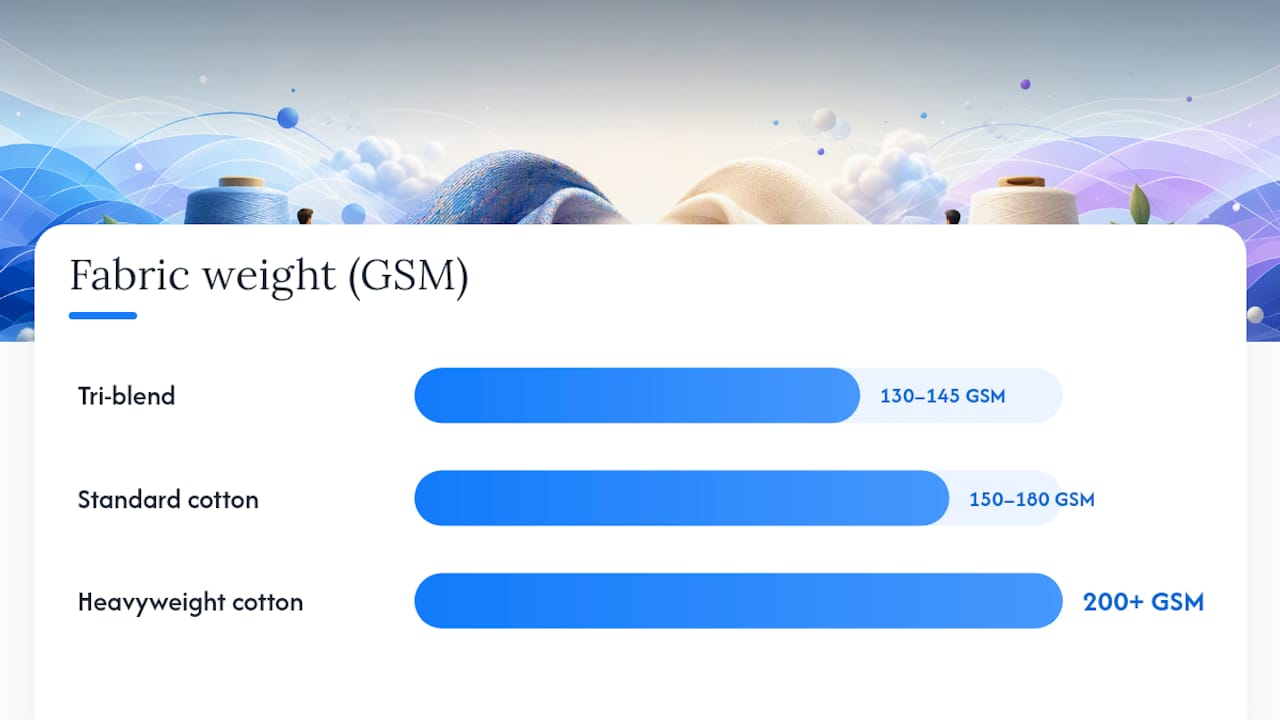
Weight tells its own story. Tri-blend blanks typically run 3.8 to 4.3 ounces per square yard, or about 130 to 145 GSM, noticeably lighter than a standard 100% cotton tee, which usually sits closer to 5 to 6 ounces. That lighter weight is why tri-blend often reads as slightly translucent, especially in pale colors, while a midweight or heavyweight cotton shirt gives you fuller opacity and a more substantial hand.
GSM and opacity, side by side:
- Tri-blend: 130 to 145 GSM, semi-sheer in lighter shades, drapes close to the body.
- Standard cotton: 150 to 180 GSM, solid opacity, holds its shape away from the body.
- Heavyweight cotton: 200+ GSM, near-opaque even in white, boxier fit.
If you’re deciding between the two for a print job, the weight difference alone should factor into your call. A design meant to pop needs a fabric that won’t show through, and that usually points toward cotton.
What Does Tri-Blend Feel Like Compared to Cotton?
Tri-blend feels like a shirt you’ve already washed twenty times, even when it’s brand new. That sensation comes almost entirely from the rayon content: rayon supplies the silky drape and soft hand that makes tri-blend collapse gently against the body instead of standing off it the way stiffer fabrics do. There’s no break-in period. You put it on and it already moves like a favorite old tee.
Cotton starts firmer. A new 100% cotton shirt has more structure and a crisper hand, and it takes several washes before it really relaxes into that soft, familiar feel. Some buyers actually prefer this, since a firmer starting point holds a boxier silhouette and doesn’t cling.
Fit is where people get tripped up. Tri-blend tees often run slightly slimmer than a comparable cotton cut, partly because the fabric itself hugs the body more due to its lighter weight and drape.
- If you like a relaxed, roomy fit, size up when ordering tri-blend blanks.
- If you’re layering tri-blend under a jacket or hoodie, the slimmer cut usually works in your favor.
- Cotton tees in standard weights tend to run true to size, with heavyweight cotton adding a touch of boxiness.
- Combed ring-spun cotton feels noticeably smoother against skin than carded cotton, closer to tri-blend’s softness without the rayon.
Neither fabric is objectively better here. It comes down to whether you want a shirt that already feels lived in, or one that breaks in over time and holds a firmer shape while it does.
Which Fabric Breathes Better and Handles Sweat?
Cotton wins on breathability, and the reason comes down to a fiber property called moisture regain. Cotton absorbs roughly 7 to 8% of its weight in moisture, compared to polyester’s 0.4%. That gap explains almost everything about how these fabrics feel during a hot day or a hard workout.
Cotton pulls sweat off your skin and holds onto it, which keeps you feeling dry at first but means the fabric stays damp longer after you stop sweating. Polyester, the dominant fiber in tri-blend, does the opposite: it barely absorbs moisture, so sweat sits on the surface rather than soaking in. That’s efficient for quick-drying performance wear, but it also means a heavily sweated tri-blend shirt can feel clammy and cling to skin in a way cotton usually doesn’t.
Drying speed favors tri-blend by a wide margin. The polyester content sheds water fast, so a sweaty tri-blend tee will air dry well before a soaked cotton one does. For anyone doing laundry on a tight schedule or packing light for travel, that’s a real practical advantage.
Odor is the tradeoff nobody mentions enough. Synthetic fibers like polyester are linked to higher odor retention and more microfiber shedding than natural fibers, largely because bacteria bind more readily to synthetic surfaces than to cotton. If you’ve ever pulled a polyester-heavy shirt out of the hamper and caught a smell that a cotton shirt from the same load didn’t have, that’s not your imagination.
A few practical fixes help either fabric:
- Wash tri-blend and other polyester-heavy garments promptly after heavy sweating rather than letting them sit in a bag or hamper.
- Use a detergent formulated to break down body oils (enzyme-based formulas work well) for synthetic blends prone to odor buildup.
- For cotton, don’t over-dry on high heat repeatedly, since that accelerates fiber breakdown over time even though it doesn’t cause odor issues the way synthetics do.
For all-day comfort in heat, cotton usually feels better against skin. For fast turnaround between wears or activities where quick drying matters more than absorbency, tri-blend has the edge.
Which Fabric Holds Up Better Over Time?
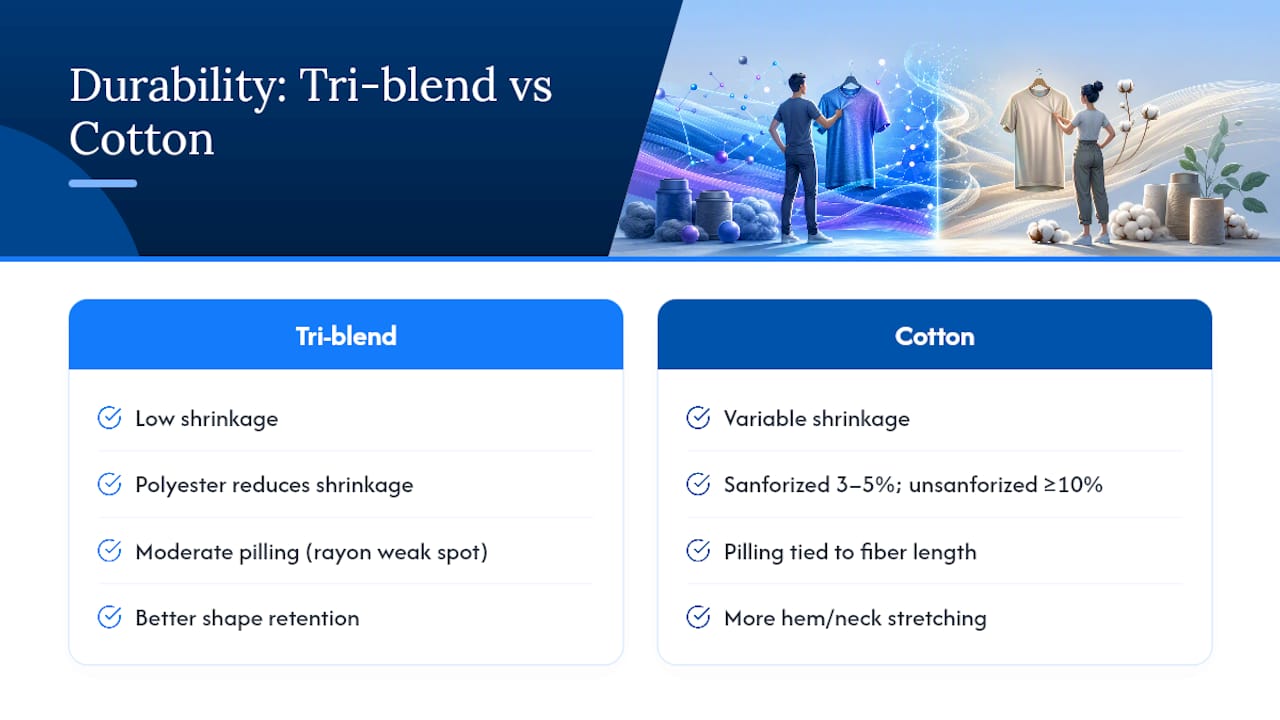
Tri-blend resists shrinking far better than plain cotton, and the mechanism is simple: polyester makes up half the blend and has almost no moisture regain, so it barely changes dimension when washed. Cotton fibers swell when wet and contract as they dry, which is the root cause of shrinkage.
Cotton shrinkage isn’t universal, though. Sanforized cotton, a pre-shrinking process most quality blanks go through before cutting, controls a large share of potential shrinkage before the fabric ever reaches a sewing machine. A sanforized cotton tee typically shrinks only 3 to 5% after the first wash, versus 10% or more for unsanforized fabric. If you’re buying blanks, checking whether the manufacturer specifies sanforized cotton is worth thirty seconds of label-reading.
Pilling comes down to abrasion and fiber length more than fabric type alone. Shorter, weaker fibers break and tangle into those little balls faster than long, strong ones. Polyester actually resists pilling reasonably well on its own, but tri-blend’s rayon content is the softer spot in the weave. Rayon can lose strength when wet, and repeated wash cycles or rough drying can accelerate wear in ways that don’t show up as dramatically on straight cotton or straight polyester garments.
Shape retention overall favors tri-blend for the life of the garment, mostly because polyester’s structural stability keeps necklines and hems from stretching out the way an all-cotton tee can after heavy wear. Cotton fights back with fiber toughness. Cotton’s natural tensile strength holds up well against abrasion, which is part of why a well-made heavyweight cotton shirt can last for years of regular wear even as it softens.
How Do Prints Look on Tri-Blend vs. Cotton?
Cotton delivers brighter, crisper prints. Tri-blend delivers softer, heathered ones. That single distinction should drive most of your fabric decision if printing quality is the priority.
Prints on tri-blend come out muted because the fabric itself is heathered, a blend of different-colored fibers that scatters light rather than reflecting it uniformly. Ink sits on top of a slightly textured, multi-toned surface, so even solid colors pick up a faded, vintage cast. Cotton, especially bright white or solid-dyed cotton, gives ink a flat, consistent surface to bond with, which is why the same design can look punchy on cotton and washed out on tri-blend.
Print method guidance by fabric and goal:
- Screen printing performs best on cotton for bold, solid-color graphics where color accuracy matters. It also works on tri-blend but expect the heather to soften every color slightly.
- Direct-to-garment (DTG) suits cotton well because the fabric’s flat surface holds fine detail and gradients cleanly; it can struggle to anchor properly on tri-blend’s synthetic content.
- Direct-to-film (DTF) works across both fabrics since the design transfers as a film layer rather than absorbing into the fibers, making it a safer bet when you’re not sure which blank you’ll end up using.
- Sublimation requires high polyester content to bond properly, which makes tri-blend a workable substrate but rules out 100% cotton entirely, since sublimation ink needs polyester fibers to gasify into.
Opacity plays into this too. Because tri-blend runs lighter and thinner than most cotton blanks, dark or highly saturated designs may need an extra ink pass or a white underbase to avoid looking see-through against the fabric’s natural texture.
Bella+Canvas and Next Level publish detailed spec sheets for their tri-blend and cotton lines, and checking those references before placing a bulk order is smart practice; GSM, fiber percentage, and fit specs vary more between brands than most buyers expect.
Pro Tip: If you want a genuine vintage-wash look without actually distressing the garment, print on tri-blend with a slightly desaturated color palette. Fighting the heather with oversaturated ink almost always looks worse than designing around it.
For fine-line artwork, small text, or photorealistic designs, cotton is close to a requirement rather than a preference. For band merch, streetwear drops, or anything chasing a worn-in retro aesthetic, tri-blend’s muted print quality becomes the feature, not the flaw.
How Should You Wash Tri-Blend and Cotton to Make Them Last?
Cold water is the safer default for both fabrics, especially anything printed. Hot water accelerates shrinkage in cotton and can soften certain print inks over repeated cycles, so cold or warm water extends the life of graphics on either substrate.
Turn printed shirts inside out before washing. This single habit does more to protect a print than any detergent choice, since it reduces direct friction between the ink and the washer drum or other garments.
Skip fabric softener on tri-blend. Softener residue builds up on synthetic fibers over time and can actually make polyester-heavy blends feel waxy rather than soft, undercutting the natural drape rayon already provides.
Air drying beats tumble drying for shrink control on cotton, and it protects tri-blend’s rayon content from the repeated heat stress that weakens fibers over time. If you need a dryer, use low heat and pull garments out while still slightly damp.
Realistically, a well-cared-for cotton tee lasts several years of regular wear before fading or thinning becomes obvious, while tri-blend’s synthetic backbone can outlast cotton structurally, even as its softer rayon content means it needs gentler handling to avoid pilling. Neither fabric is fragile. Both just reward slightly different habits.
Which Fabric Should You Choose for Your Project?
Match the fabric to what actually matters most for your shirt, not to whichever one sounds trendier.
- Want a soft, vintage feel with no break-in period? Choose tri-blend. The rayon content delivers that lived-in drape from day one.
- Need bright, high-fidelity prints with fine detail? Choose cotton, ideally combed ring-spun. It holds ink better and won’t mute your color palette.
- Expecting heavy sweat, like athletic or outdoor use? Lean tri-blend for faster drying, but know that cotton feels more absorbent against skin during the activity itself.
- Layering under jackets or hoodies? Tri-blend’s slimmer fit and lighter weight work well here; size up if you want more room.
- Working with a tight budget on a large order? Cotton blanks are generally more widely available at lower price points across a broad range of GSM weights, though exact costs depend on your supplier and order volume.
- Building a print run meant to look worn-in or retro on purpose? Tri-blend’s heathered, muted print appearance does that work for you without any special ink technique.
- Considering something outside these two entirely? Heavyweight cotton (200+ GSM) gives you cotton’s breathability with a boxier, more durable structure, while performance synthetics (100% polyester athletic blends) beat tri-blend on pure moisture-wicking if breathability during hard activity is the only priority.
Sizing note: since tri-blend runs lighter and slimmer than most cotton blanks, always check a brand’s specific size chart rather than assuming your usual cotton size transfers directly. A medium in one line’s tri-blend can fit closer to a small in another brand’s cotton cut.
Tekton LA’s Take on Choosing Blanks for Client Work
When a client brings us artwork, the fabric decision comes down to four questions: how detailed is the print, what look are they after, how much wash durability do they need, and which production method fits the budget and timeline. A photorealistic design headed for combed ring-spun cotton and DTG printing is a completely different job than a faded, vintage-style graphic going onto tri-blend with a screen print.
Small brands ordering their first run often default to cotton because it feels like the “safe” choice, but tri-blend frequently fits their actual goals better once we walk through the softness and drape they’re picturing. No minimum order requirements matter here too. A designer testing a single tri-blend style doesn’t need to commit to a bulk cotton order just to find out which fabric their audience responds to.
— Christian
How Tekton LA Turns This Comparison Into Your Next Shirt
Custom print providers often offer both tri-blend and cotton blanks with flexible order quantities, allowing testing before committing to large runs. Whether you need DTG for a detailed cotton print or DTF for a heather-friendly tri-blend run, production happens locally with fast turnaround, including same-day or next-day options when a project is on a deadline.
If you already know your fabric, the tri-blend shirt and the printers shirt are solid starting points for a sample order. If you’re still deciding between screen printing and DTG for a specific design, a 2 color screen print run is a low-risk way to test how your art holds up on the substrate you’re leaning toward. Request a quote or order a sample through Tekton LA and see how your design actually looks before committing to a full print run.
Sources
The fiber and construction claims here draw on manufacturer and industry references, including Bella+Canvas’s own breakdown of tri-blend construction, RIPT Apparel’s explanation of the 50/25/25 tri-blend standard, and Natu Clothes’ composition and GSM data. Moisture regain figures come from Craft and Design’s fiber comparison, and background on synthetic fiber behavior comes from the Science History Institute. Always check a manufacturer’s current spec sheet before placing a bulk blank order, since GSM and fiber ratios can shift between production runs.
- What Is a Tri-Blend T-Shirt? Composition and Feel
- What Is A Tri-Blend Shirt? 50/25/25 Explained | RIPT Apparel
- Tri-Blend VS Cotton T-Shirts — Craft and Design
- What’s a Triblend? – Beyond the Blank
- Synthetic Threads (Science History Institute)
FAQ
What Does Tri-Blend Feel Like?
Tri-blend feels soft and slightly clingy from the first wear, with a drape closer to a well-worn shirt than a new one. That texture comes from the rayon content, which gives tri-blend its silky hand and fluid movement against the body.
What Fabrics Should You Stay Away From for Fine-Detail Printing?
Avoid tri-blend and other heathered synthetic blends if your design has fine lines, small text, or photorealistic detail. The heathered surface mutes ink and scatters color, so combed ring-spun cotton is the safer substrate for high-fidelity artwork.
Does Tri-Blend Fabric Shrink?
Tri-blend shrinks less than 100% cotton because polyester, roughly half the blend, has almost no moisture regain and resists dimensional change in the wash. Cold water washing and air drying keep shrinkage minimal on any tri-blend garment.
What’s Better, 100% Cotton or 100% Polyester?
Neither is universally better since they serve different needs. Cotton breathes better and feels more natural against skin, while polyester dries much faster and resists wrinkling, which is exactly why tri-blend blends both fibers to capture pieces of each advantage.
Does Tekton LA Offer Both Tri-Blend and Cotton Blanks?
Yes, Tekton LA prints on both fabric types with no minimum order requirement, letting you order a single sample or a full production run of either. Current pricing is available directly on the Tekton LA site.