

A custom bandana is a square of fabric carrying your logo or artwork. The right print method depends on the fabric, the number of colors in your design and how many pieces you need. Cotton with a one- to three-color logo points to screen printing. Full-color, edge-to-edge art on a light polyester points to sublimation. Small runs of detailed art point to digital or DTF. Our team prints in Los Angeles and can match the method to the job, with no minimum order on blanks and same-day or next-day options for urgent work.
This guide is for brands, designers, event organizers, teams and marketing departments. It covers what each method does, which size and fabric to choose, how to prepare your file, what drives cost and turnaround, and how bags and other merchandise can match your bandanas.
TL;DR
- Match the method to the fabric: screen printing for cotton logos, sublimation for white or light polyester with full-color art, digital direct-to-fabric for detailed art on cotton in smaller runs, DTF for small runs on thin fabric.
- The standard adult bandana is about 22 x 22 inches, with a printable area of roughly 19 to 20 inches square, or full bleed if the method allows it.
- Send vector artwork and decide where the logo sits before you request a quote. Most delays and reprints start with the file.
- Cost and minimums move with the method, the number of colors and the quantity, so settle those three first.
- Bandanas work well alongside bags, headwear and woven-label apparel as one coordinated merchandise line.
Table of Contents
- What a custom bandana can do for your brand
- Printing methods compared
- Fabric, size and finish
- How to prepare your artwork
- What affects cost, minimums and turnaround
- Pairing bandanas with bags and other merch
- Our view on bandana orders
- Start your bandana order with Tekton LA
- FAQ
- Sources
What a custom bandana can do for your brand
The bandana is a fashion item again, which is why it works for brands as well as for giveaways. In its October 2025 issue, PPAI Magazine features a US-made 100% cotton bandanna printed with water-based ink and notes that bandanas are making a comeback in fashion. The same issue observes that subtle logos and artistic graphics make promotional items feel more like retail pieces.
That gives you three practical uses:
- Brand and merch drops. A bandana is cheap to ship, fits any size and gives a small label a wearable canvas for a pattern or illustration, not just a logo.
- Events and festivals. One print run covers every attendee, and a date or event name turns the bandana into a keepsake.
- Teams and clubs. Team colors and a crest work as neckwear, headwear or a bag accent, and one item serves players, staff and fans.
Corporate marketing teams tend to use them as a step up from a standard giveaway, with a pattern or understated mark rather than a large logo.
Printing methods compared
There are five methods you will meet on a quote. DAX Show’s custom bandana guide matches each to a fabric and run size, and the table below follows it.
| Method | Best fabric | Best for | Run size |
|---|---|---|---|
| Screen printing | Cotton | Logos and designs with 1 to a few spot colors | Larger runs |
| Dye sublimation | White or light, high-polyester | Full-color, edge-to-edge art | Small to large |
| Digital direct-to-fabric | Cotton | Detailed art | Smaller runs |
| Heat transfer vinyl (HTV) | Various | One-offs and very small runs | Very small |
| DTF transfer | Thin fabric | Detailed art via a film layer | Small runs |
Screen printing
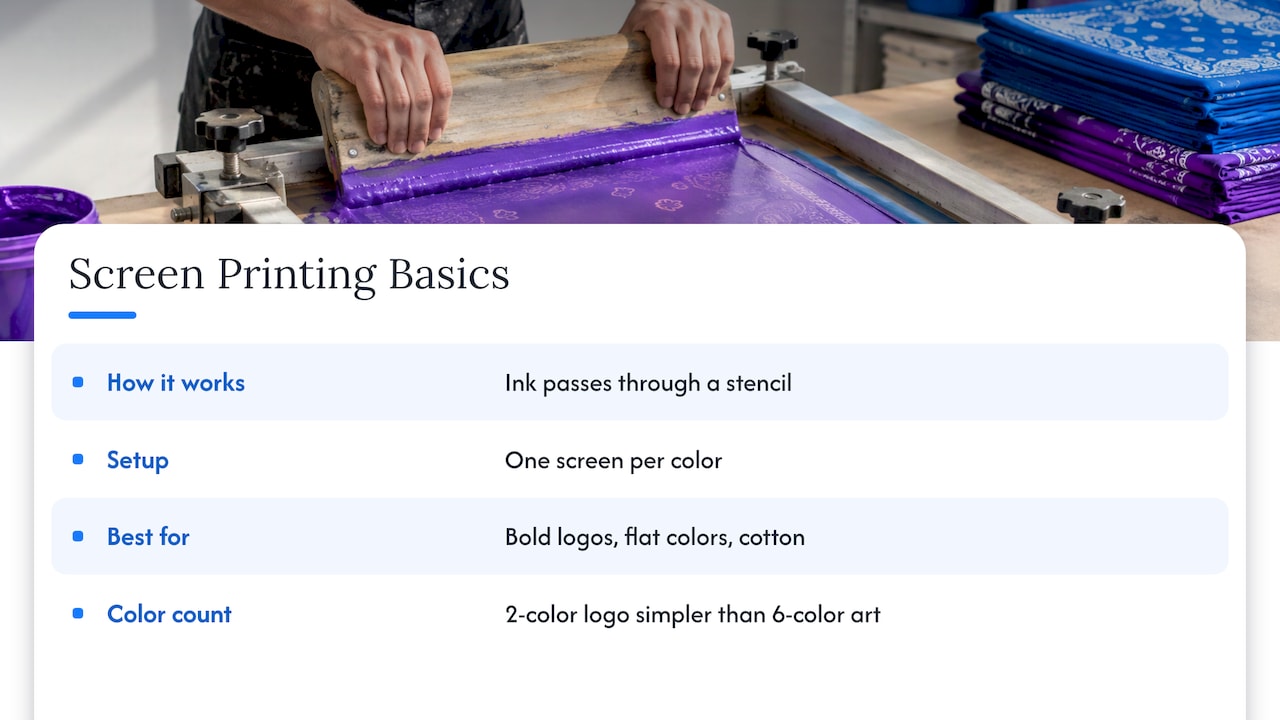
Screen printing pushes ink through a stencil, one screen per color. It suits bold logos, flat colors and repeat orders on cotton. Every added color means another screen, so a two-color logo is far simpler than a six-color illustration. We run silkscreen in house, and you can see its silkscreen pricing before you commit. If you want the retail-side trade-offs between screen printing and digital for small brands, this screen print versus DTG comparison covers cost and durability.
Dye sublimation
Sublimation turns ink into a gas that bonds with polyester fibers, so the design is part of the fabric and has no raised feel. It needs white or light fabric with a high polyester content, and it is the method for artwork that runs right to the edge of the bandana. Dark or cotton-rich fabric will not give you vivid color.
Digital direct-to-fabric and DTG
Large-format digital printing places a computer-generated design directly onto cotton. It handles gradients, photographs and many colors without extra setup per color, which is why it suits smaller runs of detailed art. Our DTG service uses the same idea on garments, and DTG pricing is published on our site.
DTF transfers
Direct-to-film prints the design onto a film, then presses it onto the fabric. It works for small runs and for thin fabrics where you want sharp detail. Details on how we run it are on our DTF page.
Heat transfer vinyl
HTV is cut vinyl pressed onto the cloth. It is a fit for one-offs and very small quantities such as a sample, a founder’s own piece or a single custom order.
Fabric, size and finish
Size. DAX Show says the most common adult bandana is about 22 x 22 inches, with a printable area of about 19 to 20 inches square, or full bleed. Pet or smaller sizes may be available on request, so decide early if you want a pet version for an event or brand collection.
Fabric. Your fabric and your method decide each other:
- 100% cotton is the classic. It takes screen printing or digital cotton methods well. The PPAI-featured US-made bandanna mentioned above is 100% cotton, printed with water-based ink.
- Polyester is the choice for sublimation and full-color edge-to-edge artwork.
- Poly-cotton blends are used where durability and washing matter. PPAI Magazine’s April 2025 issue describes a pet bandana made from a breathable poly-cotton blend that is durable and machine washable.
If you are printing on polyester with any ink-based method, dye migration can bleed color into light areas. Our notes on preventing dye migration in polyester printing explain what to watch for. For garments rather than bandanas, our guide to polyester DTG printing covers pretreat and print area.
Finish. Eco-conscious teams often ask about water-based inks and natural cloth. Ask for those specifically when you request a quote. We also emphasize eco-friendly practices, including locally sourced materials and garment dyeing, which you can pair with a printed bandana in a matching color story.
How to prepare your artwork
Bad artwork is the most common reason a first bandana run looks off. Work through this list before you send anything.
- Use vector files. PPAI’s Apparel Decorating Guidelines advise providing a vector file for embroidery and cut-vinyl decorating, because vector art is built from points, nodes and outlines that can be filled or outlined without losing quality. The same logic applies when a logo is enlarged for a bandana corner or a repeat pattern.
- Know your print area. Design inside roughly 19 to 20 inches square unless your method supports full bleed. Keep anything critical, like a wordmark, clear of the edges where hemming or trimming can cut into it.
- Limit the colors for screen printing. One to a few spot colors keeps the run simple. If your design has twelve colors and gradients, pick digital or sublimation instead.
- Decide the layout. Options include a centered logo, a corner mark with a pattern field, or an all-over repeat. A corner or center logo reads differently when the bandana is folded and worn, so picture it folded before you approve.
- Check fabric color against ink. Light inks vanish on dark cotton, and sublimation will not show on dark polyester.
Our print file best practices guide goes through file formats, resolution and color setup in more detail. If your order also includes banners, the banner file setup checklist covers bleed and safe zones.
What affects cost, minimums and turnaround
Bandana pricing is not one number. Four things move it:
- Method. Screen printing has setup per color, so unit price drops as quantity rises. Digital and sublimation have less setup, which makes them practical for smaller runs.
- Number of colors and coverage. More screens or more ink coverage increases cost. An all-over design costs more to produce than a one-color corner logo.
- Quantity. DAX Show says supplier minimums often range from about 12 to 50 pieces depending on the method, so a very small test run limits your options. Plan quantity and method together.
- Fabric and size. Specialty fabric, smaller or larger sizes and finishing add to the price.
Turnaround follows the same logic. Screen printing needs screens made and a press set up. Digital and transfer methods start sooner. Because our production is made entirely in Los Angeles, we can offer same-day or next-day options for urgent jobs, which matters when an event date is fixed. If you are working back from a launch or a show, tell us the in-hands date when you ask for a quote, since that decides which method fits.
Published prices for our related services are on the pricing pages for embroidery and private labeling and finishing. For a bandana quote, send the quantity, size, fabric and artwork.
Pairing bandanas with bags and other merch
A bandana is rarely the only item in a campaign. The brands that get the most from them treat bandanas, bags and headwear as one line with matching colors and marks.
In PPAI Magazine’s April 2025 issue, Sarah Whitaker of Williams Advertising says clients love multipurpose products and full customization, including full-color edge-to-edge design, color-matched stitching and custom hardware on bags, because those items are both functional and highly visible. That works the same way for a bandana: it can be neckwear, a hair wrap or a bag accent.
Some ways to coordinate:
- Match the palette. Use the same ink colors across the bandana, a tote and a cap so the items read as one collection.
- Repeat one mark. A pattern on the bandana and a small logo on a bag strap is stronger than the same big logo everywhere.
- Add a label. If you sell apparel alongside, custom woven labels in all sizes carry your brand into the garments that go with the bandana.
- Use our blanks. Our range includes bags, headwear, water bottles, mugs and activewear, with no minimum order quantities on blanks, so you can add items without committing to a big run.
For ideas on how young labels build a recognizable look, see these custom apparel branding examples for startups. For retail-style inspiration on bandanas as a fashion accessory, this piece on streetstyle accessories and understated logos shows the look many brands aim for.
Our view on bandana orders
Most bandana orders we talk about start with a design and a date, and the method follows from those two things. A one-color logo for a team does well on cotton. A full-color illustration for a festival wants a different process. The mistake we see people want to avoid is picking the method first and fitting the art into it.
We print in Los Angeles, so we can handle complex branding requirements and urgent timelines in one place: screen printing, DTG, DTF, embroidery, woven labels, private label and banners. That means the bandana, the tote and the labels on your apparel can come from one shop, in one color story, instead of three suppliers with three sets of proofs.
If you are a startup, start small. No minimums on blanks means you can test a product line before you commit to a large run, then scale the same design when it sells.
Christian
Start your bandana order with Tekton LA
We produce custom clothing printing and branding for independent brands, designers, event organizers, sports teams and corporate marketing teams. Our services include fabric printing, silkscreen, DTF, DTG, embroidery, woven labels and private label work, all produced in Los Angeles, with same-day or next-day options for urgent jobs.
Send us your artwork, quantity and in-hands date through our site and we will recommend the method that suits your fabric and design.
FAQ
What is the best method for printing a logo on a bandana?
For a logo with one to a few solid colors on cotton, screen printing is the usual match, especially on larger runs. If your logo has many colors or gradients, digital or sublimation handles that detail better. Send us the file and we will tell you which fits.
What size should a custom bandana be?
The most common adult size is about 22 x 22 inches, with a printable area of roughly 19 to 20 inches square. Full-bleed printing is possible with some methods, and smaller or pet sizes may be available on request.
What file format works best for bandana artwork?
Vector files are the best choice because they scale without losing sharpness, which matters when a logo moves between a bandana corner, a tag and a bag. Send the original vector file along with any color references you want matched.
How many bandanas do I need to order?
Supplier minimums commonly run from about 12 to 50 pieces depending on the print method. Quantity, method and colors together set the unit price, so give us all three when you ask for a quote.
Can I match my bandanas to bags and other merchandise?
Yes. Use the same colors and one repeated mark across the bandana, a tote and headwear, and add woven labels to coordinated apparel. We offer bags, headwear, water bottles and mugs as blanks that can be decorated to match.
Sources
- PPAI Magazine, October 2025
- PPAI Magazine, April 2025
- DAX Show: Custom Bandanas
- PPAI: Apparel Decorating Guidelines