


If you’re branding polos, jackets, or anything that gets washed weekly, choose embroidery. If you’re printing bold, colorful graphics across a large area or running a big batch of shirts, choose screen printing. That’s the short version.
Embroidery stitches thread directly into fabric, producing a raised, textured finish that holds up to repeated washing and reads as premium on a chest logo or hat. Screen printing pushes ink through a mesh stencil, which makes it the better tool for vibrant, multi-color artwork and gets cheaper per piece as your order grows.
Tekton LA runs both processes in house, so you’re not locked into one method before you know what your project actually needs. Use the checklist near the end of this article with whichever decorator you work with.
Key Takeaways
Embroidery wins on durability and premium feel for small logos, while screen printing wins on color range and per-piece cost at higher quantities.
| Point | Details |
|---|---|
| Pick by project type | Choose embroidery for small logos and frequently washed apparel, screen printing for large, colorful bulk runs. |
| Mind the size limits | Embroidered text under three-eighths of an inch tends to blur; screen printing handles fine detail better. |
| Quantity flips the cost math | Screen printing’s per-piece cost drops fast past a few dozen units; embroidery’s cost stays flatter. |
| Always sample first | Request a physical wash-tested sample before committing to a full production run. |
| Tekton LA runs both methods | Tekton LA handles embroidery, screen printing, and file prep in house, so the recommendation isn’t tied to one machine. |
Table of Contents
- Embroidery vs Screen Printing at a Glance
- What Is Embroidery and How Does It Actually Get Made?
- What Is Screen Printing and How Does It Actually Get Made?
- The 8 Decision Factors, With Real Pricing Scenarios
- Best Uses for Embroidery and Screen Printing
- How to Estimate Cost, Quantity, and Turnaround
- Care, Washing, and How Long Each Method Lasts
- Materials, Placements, and Design Limits to Watch
- Tekton LA’s Practical Tips From the Production Floor
- Why Most Buyers Overthink This Decision
- Ready to Print or Stitch Your Next Order?
- Sources
- FAQ
Embroidery vs Screen Printing at a Glance
The two methods solve different problems, and the gap shows up clearly once you line up the variables side by side.
| Factor | Embroidery | Screen Printing |
|---|---|---|
| Durability / washability | Excellent, resists fading for years | Good, can crack or fade over many wash cycles |
| Detail / small text | Struggles below a certain stitch size | Handles fine lines and small text well |
| Color capability | Limited by thread count, no gradients | Strong with gradients, halftones, unlimited color mixing |
| Texture / finish | Raised, tactile, premium feel | Flat to slightly raised depending on ink |
| Fabric compatibility | Best on stable, denser fabrics | Best on flat knits and wovens |
| Cost at quantity | Cost stays steady regardless of design size | Setup cost drops sharply per piece at volume |
| Setup / turnaround | Faster setup for small logos | More setup, but scales fast |
| Placement / size limits | Limited by hoop size, tight on caps | Handles large-format prints across the chest |
A few things jump out immediately:
- Embroidery wins on longevity and feel; screen printing wins on color range and price at scale.
- Small logos on hats and polos almost always look and wear better embroidered.
- Big, colorful graphics on the front of a shirt almost always favor screen printing.
Picture a baseball cap with a small embroidered logo on the front panel next to a t-shirt with a full-color, full-front graphic. The cap wins with embroidery every time. The tee wins with screen printing almost as often.
What Is Embroidery and How Does It Actually Get Made?
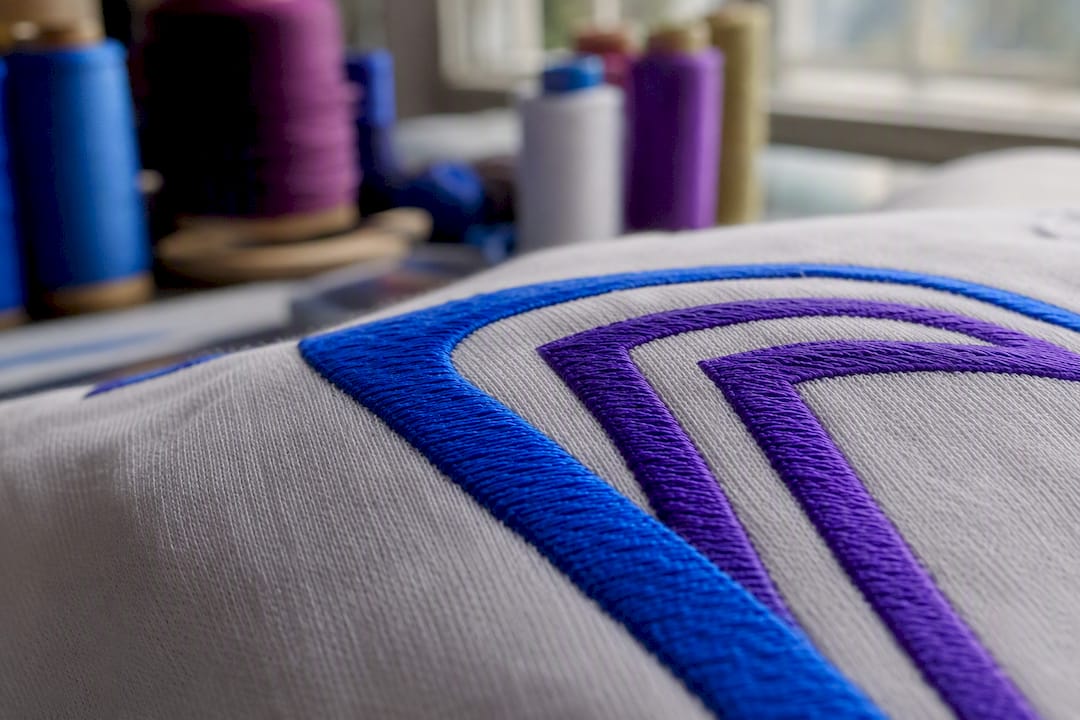
Embroidery starts as a digital file, not a needle and thread. A digitizer converts your artwork into a stitch file the machine can read, mapping out stitch direction, density, and order.
- Digitize the artwork — the logo gets converted into a machine-readable stitch pattern.
- Hoop the garment — fabric gets stretched taut in a frame so stitches land in the right spot.
- Run the machine — needles lay thread in the pattern, one color at a time.
- Trim and finish — loose threads get cut and the garment gets pressed.
Three stitch types cover most jobs. Satin stitches create the smooth, shiny fill you see on letters and borders. Fill stitches cover large areas with a crosshatch pattern. Run stitches trace thin outlines or fine detail lines. A digitizer picks the mix based on the artwork.
Pro Tip: Keep embroidered text at three-eighths of an inch tall or larger, and avoid stitch densities so tight the fabric puckers. Below that size, letters tend to blur into a solid blob of thread.
What Is Screen Printing and How Does It Actually Get Made?
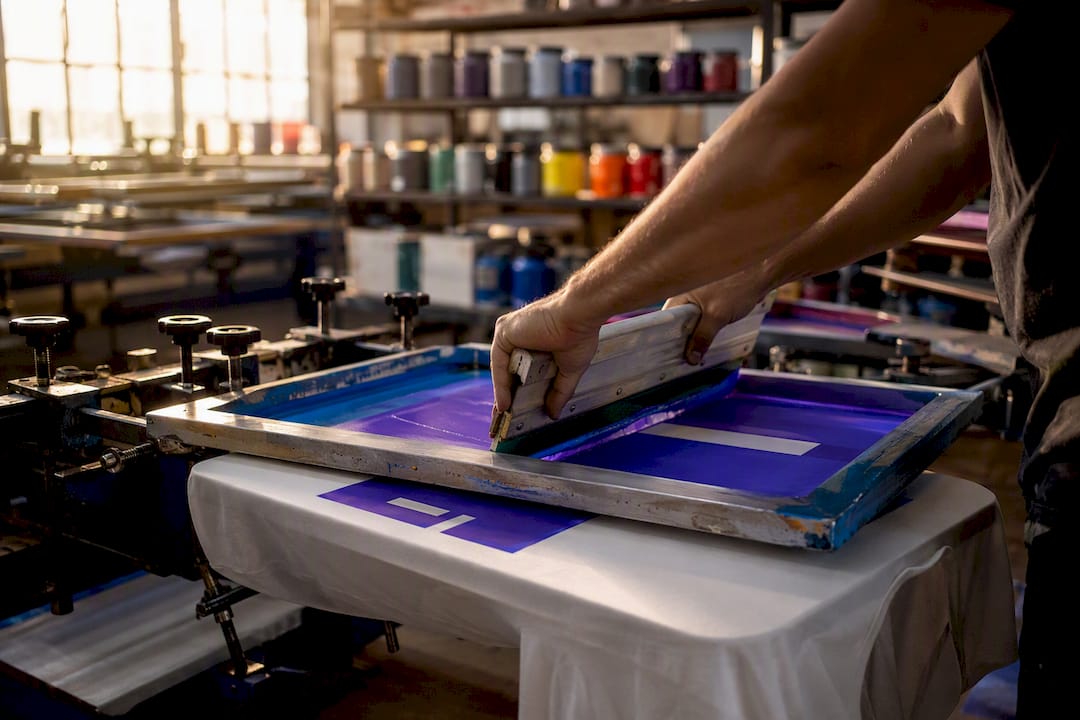
Screen printing works more like stamping ink through a stencil than stitching anything into cloth. Each color in your design needs its own screen, so complexity adds steps.
- Separate the art — the design gets split by color, each one assigned its own screen.
- Make the screens — a mesh screen gets coated with emulsion and exposed to burn in the stencil.
- Register and print — screens get aligned and ink gets pulled across the mesh onto the garment, one layer per color.
- Cure the ink — the shirt runs through a heat tunnel that sets the ink permanently.
Ink choice changes the final feel. Plastisol ink stays opaque and durable but sits on top of the fabric with a slightly heavier hand. Water-based ink soaks into the fibers for a softer feel but needs specific curing temperatures and doesn’t perform well on every fabric blend.
Pro Tip: Use spot colors for logos with three or fewer flat colors. Save halftones for photographic or gradient artwork. Halftones add screens and cost, so reserve them for designs that actually need the blend.
The 8 Decision Factors, With Real Pricing Scenarios
Buyers usually make this decision based on eight things, and each one points toward a different winner depending on the project.
| Dimension | Practical implication |
|---|---|
| Durability / washability | Embroidery outlasts screen printing on garments washed weekly, like uniforms |
| Detail / resolution | Screen printing handles fine text and lines better; embroidery blurs below roughly three-eighths of an inch |
| Color capability | Screen printing supports gradients and unlimited color blends; embroidery is capped by thread count |
| Texture / finish | Embroidery gives a raised, tactile logo; screen printing stays closer to flat |
| Fabric compatibility | Embroidery favors denser weaves and knits; screen printing favors flat cotton and poly blends |
| Cost per unit at quantity | Screen printing’s per-piece cost drops fast past a few dozen units; embroidery’s cost stays flatter regardless of run size |
| Setup and turnaround | Embroidery has quicker setup for a single small logo; screen printing needs more prep but scales efficiently |
| Placement and size limits | Embroidery is boxed in by hoop size, especially on caps; screen printing handles large chest and back prints |
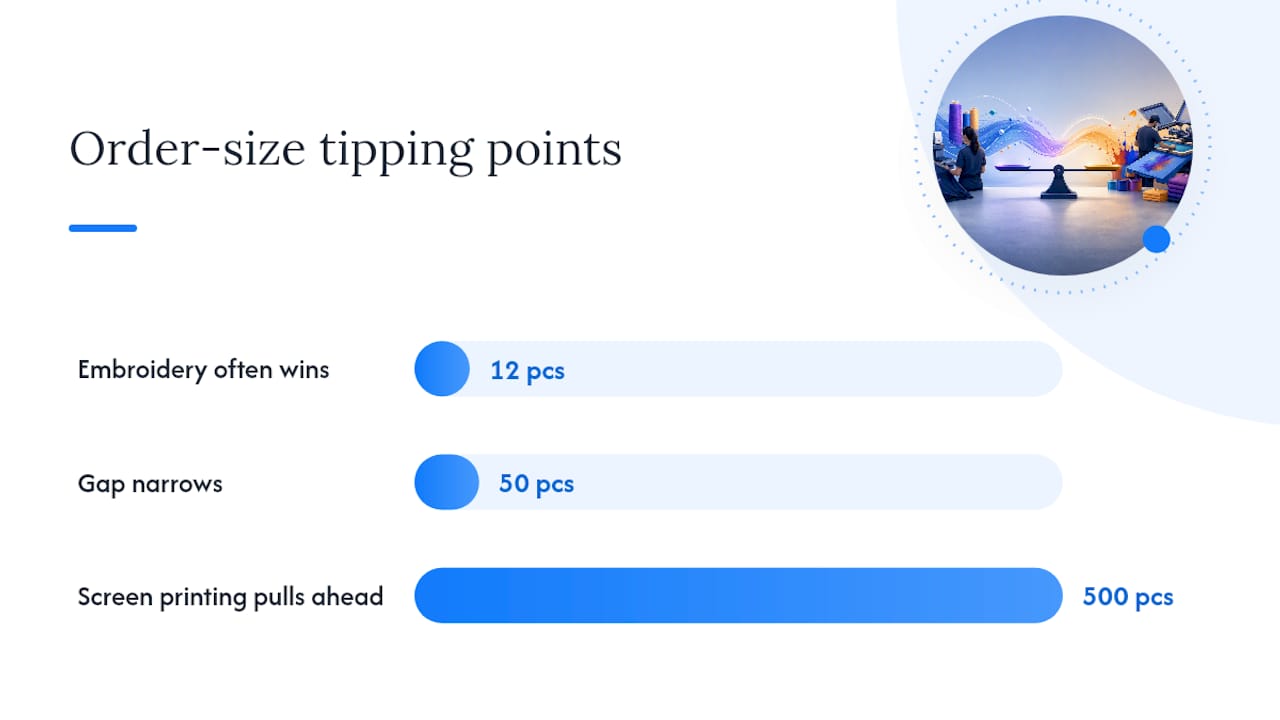
Quantity changes the math more than almost anything else. Setup costs and per-piece costs move in opposite directions for each method as order size grows.
At 12 pieces: embroidery often comes out ahead for a small logo, since screen printing’s setup cost gets spread across so few shirts. At 50 pieces: the gap narrows, and simple one or two-color screen designs start competing on price. At 500 pieces: screen printing usually pulls ahead on cost per shirt for anything beyond a small chest logo, since setup costs get absorbed across a much larger run while embroidery’s per-piece thread and machine time stays roughly constant.
A handful of hard limits often decide the method before cost even enters the conversation:
- Embroidered text below roughly three-eighths of an inch tends to blur.
- Screen printing on stretch fabrics like performance polyester can crack faster than on cotton.
- Hat crowns limit embroidery to smaller, simplified logos, not full-detail artwork.
Best Uses for Embroidery and Screen Printing
Matching the method to the project usually comes down to size, color count, and how often the garment gets washed.
- Team polos and corporate uniforms → embroidery. It survives daily washing and looks sharp on a breast logo.
- Branded caps and hats → embroidery. The structured crown holds stitched logos better than flat ink.
- Merch drops with bold, colorful graphics → screen printing. Big color-heavy designs need the ink coverage and gradient capability.
- Jackets and outerwear → embroidery, especially on chest logos, since the raised texture reads as higher quality on structured fabric.
- Hoodies with large back graphics → screen printing, since the print area is bigger than embroidery hoops comfortably cover.
- Limited-run luxury drops → embroidery for accent details, sometimes paired with screen printing for the main graphic.
Some projects don’t fit cleanly into either box. Tackle twill or patches can bridge that gap, giving you the bold visual impact of large graphics with some of the dimensional feel of embroidery, particularly on letterman-style jackets and varsity gear.
How to Estimate Cost, Quantity, and Turnaround
Before you sign off on a quote, get specific answers on a few things that determine both price and quality.
- What file types do you accept, and do you charge for digitizing or color separations?
- What thread or ink brands do you use in production?
- Do you offer a physical sample before running the full order?
- What’s your wash-test policy for durability claims?
- How does turnaround change between 12 pieces and 500 pieces?
On pricing, expect embroidery’s per-piece cost to stay fairly flat across quantities, while screen printing’s per-piece cost usually drops noticeably once you clear a few dozen units of the same design.
Watch for these red flags before committing to a decorator:
- No sample or proof policy before full production runs.
- Vague turnaround estimates with no specific day range.
- No clear file-prep guidance for vector art, color separations, or resolution requirements.
Care, Washing, and How Long Each Method Lasts
Care habits change the lifespan of both methods more than most buyers expect.
For embroidered garments: turn them inside out before washing, skip high-heat drying, and check regularly for snagged threads on high-friction areas like cuffs. For screen-printed garments: wash in cool water, avoid harsh detergents with bleach, and go easy on high-heat drying, which can crack ink over time.
A daily work uniform will show wear differently than a shirt someone wears twice a month. Embroidery on a uniform can last years of weekly washing; a screen-printed graphic on an occasional-wear tee can look fresh for just as long simply because it sees less abuse.
Pro Tip: Always request a sample wash test before committing to a large production run, especially on unfamiliar fabric blends. It’s the cheapest insurance against a costly reprint.
Materials, Placements, and Design Limits to Watch
Fabric choice and placement decide a lot of this before design even enters the picture.
- Denser fabrics, structured jackets, and hats favor embroidery; thin, loosely woven fabric can pucker under heavy stitching.
- Soft cottons and performance poly blends favor screen printing; very thin or sheer fabric can show ink bleed-through.
- Hat crowns cap embroidery designs to smaller, simplified logos, not fine detail.
- Screen printing has a practical maximum flat print area, and stretch fabrics risk ink cracking at the seams.
- Avoid overly fine lines in embroidery files. Avoid heavy, solid ink coverage on very thin fabric, since it stiffens the garment more than buyers expect.
Tekton LA’s Practical Tips From the Production Floor
Years of running both machines side by side teaches you where projects usually go wrong, and it’s rarely the big decisions. It’s the file prep.
Tekton LA asks for vector artwork in AI, EPS, or high-res PDF formats, with text outlined and raster layers flattened before it hits the digitizer or screen room. That single step avoids most reprints. For embroidery, stitch density gets tuned garment by garment rather than applied as a flat default, since a hoodie and a polo behave differently under the needle.
On the sustainability side, Tekton LA offers garment dyeing and locally sourced blanks, which can shift decoration choices. Garment-dyed fabric sometimes takes ink differently than pre-dyed stock, which is worth flagging to your decorator before you finalize a design. Custom clothing details, from embroidered accents to printed graphics, tend to land better when the garment construction gets factored in early, not bolted on after the blank is already chosen.
- Preferred file types: AI, EPS, PDF, high-res PNG with a clear color profile.
- Stitch density: adjusted per garment weight, not a single default setting.
- Ink families: matched to fabric and intended hand feel, not chosen automatically.
Pro Tip: If you’re deciding between embroidery, screen printing, DTG, or tackle twill, bring reference photos of the finish you want. It shortcuts a lot of back-and-forth on stitch density and ink opacity.
Why Most Buyers Overthink This Decision
Most of the mistakes I’ve seen come from picking a method based on what looks cool in a mockup instead of how the garment gets used. A logo that photographs beautifully in a gradient can turn into a muddy mess once it’s stitched at three-eighths of an inch, and nobody catches that until the sample lands on their desk.
My honest rule: if you’re unsure, order a physical sample before committing to volume. It costs a fraction of a full production run and it catches problems no digital mockup ever will. Tekton LA’s sample and quoting process exists specifically for this reason, and skipping it is the single most expensive shortcut a buyer can take.
Ready to Print or Stitch Your Next Order?
Tekton LA runs embroidery and screen printing under one roof, so you’re not choosing a decorator based on which machine they happen to own. That matters because most shops specialize in one method and will steer you toward it regardless of what your project actually needs.
To get a quote moving, send over your artwork file, the quantities you’re considering, your preferred placement, and your deadline. Tekton LA will tell you straight whether embroidery or screen printing fits better, and can run a sample before you commit to a full batch. If you’re starting from scratch on garments, the Premium Tee works well for either method, and the Printers Shirt is built specifically for flat, large-area screen prints. Browse the full lineup and get a quote started at Tekton LA.
Sources
FAQ
Is embroidery more expensive than screen printing? It depends on quantity and design size. For small logos in low volumes, embroidery and screen printing often land close in price. At high volumes with large, colorful designs, screen printing typically becomes cheaper per piece.
Which lasts longer, embroidery or screen printing? Embroidery generally holds up longer under frequent washing, since the thread is stitched into the fabric rather than sitting on the surface like ink.
Can you do gradients with embroidery? Not reliably. Embroidery is limited by thread count and stitch type, so smooth color blends and photographic detail are better suited to screen printing’s halftone capability.
What about DTF or DTG instead of embroidery vs screen print? Direct-to-film and direct-to-garment printing are separate methods better suited to detailed, full-color designs in smaller quantities without the setup cost of screen printing. Tekton LA offers both alongside embroidery and screen printing for projects that need that flexibility.
Is there a minimum order for embroidery or screen printing? Minimums vary by decorator. Screen printing typically has a practical minimum because of screen setup costs, while embroidery scales down more easily for small logo runs. Ask your decorator directly, since policies differ shop to shop.