


Most small clothing brands assume they need to place large bulk orders to get custom apparel printed. That assumption is wrong, and it costs founders real money in wasted inventory. Understanding what is no minimum order can change how you launch, test, and grow your brand without tying up capital in boxes of unsold shirts. This guide covers the concept clearly, explains where it actually applies, flags the traps that catch brands off guard, and shows you how to use it as a strategic tool rather than a default setting.
Table of Contents
- What does no minimum order mean in custom apparel and promotional products?
- Why do minimum order quantities (MOQ) exist, and how does no minimum order differ?
- What nuances and limitations should you watch for in ‘no minimum order’ claims?
- How can clothing startups and small brands use no minimum order effectively?
- Comparison table: No minimum order vs traditional minimum order quantity models
- The real impact of no minimum order for indie brands: Challenges beyond flexibility
- Explore Tekton LA’s no minimum order options for custom apparel
- Frequently asked questions
Key Takeaways
| Point | Details |
|---|---|
| Definition | No minimum order means you can buy single items without bulk requirements. |
| Reason for MOQ | Minimum order quantities cover fixed costs to keep traditional manufacturing profitable. |
| No minimum limits | Hidden fees or minimum spends may still apply despite no minimum quantity claims. |
| Strategic use | Use no minimum order mainly for sampling and testing to protect margins. |
| Business fit | No minimum suits startups testing markets; bulk MOQs help scale with lower unit cost. |
What does no minimum order mean in custom apparel and promotional products?
No minimum order means exactly what it sounds like. As the no minimum definition explains, you do not need to order a certain number of items, and you can buy just one without any bulk requirement attached. In the world of custom apparel and promotional products, this is a big deal because traditional printing methods were built around runs of dozens or hundreds of units.
The model works because of how production is structured. Instead of printing a batch of 200 shirts and storing them, print-on-demand for business relies on decorating each item only when a customer places an order. No warehousing, no unsold stock, no dead inventory sitting in a corner of your apartment.
For indie clothing brands and startups, this opens up a few immediately useful options:
- Order a single sample of a new design before committing to anything larger
- Test multiple colorways without buying 50 units of each
- Create custom promotional items for an event without hitting a bulk threshold
- Offer a limited drop with zero inventory risk if it does not sell
- Fill small wholesale orders without overproducing
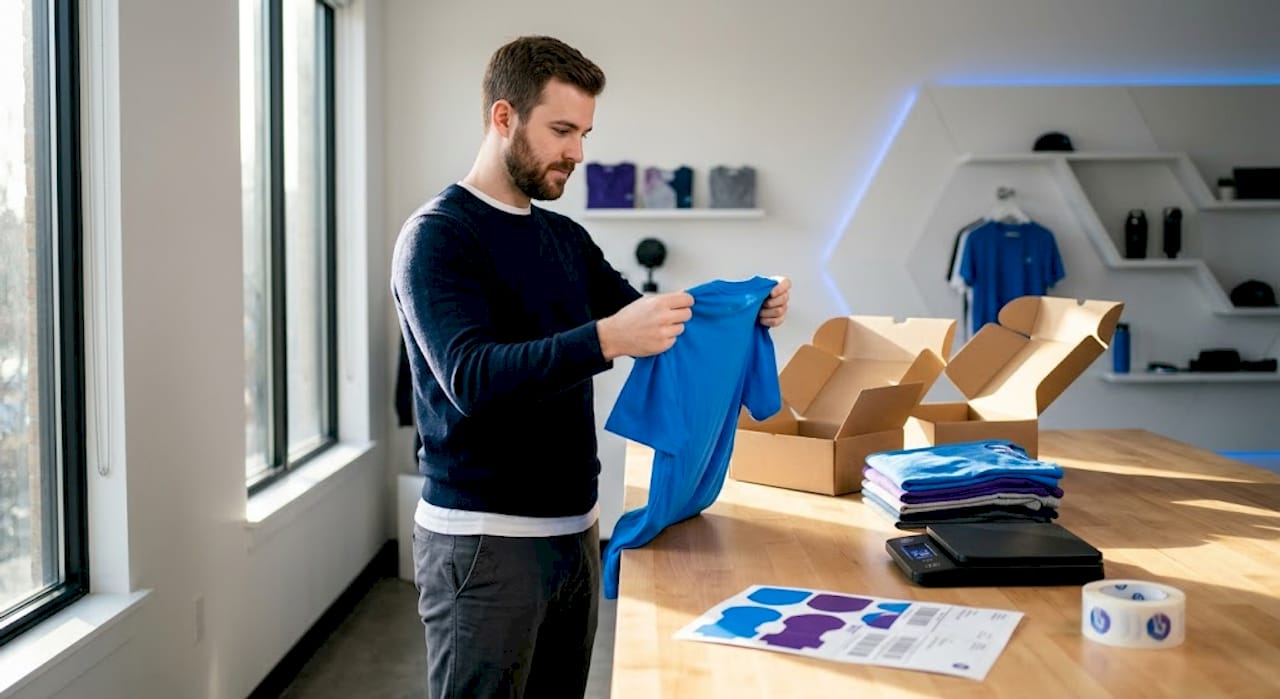
At Tekton LA, no minimum applies to blank apparel, which means you can order one garment dye shirt to check the weight, color, and fit before building a full collection around it. That kind of freedom is not available through traditional manufacturers, and it removes one of the most common early mistakes founders make.
Why do minimum order quantities (MOQ) exist, and how does no minimum order differ?
Before you can fully appreciate no minimum order, you need to understand why most manufacturers require the opposite. MOQ requirements exist because manufacturers and wholesalers need to cover setup costs, admin overhead, raw material procurement, and other fixed expenses that do not scale down easily. A screen printing setup, for example, requires burning a screen, mixing inks, and running a press. Those costs are the same whether you print 10 shirts or 500. Spreading them across 500 makes economic sense. Spreading them across 2 does not.
Here is how that logic plays out in a standard production environment:
- Screen printing requires physical screens per color, so a 4-color design might have $60 to $120 in setup fees before a single shirt is printed.
- Cut-and-sew manufacturing involves pattern making, fabric cutting, and sewing labor that only becomes cost-efficient above certain quantities.
- Embroidery digitizing converts artwork into machine-readable files, a one-time fee that becomes negligible when spread across large orders but painful on a single-piece run.
- Raw material sourcing often comes with minimum purchase requirements from fabric mills and suppliers, which cascade into the finished product’s MOQ.
Print-on-demand and order-by-order production models work differently. They use digital printing technology like DTG (direct-to-garment) or DTF (direct-to-film), where setup costs are minimal and each print is essentially a one-off. This is what makes no minimum possible without destroying unit economics on the supplier side.
Understanding this distinction matters because it tells you where no minimum is a genuine operational feature and where it is marketing language layered over a model that still has hidden friction.
For fast turnaround clothing brands, the ability to skip MOQ requirements also means you can respond to trends and customer feedback quickly, without waiting to accumulate enough orders to hit a threshold.
What nuances and limitations should you watch for in ‘no minimum order’ claims?
Here is where many brands get burned. No minimum order explained correctly means understanding that “no minimum quantity” and “truly no constraints” are not the same thing. A provider can remove quantity minimums while still enforcing constraints like minimum shipping spends, setup fees for artwork, or restrictions on rush orders and complex colorways.
Watch for these specific friction points when evaluating any no minimum offer:
- Minimum shipping thresholds: Some providers require a minimum dollar amount in the cart before they ship, which effectively creates a spend floor even without a unit floor.
- Setup or origination fees: Even with no quantity minimum, a provider might charge $25 to $50 to process your artwork for decoration.
- Per-item surcharges on small orders: Some pricing structures include a “small order fee” that disappears at higher quantities.
- Color and complexity limitations: A no minimum offer might apply to standard single-color prints but not to 6-color designs or photographic prints.
- Rush order restrictions: Need it in 3 days? Some providers reserve that option for orders above a certain size.
The difference between understanding no minimum order at face value and understanding it in practice is reading the full pricing breakdown before you commit. Ask specifically: What is the total cost per unit at quantity 1, including blanks, decoration, packaging, and shipping? That number is what matters.
Pro Tip: Before choosing a print partner for a no minimum run, ask them to quote a single unit, 12 units, and 50 units side by side. The gap between those prices tells you exactly how their cost model is structured and whether small orders are actually viable for your margins.
At Tekton LA, blanks carry no minimum order requirements, which means you get genuine flexibility without hunting for the asterisk in the fine print.
How can clothing startups and small brands use no minimum order effectively?
Knowing what no minimum order means is one thing. Using it well is another. The key insight from starting a clothing brand with low MOQs is that no minimum is best treated as a sampling and testing mechanism, not a long-term supply strategy. The higher per-unit cost at low quantities will erode your margins if you rely on single-item production for everything you sell.
Here is a framework for using it strategically:
- Sample before scaling. Use no minimum to order one or two units of a new design. Check the quality, the fit, the color accuracy. Then decide whether to scale up.
- Test market response. Drop a limited run of 5 to 10 pieces and see how your audience responds before committing to 100.
- Build narrow, then wide. Start with two or three SKUs (stock keeping units, meaning distinct product variants). Master those before adding more styles.
- Calculate your full landed cost. Landed cost includes the blank, decoration, packaging, shipping to you, and any fees. That is your real cost baseline before pricing.
- Replenish proven winners in larger batches. Once you know a design sells, move to higher quantities where your unit cost improves and your margin grows.
Pro Tip: Your success metric is not the lowest unit price. It is margin after landed cost. A $6 unit cost at 1 piece with a $28 retail price gives you $22 gross margin. A $4 unit cost at 100 pieces gives you $24. The difference is real but not as dramatic as it seems. However, if you are ordering 100 pieces of something that does not sell, you have turned a $200 loss into a $400 loss.
Here is a quick reference table to help you think through your options:
| Order quantity | Typical unit cost (decoration + blank) | Inventory risk | Best use case |
|---|---|---|---|
| 1 to 5 units | Highest | None | Sampling, gifting, personal use |
| 6 to 24 units | Moderate | Low | Limited drops, market testing |
| 25 to 99 units | Lower | Medium | Proven designs, small wholesale |
| 100+ units | Lowest | High | Established sellers, retail orders |
The fast turnaround printing insights from brands that have gone through this process consistently point to one truth: the brands that grow are not the ones who found the cheapest per-unit cost. They are the ones who managed margin and inventory discipline from day one.
Comparison table: No minimum order vs traditional minimum order quantity models
Before diving into perspective, here is a side-by-side look at how these two models compare across the metrics that matter most to indie brands and startups.
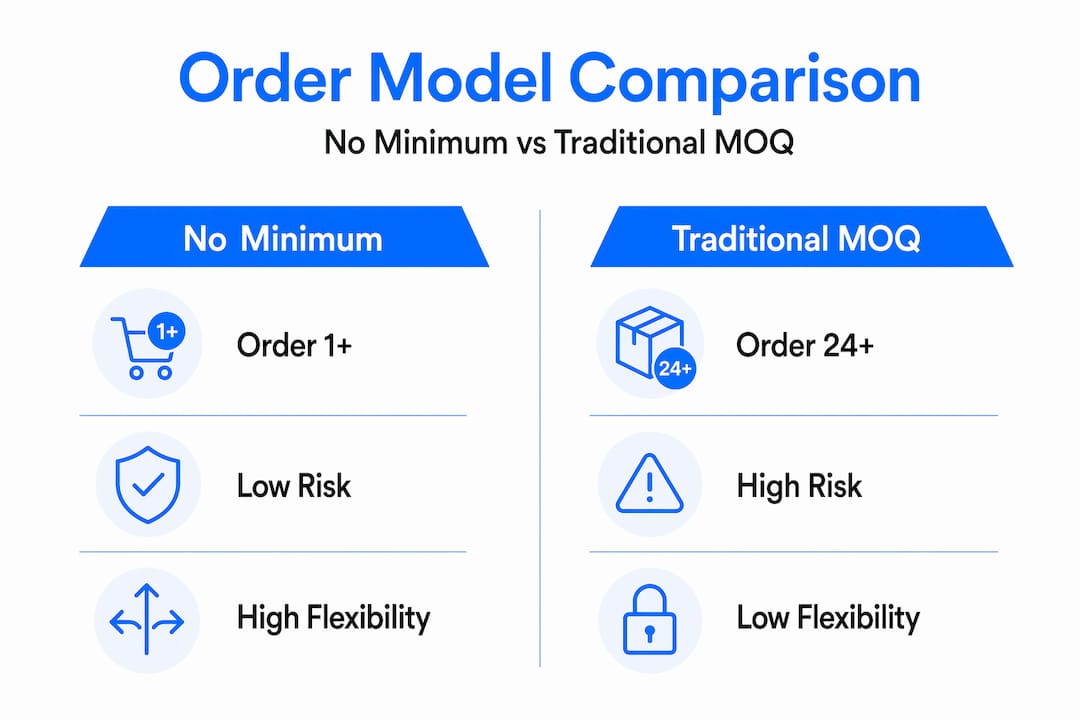
| Feature | No minimum order | Traditional MOQ |
|---|---|---|
| Order quantity | As low as 1 unit | Typically 24 to 500+ units |
| Unit cost | Higher per item | Lower per item at scale |
| Upfront capital required | Minimal | Significant |
| Inventory risk | None to very low | Medium to high |
| Cash flow impact | Easy on cash flow | Ties up working capital |
| Production lead time | Often faster (1 to 5 days) | Longer (1 to 4 weeks) |
| Best for | Testing, sampling, small drops | Proven sellers, wholesale |
| Flexibility | High | Low |
| Margin potential | Lower at small scale | Higher when products sell through |
At Tekton LA, you get the benefits of the no minimum column without sacrificing the quality you would expect from a higher-volume run. That combination is harder to find than most people realize.
The real impact of no minimum order for indie brands: Challenges beyond flexibility
Here is the thing most articles about no minimum order get wrong. They frame it as pure liberation. No minimums, no risk, no problem. That framing is incomplete and, for some brands, genuinely harmful.
The honest reality is that no minimum order is a tool, and like any tool, it causes damage when misused. The clearest warning in the industry is direct: low MOQ helps you test a design, but higher unit cost comes with it. If the unit cost destroys your margin, the order is not actually helping your brand. It is just costing you less money to make the same mistake.
We see this pattern repeatedly with early-stage clothing brands. They discover no minimum, get excited, and start ordering everything in ones and twos. They build a “collection” of 20 styles. They spend heavily on photography and social content. Then they check their numbers and realize they cannot price competitively with their unit costs at that scale. Their only options are to raise prices above what the market will pay, or sell at margins that do not support growth.
The brands using no minimum order well are disciplined about one thing: they treat it as an R&D budget, not a supply chain. They test fast, learn fast, and then make deliberate decisions about what gets produced at scale. They use no minimum for validation and traditional production runs for execution.
There is also a psychological risk. The flexibility of no minimum can become an excuse to avoid making product decisions. You never have to bet on a design because you can always order just one more. But building a brand requires conviction. At some point you have to decide what you are making and stand behind it in volume. No minimum is a starting line, not a finish line.
The smartest use of this model is as part of a broader strategy: use no minimum to find your winners, then scale the winners with volume pricing that protects your margins. That is how no minimum order becomes a genuine business advantage rather than just a low-risk way to spend money slowly.
Explore Tekton LA’s no minimum order options for custom apparel
If you are ready to move from understanding no minimum order to actually using it, Tekton LA makes it straightforward. Our garment dye shirt and garment dyed sweatshirt are available with no minimum purchase on blanks, giving you the freedom to sample, test, or launch a limited drop without committing to inventory you are not sure about.
Every order comes with high-quality printing and fast turnaround from our Downtown Los Angeles facility. Whether you are a first-time founder ordering a single sample or a growing brand running a small batch to test a new colorway, Tekton LA is set up to serve you at whatever scale makes sense today. Start with one. Scale when you are ready.
Frequently asked questions
What does ‘no minimum order’ mean for custom apparel?
It means you can order as few as one item without needing to meet a bulk minimum, allowing flexible, low-risk purchasing for custom products.
Why do most manufacturers have minimum order quantities?
Manufacturers require MOQs to cover fixed production costs and ensure profitability. As NetSuite’s MOQ breakdown explains, setup, admin, and raw material costs are the core drivers, which is why true no minimum options usually come from print-on-demand models.
Are there hidden fees with no minimum order services?
Sometimes yes. Some providers remove quantity minimums but still charge setup fees, require minimum shipping spends, or limit rush orders. Always evaluate the full cost structure, not just the quantity policy.
How should small clothing brands use no minimum order models effectively?
Use no minimum orders mainly for sampling or testing new products. As industry guidance emphasizes, low MOQ can raise unit costs, so your real success metric is margin after all landed costs are included.
Can I start selling custom apparel without bulk inventory using no minimum order services?
Yes. No minimum order services, especially print-on-demand, let you sell products one at a time without upfront inventory, eliminating the risk of unsold stock while you figure out what your customers actually want.