

DTF (direct-to-film) shirt printing prints your artwork in full color onto a special film, coats it with adhesive powder, and presses it onto the garment with heat. It gives sharp detail, opaque color on dark shirts and works across cotton, polyester and blends. For a brand, team or event, it is the practical way to get detailed multicolor designs onto mixed garments in small or mid-size runs. We run DTF printing in Los Angeles, with no minimums on blanks and same-day or next-day options for urgent jobs.
TL;DR
- DTF prints a mirrored design on film, adds adhesive powder, then heat-presses it onto the shirt. No pre-treatment of the garment is needed.
- It works on cotton, polyester, blends, nylon and dark fabrics, and on caps, bags and jackets too, so one artwork can go across a whole merch line.
- Press temperature matters more than press time. Poor adhesion usually traces back to heat, pressure or curing, not to the design.
- DTF suits detailed logos, multicolor art and mixed-fabric orders. Large solid blocks and very soft-hand fashion tees are where we compare it with DTG first.
- Washing cooler and turning garments inside out keeps prints looking good longer.
Table of Contents
- What DTF shirt printing actually is
- How the process works, step by step
- Which shirts and fabrics suit DTF
- Heat, pressure and time: what matters most
- How long DTF prints last and how to wash them
- DTF compared with DTG, screen printing and other methods
- Design tips for the best DTF results
- Can you use DTF for on-demand and small orders?
- What to ask a DTF printer before you order
- Order DTF shirts from Tekton LA
- Our perspective on DTF
- FAQ
- Sources
What DTF shirt printing actually is
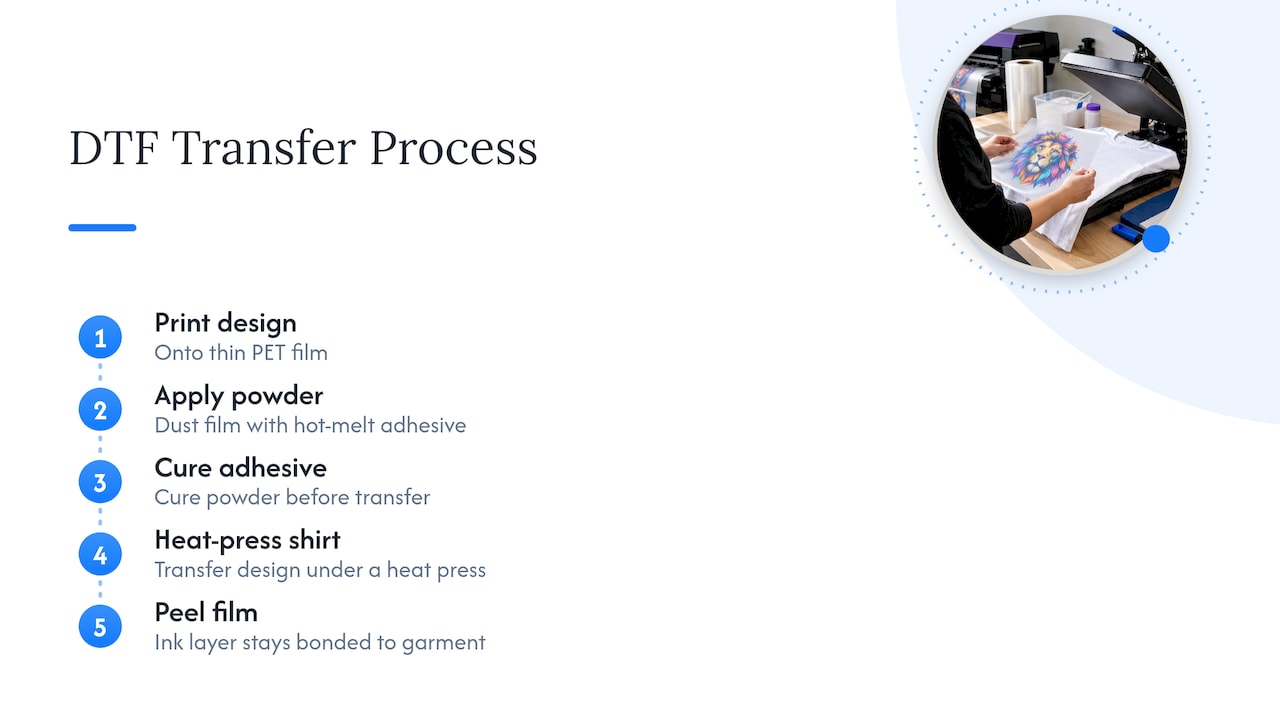
DTF stands for direct to film. Instead of printing ink straight into the fabric, the printer lays the design on a thin PET film. The film is then dusted with a hot-melt adhesive powder, cured, and later transferred to the shirt under a heat press. The film is peeled away and the ink layer stays bonded to the garment.
The process has become widespread in wearable printing because it skips plate preparation and weeding (cutting away excess material, as you do with vinyl) and can run largely unattended, which cuts labor time and cost. That is how Mimaki described the method when it launched its first DTF printer in 2023.
For a buyer, the useful consequence is simple. The print is made as a standalone transfer, so the same file can be applied to a tee, a hoodie, a tote and a cap in the same session.
How the process works, step by step
Knowing the steps helps you brief a printer properly and spot where a job can go wrong.
- Artwork preparation. The design is set up in RIP software (the program that controls how ink is laid down) and mirrored, because the film is printed face-down against the garment. Send vector art or high-resolution files, ideally at the size they will print. Low-resolution images stay low resolution on film.
- Printing. The printer lays down the color layers first (CMYK, meaning cyan, magenta, yellow and black), then a white layer on top. After transfer, that white becomes the opaque base under your colors, which is why DTF stays vivid on black and navy shirts.
- Powder application. Thermoplastic polyurethane (TPU) adhesive powder is applied while the ink is still wet, so it sticks only where there is ink.
- Curing. The film passes through an oven that melts the powder and sets the ink into a ready-to-press transfer. Under-curing or damp powder leads to patchy or lifting prints.
- Heat pressing. The transfer is placed on the garment and pressed with controlled heat, pressure and time.
- Peeling. The carrier film is peeled off after the film’s specified cooling time, hot or cold depending on the film type.
This sequence is laid out in the industry guides, for example the Shopify DTF guide, which describes the same six stages from file to peel.
For a deeper look at the production side, our own article on what every brand needs to know about DTF printing goes through it from the brand’s point of view.
Which shirts and fabrics suit DTF
The short answer: most of them. DTF works on cotton, polyester, blends and nylon, including dark colors, without pre-treatment of the garment. Epson lists t-shirts, hoodies, denim, shorts, onesies, tote bags, backpacks, caps and shoes among the items DTF can decorate, which is why it suits full merch collections rather than a single product.
A few practical points for choosing the blank:
- Smooth, tight-knit fabrics give the cleanest edge detail on fine lines and small text.
- Heavier cotton tees and fleece carry bold graphics well and take the press without scorching.
- Performance polyester is a strong fit for team and club wear, because the print is not limited to cotton-rich fabric. Press temperature may need adjusting for heat-sensitive synthetics, so tell your printer the fiber content.
- Hard surfaces are outside what DTF is designed for. Epson does not recommend it there.
If you are building a line and want to pair printing with garments, we sell blanks with no minimum order quantity, in apparel and accessories including activewear, headwear, bags and more. That lets you order a small test run of a tee, a hat and a tote in one go.
Heat, pressure and time: what matters most
Most print failures that reach a customer are press problems, not design problems. Two sources give useful numbers.
A 2025 University of Groningen bachelor study done for Vistaprint tested press settings on black cotton tees. It found temperature was the dominant factor: 170 °C with a 10-second dwell gave the least color shift and the least loss of black density. Dwell time between 10 and 15 seconds made no clear difference, so a longer press did not improve color retention in the tested range.
Epson America’s Tim Check, speaking to Graphics PRO, puts the working range at 280 to 320 °F with medium-to-firm pressure of 30 to 50 PSI for a strong adhesive bond. He also notes that cold-peel transfers help adhesion and durability on textured or thicker fabrics, while hot-peel transfers can be peeled right away.
The same article lists the usual causes of bad transfers:
| Symptom | Typical cause |
|---|---|
| Poor adhesion | Wrong heat or pressure |
| Ink bleeding or smudging | Over-inked film or insufficient drying |
| Cracking or lifting | Improper curing or an incompatible fabric |
| Patchy transfer | Uneven, aged or moisture-absorbed adhesive powder |
The lesson for a buyer is that DTF quality depends on a controlled production routine: clean printheads, fresh powder, calibrated presses. That is the reason many brands hand it to a production shop rather than building the setup themselves. Our production is made entirely in Los Angeles, which keeps the whole chain, from print to press to packing, under one roof.
How long DTF prints last and how to wash them
A well-executed DTF transfer holds up to roughly 40 to 50 washes before it begins to degrade, according to How-To Geek. Care makes a visible difference to how close you get to that range.
A June 2024 wash study in Images Magazine tested DTF output from six devices. It found that high-temperature washing was the bigger factor: over half of the garments became unsuitable for public wear within 20 hot washes, while garments put through a high-spin cycle at 1,400 rpm stayed acceptable for everyday use.
Put that into a care label your customers will actually follow:
- Turn the garment inside out before washing.
- Wash in cold or warm water on a normal cycle.
- Tumble dry low or hang dry, and avoid ironing directly on the print.
- Skip bleach and heavy fabric softeners.
If you want a plain-language reference to pass along to customers, this guide to washing printed garments covers the general habits that preserve printed designs. Many brands print these instructions on a woven or printed care label, and we make custom woven labels so the instructions travel with the product.
DTF compared with DTG, screen printing and other methods
You do not have to pick one method for your whole brand. Match the method to the design, the quantity and the garment.
DTF vs DTG. Direct-to-garment (DTG) prints ink straight into the fibers of the shirt. Epson frames the trade-off this way: DTF works on a wider variety of textiles and shaped items such as caps, backpacks and shoes, and needs no pre-treatment, while DTG is more breathable and softer to the touch. In practice:
- Choose DTF for mixed fabrics, polyester team wear, detailed logos, small text, and orders where one design goes on several product types.
- Choose DTG when you want the softest possible hand on a cotton tee, especially with large artwork or photographic imagery.
We do both, so the comparison is about your design, not about our equipment. Our five minute wash test for DTF vs DTG article shows how small brands can compare samples side by side before committing.
DTF vs screen printing. Screen printing builds the design one ink color at a time through a stencil, with setup for each color. It tends to win as quantities climb and designs stay at a few flat colors. DTF avoids per-color setup, which makes it attractive for multicolor art in smaller runs. We lay out the crossover in our break-even rules for small brands.
DTF vs heat transfer vinyl (HTV). HTV is cut from colored vinyl sheets and weeded by hand, so labor grows with every shirt and with design complexity. DTF removes the cutting and weeding. If you are weighing it up, see when DTF saves labor over HTV.
DTF vs sublimation. Sublimation dyes polyester fibers and works best on light polyester. DTF carries white ink, so it keeps colors vibrant on dark garments, which sublimation cannot do. Our guide on fabric and color deciding sublimation vs DTF goes through the cases.
Design tips for the best DTF results
Good files make good prints, and these are the habits that matter most.
- Use vector or high-resolution art. Aim for 300 dpi at final print size. Fine lines and small type reproduce well, but only if the file carries that detail.
- Keep a clean background. Remove stray pixels and semi-transparent edges. They can turn into visible halos when white ink is laid under them.
- Plan placement and size. A left-chest logo, a full-front graphic and a sleeve mark each need different dimensions. Tell your printer the garment size range so artwork scales sensibly across small to 3XL.
- Mind solid coverage. Detailed designs and logos are where DTF is at its best. Very large solid blocks of ink create a more substantial layer on the garment, so for full-front fills you may want to ask which method gives the feel you want.
- Pick colors on screen with care. Screens are brighter than ink. If a brand color is critical, a sample print is the surest check.
Can you use DTF for on-demand and small orders?
Yes, and this is where DTF is especially flexible. Transfers can be printed ahead and stored for later heat application, as Epson America’s Tim Check explains. Printing is separated from garment finishing, so a brand can hold prepared transfers and apply them as orders come in.
What that means by audience:
- Independent brands and startups: drop a limited run, test a colorway, or reorder a bestseller without committing to a large minimum.
- Designers and artists: reproduce multicolor illustration with fine detail on tees, totes and hoodies.
- Event organizers and promoters: produce staff, crew and attendee shirts on a deadline, with same-day or next-day options for urgent jobs.
- Sports teams and clubs: put the same crest on jerseys, hoodies and caps, even when the fabrics differ.
- Corporate marketing teams: match brand colors across a mix of giveaway items and uniforms.
What to ask a DTF printer before you order
Whichever shop you use, a short checklist avoids most surprises.
- Which blank are you printing on? Fiber content decides press settings.
- Which file formats do you accept? Send vector art if you have it.
- What is the turnaround? Confirm production time and any rush options in writing.
- Can I see a sample? For brand-critical colors, a sample on the actual garment tells you more than any proof.
- How should I label the care? Share the washing guidance above with your customers.
- Do you offer finishing? Woven labels, private labeling and packing turn a printed shirt into a finished product. Our private labeling and finishing pricing page shows what that covers.
Order DTF shirts from Tekton LA
We print DTF in Downtown Los Angeles for brands, designers, event organizers, teams and corporate marketers. Production is made entirely in LA, there are no minimum order quantities on blanks, and we offer same-day or next-day options for urgent jobs. We can also take care of complex branding requirements, from woven labels and private label options to custom banners.
Start on our DTF page to see how to send artwork and place an order. If you are still choosing between methods, our site lists every service, including DTG, screen printing and embroidery.
Our perspective on DTF
We see DTF as the method that finally made detailed, multicolor merch practical for small brands. A designer can bring a layered illustration, a team can bring a crest, and an event can bring a deadline, and the same process handles all three.
Our advice is to treat the press as the heart of the job. Temperature, pressure and a clean, fresh transfer decide whether a print lasts, and that is why we keep our production in Los Angeles, where we can control it from file to finished garment.
We also like DTF because it fits how brands really grow. You can start with a handful of shirts on blanks with no minimums, learn what your customers buy, and then add hats, bags, labels and finishing. When a design is better suited to DTG for softness or to screen printing for volume, we say so and run it that way, because we offer all of them.
Test your artwork, choose the blank for the audience, and give your customers a simple care instruction. Do those three things and DTF will serve your brand well.
Christian
FAQ
Which shirt is best for DTF printing?
Cotton, polyester and blend tees all work, and dark colors are no problem because white ink forms an opaque base. Smooth, tight-knit fabrics show the sharpest fine detail. Tell your printer the fiber content so the press settings suit the fabric.
Can I print a t-shirt on demand with DTF?
Yes. Transfers can be printed in advance and stored, then pressed onto shirts when orders arrive. That lets a brand keep inventory flexible. We offer no minimum order quantities on blanks, so small and test runs are workable.
How long does a DTF print last?
A well-made transfer can last roughly 40 to 50 washes, and care affects the result. Wash inside out in cold or warm water, avoid very hot cycles, and dry on low or hang dry.
Is DTF better than DTG?
It depends on the design and the garment. DTF suits mixed fabrics, polyester, detailed logos and items such as caps and bags. DTG gives the softest feel on cotton and suits large or photographic artwork. We offer both, so we can match the method to your order.
Sources
- Mimaki DTF printer announcement, PRINTING United Alliance
- Direct to Film Printing guide, Shopify
- Direct to Film Printing Guide, LexJet
- DTG & DTF Printers for Small Businesses, Epson US
- Optimizing Heat Press Parameters, University of Groningen
- A look inside direct-to-film printing, Graphics PRO
- What Is DTF Printing?, How-To Geek
- DTF wash study, Images Magazine, June 2024