


For polyester activewear, all-over designs, and performance fabrics, sublimation typically wins. For cotton tees, photorealistic art, and small runs with fine detail, direct-to-garment printing usually comes out ahead. The real deciding factor is your fabric first, then your design, then your order size. The comparison below breaks down exactly why, and gives you a checklist to confirm the right call before you print.
TL;DR:
- Sublimation is ideal for polyester fabrics and full-garment designs, offering vibrant colors and durability after multiple washes.
- DTG works best on cotton and blends for fine detail, photographic prints, and smaller runs with complex designs.
- Fabric choice is the main factor: sublimation cannot print on cotton, while DTG handles a wider variety of fabrics, especially dark-colored garments.
- Production costs and speed vary: sublimation is more efficient for bulk, uniform jobs, whereas DTG suits small, variable orders with quick turnaround.
- Conducting wash tests before large production is crucial to ensure print durability, regardless of the method used.
Table of Contents
- How Sublimation and DTG Actually Work
- Which Fabrics and Colors Work With Each Method
- Print Quality, Color Vibrancy, and Wash Performance
- Startup Costs, Running Costs, and Production Speed
- Matching Real Jobs to the Right Printing Method
- Environmental Impact and Garment Care
- What Tekton LA Sees in Daily Production
- Why the “Better Method” Question Misses the Point
- Getting Your Custom Print Job Done Right
- Sources
- FAQ
How Sublimation and DTG Actually Work
Sublimation and direct-to-garment printing solve the same problem, putting a design onto fabric, but they do it through completely different physical processes, and that difference explains almost everything else in this comparison.
Sublimation starts with a design printed onto special transfer paper using dye-based ink. Under heat and pressure, that dye turns into a gas and bonds directly into polyester fibers, becoming part of the fabric rather than sitting on top of it. This is why the process needs polyester or a polymer coating to work at all: cotton fibers have nothing for the dye gas to bond with.
DTG works more like a specialized inkjet printer aimed at fabric. Water-based inks get printed directly onto the garment, usually after a pretreatment spray that helps the ink bond and stay opaque, followed by a curing step that sets the print. Unlike sublimation, the ink sits on and in the fibers rather than becoming part of them.
A quick capability rundown:
- White ink support: DTG requires it for dark garments; sublimation has no white ink and needs light-colored polyester.
- All-over printing: Sublimation handles full-garment coverage naturally; DTG is typically limited to a printable panel.
- Substrate constraints: Sublimation needs polyester or coated surfaces; DTG works on cotton, cotton blends, and some synthetics.
- Finishing feel: Sublimation leaves zero hand feel since the dye is inside the fiber; DTG has a slight texture, though modern inks minimize it.
Which Fabrics and Colors Work With Each Method
Before you cost anything out or run a sample, fabric is the fastest filter for eliminating one method entirely.
Sublimation needs polyester or a polymer-coated substrate. Cotton simply will not hold sublimation dye, since there’s no polymer for the gas to bind to. Sublimation also performs best on white or light-colored blanks, since the process has no white ink and relies on the base fabric color showing through in unprinted areas.
Dark garments are printable too, but only with a white ink underbase and a pretreatment step to keep colors opaque and vivid.
Blends complicate both methods. A 50/50 cotton-poly shirt will not hold sublimation dye evenly, since the cotton content leaves patches where the color never bonds.
- Sublimation: polyester or polymer-coated only, best on white or pastel bases.
- DTG: cotton and cotton-heavy blends, dark colors possible with white ink and pretreatment.
- 50/50 blends: workable for DTG with some durability trade-off, generally unreliable for sublimation.
- Mixed-substrate orders: worth evaluating DTF as a third option when a single job spans both fabric types.
Print Quality, Color Vibrancy, and Wash Performance
The two methods produce genuinely different looking prints, and the gap shows up most clearly after a few washes.
Sublimation produces extremely vibrant, saturated color because the dye becomes part of the polyester fiber rather than a layer on top of it. There’s no texture, no cracking, and no peeling risk, since there’s nothing sitting on the surface to peel. This makes it the standard choice for all-over athletic prints and sportswear graphics that need to survive heavy wash cycles.
DTG’s strength is fine detail and photographic-style prints, especially gradients and shading that other methods struggle to reproduce on cotton. Curing temperature and pretreatment quality directly affect how the print washes over time. Underscured prints crack and fade faster, while properly cured DTG on quality cotton holds up well through normal laundering.
Epson’s documentation on its UltraChrome DG2 ink family notes OEKO-TEX ECO PASSPORT and ECOCERT certifications for specific inks, which matters directly for wash durability and safety claims on finished garments.
A simple sample wash test, running a printed piece through a normal wash and dry cycle before committing to a full production run, catches curing or pretreatment problems early, before they show up in a customer’s washing machine.

Pro Tip: Run one washed sample through your actual customer’s expected laundry routine, not just a gentle test cycle, before you approve a production run.
Startup Costs, Running Costs, and Production Speed
Equipment investment and per-print costs diverge sharply between the two methods, and that difference should shape which one fits your order volume.
Sublimation setups typically require a sublimation printer, heat press or calendar press, and specialty transfer paper as ongoing consumables. DTG setups need a garment printer, pretreatment machine, and a curing unit such as a heat press or conveyor dryer, plus specialized inks that Epson notes are built around specific printhead and ink-cartridge systems for reliability.
Per-print costs come down to a few variables:
- Ink and dye coverage: all-over sublimation designs use more consumable than a small chest-print DTG job.
- Pretreatment and transfer paper: DTG needs pretreatment solution per garment; sublimation needs transfer paper per print.
- Curing and labor time: both need a fixed cure step, but sublimation’s press cycle is usually longer for all-over jobs.
Production speed favors different jobs for each method. DTG handles small, mixed-design runs efficiently since each garment can be different with no setup change between prints. Sublimation is efficient for repeat, uniform prints since much of the cycle time goes into the press step rather than the printing itself, which makes it better suited to bulk uniform-style orders than one-off custom pieces.
Pro Tip: Estimate your break-even by multiplying ink and consumable cost per piece by your target order size, then add labor time for pretreatment or pressing, before you quote a customer.
Matching Real Jobs to the Right Printing Method
Most decisions become obvious once you match the job type to the fabric and finish it actually needs.
- Short-run cotton tees and art prints: DTG is usually the better fit, since it handles fine detail and small quantities without setup waste.
- All-over designs and polyester performance apparel: sublimation wins here, since it’s the only method built for full-garment, permanent color on synthetic fabric.
- Mixed-substrate or uncertain orders: consider DTF as a bridge technology that prints on a wider range of fabrics than sublimation, or fall back on screen printing for large, simple-color runs.
- Complex jobs spanning multiple fabric types: outsourcing to a full-service provider that runs several methods in-house avoids splitting one order across separate vendors.
Run through material first, then design complexity, then order size, then desired finish, and the right method usually reveals itself before you’ve spent anything on samples.
Environmental Impact and Garment Care
Textile printing has a real environmental footprint, and the industry has moved to address the biggest piece of it.
The EPA’s technical guidance on textile fabric printing notes that solvent emissions historically came from organic solvents in print pastes, and that the industry has shifted toward aqueous, low-solvent formulations to cut VOC output. Both DTG and modern sublimation systems largely rely on water-based inks and dyes rather than solvent-heavy pastes, which lowers emissions compared to older printing chemistries. Certifications such as OEKO-TEX and GOTS on inks are worth checking for, especially for children’s wear, since they signal reduced chemical risk in the finished product.
Care instructions matter just as much for keeping any print looking right:
- Wash inside-out in cold water to reduce surface friction on the print.
- Avoid bleach, which degrades both sublimation dye and DTG ink over time.
- Tumble dry low or air-dry rather than high heat, which accelerates fading and cracking.
What Tekton LA Sees in Daily Production
Running DTG, sublimation, DTF, screen printing, and embroidery side by side gives a working view of where each method actually holds up, not just how it looks fresh off the press.
Tekton LA’s Los Angeles production floor handles all of these methods alongside white label and garment dye services, with no minimum order quantity on blanks, which means small brands can test a method on a handful of pieces before committing to a full run.
- Blank selection for sublimation: polyester content and a light base color get checked before any print job, since even a small percentage of cotton in a blend causes uneven dye uptake.
- Pretreatment calibration for DTG: pretreatment amount and curing temperature get dialed in per fabric batch, since even garments from the same supplier can vary slightly.
- Sample-first workflow: every new design or fabric combination gets a test piece before a production run, catching color or adhesion issues while they’re cheap to fix.
A quick wash test on a single sample piece, run through a normal cycle before scaling to a full order, catches more durability problems than any spec sheet.
Why the “Better Method” Question Misses the Point
Most comparisons frame sublimation and DTG as competitors, when the honest answer is that they rarely compete for the same job. Sublimation wins on polyester and loses on cotton. DTG wins on cotton and cannot touch polyester. There’s no universal winner, only a right tool for a given fabric and design.
What gets underrated in most guides is how much the wash test matters compared to the spec sheet. A printer’s ink certifications and resolution numbers tell you what a print can look like on day one. They tell you nothing about what it looks like after fifteen wash cycles in a customer’s machine, which is the only test that actually matters for a brand’s reputation.
The advice worth prioritizing first isn’t “which method is better,” it’s “what fabric am I already committed to.” Once the fabric is locked in, the method question mostly answers itself, and the remaining decisions (order size, design complexity, turnaround) matter more than the printing technology label on the invoice.
— Christian
Getting Your Custom Print Job Done Right
Choosing between sublimation and DTG gets a lot simpler when one provider runs both methods under the same roof, along with DTF, screen printing, and embroidery, so your fabric choice never has to force a vendor switch.
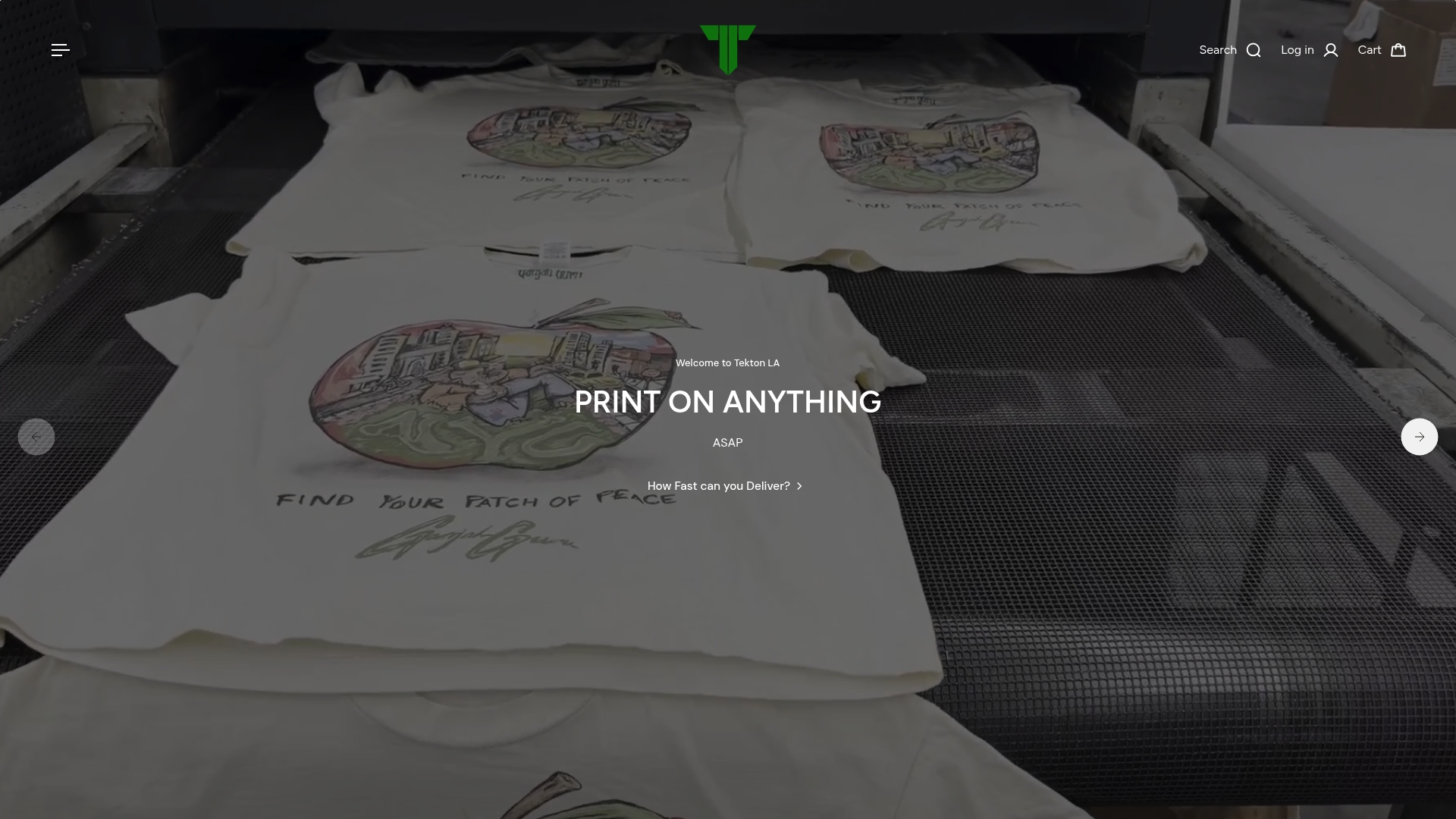
Custom apparel providers offering no minimum order quantities on blanks enable small brands or independent designers to test a method on a few pieces before scaling to a full production run. That fits naturally with everything covered above: confirm your fabric, sample the method, then commit to volume once the wash test checks out.
If your order mixes cotton and polyester pieces, or you’re not sure which method fits your design, request a quote through Tekton LA’s services page and get a recommendation based on the actual garments and artwork you’re working with, rather than a generic printing method guess.
Sources
- AP-42, Vol. I, CH 4.11: Textile Fabric Printing (EPA)
- SureColor F1070 DTG and DTFilm Standard Edition Printer | Ink | Epson US
FAQ
Can a DTF Printer Do Sublimation?
No, DTF and sublimation are separate processes with different inks, films, and equipment, so a DTF printer cannot run a sublimation job without switching to sublimation-specific hardware and transfer paper. They’re often compared as alternatives rather than interchangeable systems.
Is DTF or Sublimation Better for T-shirts?
It depends on the fabric: sublimation only works on polyester or polymer-coated shirts, while DTF prints on a wider range of fabrics including cotton. For an all-cotton shirt, DTF or DTG is the workable option since sublimation dye won’t bond to cotton fibers at all.
Which One Is Better, DTF or DTG?
DTG prints ink directly onto the garment and tends to produce a softer feel on cotton, while DTF prints onto a film first, then heat-presses that design onto the fabric, working across a broader range of materials. The better choice depends on fabric type and order size rather than one method being universally superior.
Which Is Cheaper, DTF or Sublimation?
Cost depends heavily on design coverage and order volume, since sublimation’s per-print cost scales with ink and transfer paper for all-over designs, while DTF’s cost scales with film and powder adhesive usage. Neither is consistently cheaper across every job, so comparing actual coverage and quantity for your specific design gives a more accurate answer than a blanket rule.