


Scaling a print-on-demand apparel brand is defined by your ability to automate fulfillment, choose the right print technology, and manage product complexity before it manages you. Platforms like Shopify, production tools like Printify, and orchestration software like n8n have made it possible for independent brands to operate at volumes that once required warehouses and staff. The barrier to entry is lower than ever, but the barrier to staying operational at scale is where most brands stall. This guide gives you the exact decisions, tools, and workflows to grow your custom clothing business without the chaos.
What foundational tools do you need to scale print-on-demand apparel?
The foundation of any scalable clothing business model is a storefront that connects directly to your production partner without manual intervention. Shopify is the standard platform for this, not because it is the only option, but because its API ecosystem supports direct integration with every major print-on-demand service available today.
Your choice of production partner matters more than most brand owners realize. Printify operates as a print network, routing orders to the closest or cheapest provider in its network. ShipSage specializes in fulfillment logistics for apparel brands that already have inventory. Merchize focuses on all-over print and custom cut-and-sew, which suits fashion-forward brands. Each solves a different problem, so your selection should match your product type and order profile, not just your price sensitivity.

Automation orchestration tools like n8n sit above all of this. They connect your design files, product database, Shopify store, and production API into a single pipeline. API-driven automation allows POD brands to scale beyond manual spreadsheet limits, supporting better exception handling and faster time to market. Without this layer, every new product you add requires manual work that compounds as your catalog grows.
SKU discipline is the unglamorous but critical piece. Keeping variants to two to four options per product, such as size and color only, prevents fulfillment routing from becoming a logic puzzle. The fastest scalable POD operations control manual complexity by capping custom options early and keeping SKUs repeatable for pricing and fulfillment routing automation. More options feel like more revenue potential. In practice, they create more support tickets, more reprints, and more errors.
| Tool | Primary function | Best for |
|---|---|---|
| Shopify | Storefront and order management | All POD brands |
| Printify | Print network and fulfillment routing | Brands with diverse product catalogs |
| n8n | Workflow orchestration and automation | Brands managing 100+ SKUs |
| ShipSage | Fulfillment logistics | Brands with existing inventory |
| Merchize | Custom cut-and-sew production | Fashion-forward and all-over print brands |
How does print method choice affect your ability to scale?
Print method is not a branding decision. It is an operational one, and getting it wrong costs you throughput, margin, and customer satisfaction simultaneously.
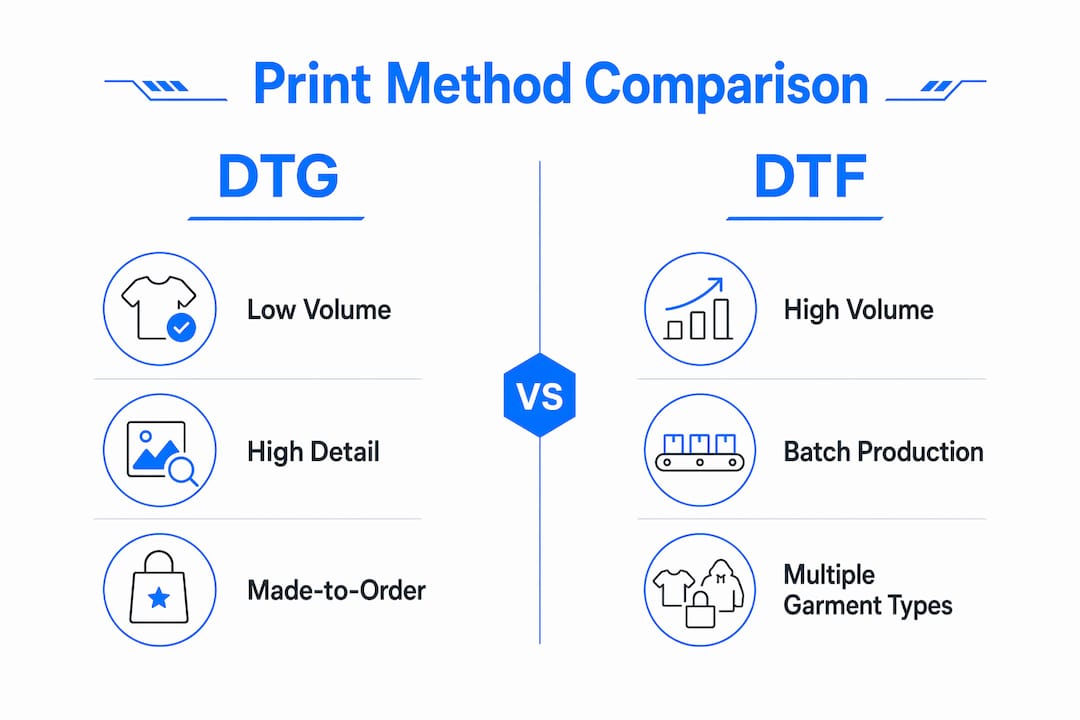
Direct-to-garment printing, or DTG, applies ink directly onto fabric using a modified inkjet process. DTG takes 3 to 5 minutes per shirt, which makes it ideal for made-to-order unique designs where each piece is different. That per-unit time means DTG does not scale well for bulk runs of the same design. If your brand sells 50 different graphic tees with one or two orders per design per day, DTG is the right fit. If you are running a campaign that moves 500 units of one design in a week, DTG becomes a bottleneck.
Direct-to-film printing, or DTF, creates a transfer that is heat-pressed onto the garment. DTF enables higher throughput with batch transfer printing, meaning you can print a large sheet of transfers and apply them rapidly across many garments. The tradeoff is a slightly different hand feel on the fabric, which matters for premium fashion positioning. Your choice between DTG and DTF should align with your order profile: unique designs versus bulk runs.
For a deeper look at how each method performs across different garment types, Tektonla’s garment printing techniques guide breaks down quality, durability, and cost considerations specific to apparel brands.
Pro Tip: If your brand runs seasonal drops with high volume on a single design, batch your DTF transfers in advance. You can produce transfers before the drop goes live and fulfill orders within hours of launch instead of days.
How do you automate product creation and order fulfillment at scale?
Automation is where ecommerce apparel scaling separates brands that grow from brands that grind. The workflow below reflects what high-volume POD operators actually use, not a theoretical framework.
- Design file intake. Collect design files in a standardized folder structure, named by SKU and variant. Inconsistent naming is the single most common source of production errors.
- AI-powered image analysis. Use an AI tool to generate product descriptions, alt text, and SEO titles from the design file. This removes the copywriting bottleneck when you are publishing dozens of products at once.
- API payload generation with caching. Build your product data payload for Shopify using a tool like n8n. Batch upload with caching avoids reprocessing files you have already prepared and speeds up bulk listings significantly.
- Human approval checkpoint. Before any product goes live, route it through a one-person review step. This catches file resolution issues, pricing errors, and description problems before customers see them.
- Shopify listing publish. Push the approved payload to Shopify via API. The listing goes live with production lead times already embedded in the product description.
- Order routing to production. When an order comes in, your automation routes it to the correct production partner based on product type, location, and current capacity.
- Shipping tracking sync. Pull tracking data from your production partner and push it back to Shopify automatically. Customers receive updates without any manual intervention.
Automation pipelines built with n8n can increase product creation speed tenfold and reduce errors to near zero. One documented case study showed nine workflows with 247 nodes automating listings for over 9,000 creators, saving between $50,000 and $70,000 annually in manual labor. That is not a marginal efficiency gain. It is the difference between a two-person operation and a ten-person one.
Stating production lead times like “Printed in 3 to 5 business days” prominently on product pages reduces customer service requests and builds trust. Operationalizing lead times within the storefront reframes potential delays into predictable delivery windows.
Pro Tip: Set your n8n workflow to flag any design file under 150 DPI before it reaches the approval step. Catching resolution issues at intake eliminates the most common cause of reprints.
| Automation stage | Tool | Time saved |
|---|---|---|
| Design file processing | n8n + AI image analysis | 15 to 20 min per product |
| Bulk product publishing | n8n API payload + caching | 80% reduction in listing time |
| Order routing | Automated fulfillment rules | Near-zero manual handling |
| Shipping updates | API sync to Shopify | Eliminates manual tracking entry |
What scaling bottlenecks should you watch for?
Most print-on-demand fashion brands do not fail because of bad products. They fail because operations collapse under volume they were not built to handle.
SKU sprawl is the first trap. Adding more products feels like growth, but each new SKU adds complexity to your fulfillment routing, your customer service queue, and your inventory of blanks. A focused catalog of 5 to 10 products is optimal for initial scaling before expanding SKU breadth. Validate demand on a tight range before you expand.
Unclear shipping timelines are the second trap. Customers who do not know when to expect their order contact support, leave negative reviews, and initiate chargebacks. Visible production and shipping timelines reduce refunds and customer bounce rates by setting expectations upfront. This is a one-time fix with compounding returns.
Agentic AI systems that automate order routing, file validation, and customer communication can reduce manual handling times by up to 94% and increase order volume by nearly 12%. That level of efficiency is now accessible to independent brands, not just enterprise operations.
The three metrics every scaling brand should track weekly:
- On-time production rate. If this drops below 95%, your production partner or your file intake process has a problem.
- Reprint rate. Anything above 2% signals a systemic issue in file quality or production setup.
- Conversion rate by product. Low conversion on a specific product often means the lead time displayed is too long, not that the product is wrong.
“High-volume POD scaling depends less on print capacity and more on automation orchestration, intelligent order routing, and AI-enhanced customer service workflows.” — Vstorm
How do you scale marketing alongside your operations?
Growing your apparel brand online without matching your marketing pace to your operational capacity is how brands create viral moments they cannot fulfill. The damage to reputation from a single oversold campaign can take months to repair.
Increase ad spend in increments tied to your production capacity, not your ambition. If your current setup handles 200 orders per week cleanly, do not run a campaign designed to generate 500. Test at 250, confirm your fulfillment holds, then step up again. This approach feels slow but compounds without crisis.
Brand identity is what converts a one-time buyer into a repeat customer. Automated post-purchase emails, shipping update notifications, and delay communications should all carry your brand voice, not generic platform templates. Customers who feel informed stay loyal even when something goes wrong.
Social proof accelerates conversion more reliably than ad spend at early scale. A product page with 40 verified reviews and real customer photos outperforms a product page with a higher ad budget and no reviews. Build a review collection sequence into your post-purchase automation from day one.
For brands thinking about multi-channel expansion, adding a second sales channel like Etsy or TikTok Shop before your Shopify operations are stable creates more problems than revenue. Stabilize one channel completely before splitting your operational attention.
Sustainability messaging resonates with fashion consumers in 2026 more than it did five years ago. If your production partner uses locally sourced materials or eco-friendly inks, say so explicitly on your product pages. It is a real differentiator in a crowded custom clothing business market.
Key takeaways
Scaling a print-on-demand apparel brand requires automation infrastructure, disciplined SKU management, and print method alignment before marketing spend can compound effectively.
| Point | Details |
|---|---|
| Choose the right print method | Match DTG to unique made-to-order designs and DTF to high-volume batch runs. |
| Automate with orchestration tools | Use n8n or similar tools to reduce manual product creation and order handling by up to 80%. |
| Cap SKUs early | Limit variants to 2 to 4 options per product to keep fulfillment routing clean and scalable. |
| Display lead times prominently | Stating production windows on product pages reduces support requests and improves conversion. |
| Track three core metrics | Monitor on-time rate, reprint rate, and conversion rate weekly to catch problems before they compound. |
Why most brands scale the wrong thing first
I have watched brand owners pour money into ads before their fulfillment could handle the volume. The logic makes sense on the surface: more traffic equals more sales. But when your production partner misses lead times and your customer service queue fills up, that ad spend is actively damaging your brand, not building it.
The brands that scale well treat operations as the product. They obsess over reprint rates the way a retailer obsesses over sell-through. They build the automation pipeline before they need it, not after the first crisis. And they keep their catalogs tight on purpose, resisting the urge to add new products until the existing ones are running without friction.
One thing I have seen consistently: brands that invest in print file best practices early avoid the most expensive scaling problems. A bad file that makes it to production costs you a reprint, a delay, and a customer relationship. Fix the file standards once and you eliminate that cost permanently.
The other shift worth making is treating customer feedback as a production signal, not just a marketing one. When customers consistently mention that a shirt feels stiff or a print looks faded after two washes, that is a print method or file quality problem, not a product problem. Brands that listen at that level iterate faster and retain customers longer.
— Christian
How Tektonla helps you grow your apparel brand
Tektonla is built for exactly the stage you are in. Whether you are launching your first custom clothing line or scaling an existing brand past its current ceiling, Tektonla’s Downtown Los Angeles production facility offers DTG, DTF, embroidery, screen printing, and embossing with fast turnaround and no minimum order quantities on blanks. The Printers Shirt is a flagship product for brands that need reliable, high-quality output at volume, and the Garment Dye Shirt delivers premium texture and color depth for brands positioning at the higher end of the market. Private label options, woven labels, and custom branding support mean you are building a real brand, not just printing shirts. Visit Tektonla to explore the full product range and request a production consultation.
FAQ
What does it mean to scale a print-on-demand apparel brand?
Scaling a print-on-demand apparel brand means increasing order volume and product range without proportionally increasing manual labor or operational costs. It requires automation, disciplined SKU management, and reliable production partnerships.
Is DTG or DTF better for scaling an apparel brand?
DTG is better for brands with many unique designs and low per-design volume, while DTF suits brands running high-volume batches of the same design. The right choice depends on your order profile, not your print quality preference.
How many products should I start with when scaling a POD brand?
A focused catalog of 5 to 10 products is the recommended starting point for scaling, allowing you to validate demand and keep fulfillment clean before expanding your SKU range.
How do I reduce customer service requests in a POD business?
Display production lead times directly on product pages, such as “Printed in 3 to 5 business days,” and automate shipping update notifications. Visible timelines set expectations upfront and significantly reduce inbound support volume.
What automation tools do high-volume POD brands use?
High-volume POD brands use orchestration tools like n8n to connect design file intake, Shopify product publishing, order routing, and shipping tracking into a single automated pipeline, reducing manual handling by up to 94%.